PNG still searching for multi-million dollar lender
pp. 22-23 · Read in the full issue
multi-million dollar lender
By Sam Vulum
PAPUA New Guinea has passed all hopes for any immediate conclu sion to talks with international lending agencies for urgent structural loans to support its 1999 Budget. Desperation is in the air, although no-one is willing to admit to this. There are conflicting reports on the state of the negotiations and the total amount of funds the country is seeking to fund the budget. In one report, the govern ment was seeking US$l2O million each from two international lenders, the World Bank and a European syndicate of banks led by the Kredit Bank of Netherlands.
In another, the government was looking to borrow US$lBO million from the world Bank and the international Monetary Fund.
And in another report, the government was negotiating to secure US$9O million from the World Bank. However, what is certain though is that negotiations between the PNG government and the lenders have stalled. The government’s chief economic advisor and former World Bank employee, Dr Pirouz Hamidian-Rad, said negotiations would be finalised by early February, although he was not keen on setting dates for the negotiations. Dr Hamidian-Rad said: “Dates become dangerous... we do not have a deadline because it will give advantage to the other party”.
He said that negotiations have become protracted because of tough conditions set by the banks, especially on the kind of col lateral. Past early February, no compromise had yet been reached with either lender. Dr Hamidian-Rad said depending on how negotiations progressed, it was possible to borrow the US$l2O million from both sources. He said the initial delay in getting the European loan was because PNG had become more sophisticated in its negotia tions where it would not give in too easily to the lender’s conditions.
PNG took a firm stand after it became aware that government officers, involved in the initial negotiations with the bank, allegedly tried to tie down the country’s for eign exchange earnings from mining and petroleum developments to an off-shore facility in a foreign country. The officials were reported to be suspended and charged for giving misleading information to the
government about the loan. Commenting on this report, Prime Minister Bill Skate said: "I will not allow money belonging to the people of Papua New Guinea to be stored away in an off-shore facility.”
He made reference to a similar arrange ment in the early 1990 s where money was stored away in such a facility in the Cayman Islands in the Caribbean. He said: “they want foreign exchange to be stored over seas. The day and time for it is all over and it is now time to move forward.” He said while the government still needed the loan from Kredit Bank, the terms and conditions must be re-negotiated and agreed to by both parties. Central Bank governor Morea Vele said: “Definitely we are not going to tie
down our foreign exchange earnings for five years and let our people suffer. If that is the case, then we will drop it (the loan)”.
Vele said they would look at other options like the World Bank and the International Monetary Fund, who had indi cated to re-negotiate with the government on a US$lBO million loan package. The government had met with officials of both organisations during separate visits to PNG in February and the results had not been very encouraging, especially the meeting with World Bank officials.
The IMF three-man team submitted a report and list of conditions for the govern ment to comply with if it wants the support of the Fund. A statement issued by the team
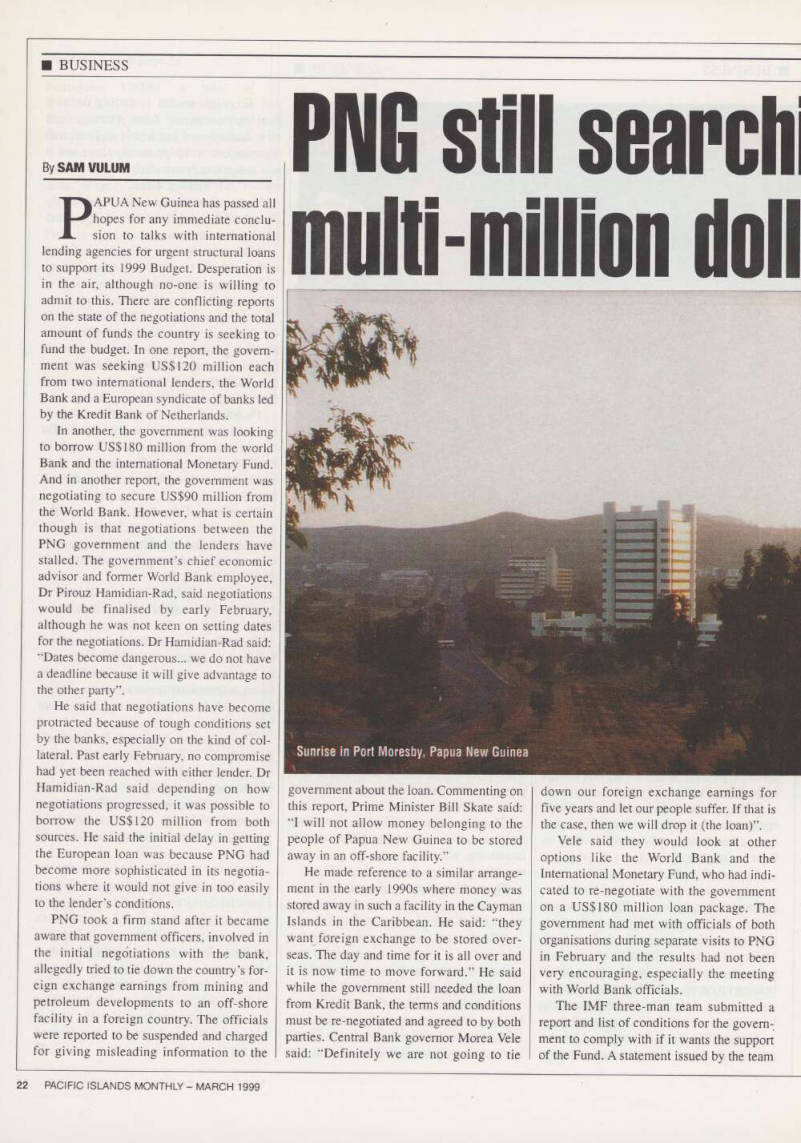
Sunrise in Port Moresby, Papua New Guinea
said: “The findings of the mission, includ ing recommendations of how best to adapt policies to achieve the government’s objec tive of sustainable, private sector-led investment and growth, were offered in the mission’s concluding statement, which was provided to the PNG authorities. While the mission had limited objective if conduct ing routine consultation discussions, its concluding statements also laid out a road map specifying the procedures, time frame, and policy actions that would be necessary to pave the way for a possible resumption of discussions on an adjustment pro gramme that could be supported by the IMF.” The team leader Lazaros Molho, who is deputy head of the IMF’s Asia and
Pacific department, said before departure that the 1999 Budget’s major public sector reform was an area of concern for his team.
He said there was some doubt and uncertainty about the exact details of the retrenchment exercise, especially cost fac tor. “We provided the government ideas on possible ways to offset possible costs under different scenarios,” Molho said. He said the team was concerned especially that there could be inadequate funding in the budget to pay for retrenchments.
More information was requested from the government, he said. Molho said his team was happy that the government had established dialogue with the World Bank.
“We are very positive... we hope that this will be sustained because we work closely with the world bank,” he said.
Molho said the IMF was happy to con tinue dialogue and discussions from the inconclusive stage it was left at last October. He said the IMF stressed its wish for PNG to adopt good governance and sound macroeconomic policies that would be conducive to growth and investor confi dence. The World Bank, which had finally resolved the issue of the engagement of Dr Hamidian-Rad as the government’s chief economic adviser, had re-opened negotia tions. However, despite being described as fruitful by PNG authorities, the talks ended on a distant note. The World Bank team, which visited in February, adopted a cautious and guarded approach in their negotiations. Team leader Julian Schweitzer, the bank’s director of strategy and operations for far east Asia and Pacific, was noncommittal on a number of issues.
The team gave immediate notice of a complicated, long and tough process before any loan financing could be decided on. This included assessment, discussions, preparations and appraisals before any serious negotiations could take place on PNG’s loan requirements. They said that even though negotiations were almost suc cessfully concluded when aborted last year, a new start would have to be made for discussions of any loan this year.
“We are not here to impose any condi tions, we are here to agree to conditions, that’s a great difference,” Schweitzer said, dispelling rumours of 44 conditions that were believed to have been set last year.
Schweitzer said, however, the bank would be keen to see specific conditions that were geared towards economic growth and the onus was on the PNG government to provide it. He said the government would have to be comfortable with its pol icy. The officials also expressed concern about the implementation record of PNG’s bank loan portfolios.'“Generally, Papua New Guinea’s performance in one area is something we can focus on a lot, and that is the area of social development. In com parison with other countries of similar income, PNG has some way to go yet,”
Schweitzer said.
“That’s something we want to work closely on which the loan will also support.
And that is also to do with how the devel opment expenditure is getting spent, how the recurrent expenditure is getting spent... making sure the money goes to where it needs to and efficiency and the quality of the investments. Budget implementation is important. It’s not just how you allocate resources but the capacity of that particular agency to spend it.”
Schweitzer said the government has also informed the team that is controver sial economic consultant Dr Hamidian- Rad would not take part in any discussions wit the team. However, it was reported later, at the end of the team’s visit, that the bank will have to strike a new deal before any structural adjustment funds will be released. It was reported also that the team had made a preliminary assessment that indicated that economic conditions had deteriorated in the two years since a simi lar assessment was carried out.
The team is expected to compile a report on PNG based on its assessment.
The report is expected to be ready in two months. Following the release of the report, a new round of talks will be held with the PNG government for any possible structural loans for PNG. It would be an
entirely new package, separate from previ
ous negotiations for the aborted US$9O million. The PNG government’s inability to establish quick compromise with lenders raises doubts on its capability to negotiate.
Many people are wondering if the world’s perception of PNG’s economic manage ment ability and its moral credibility has anything to do with the delays. ■