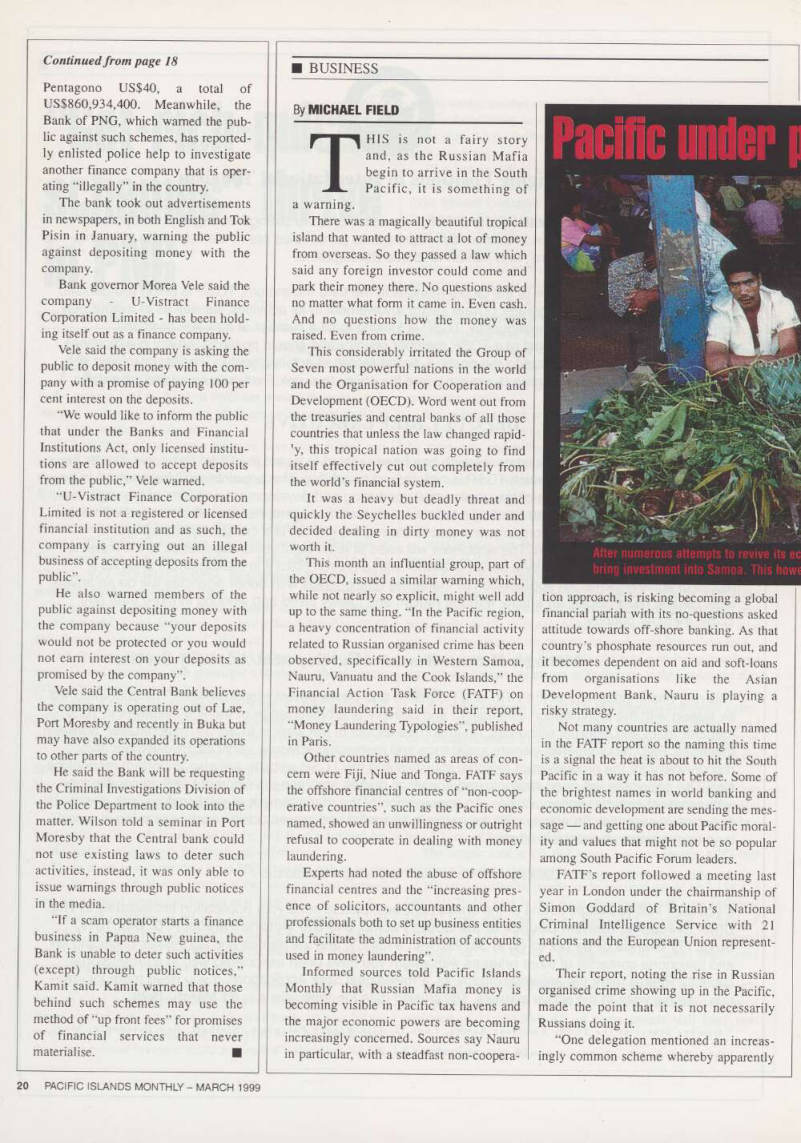
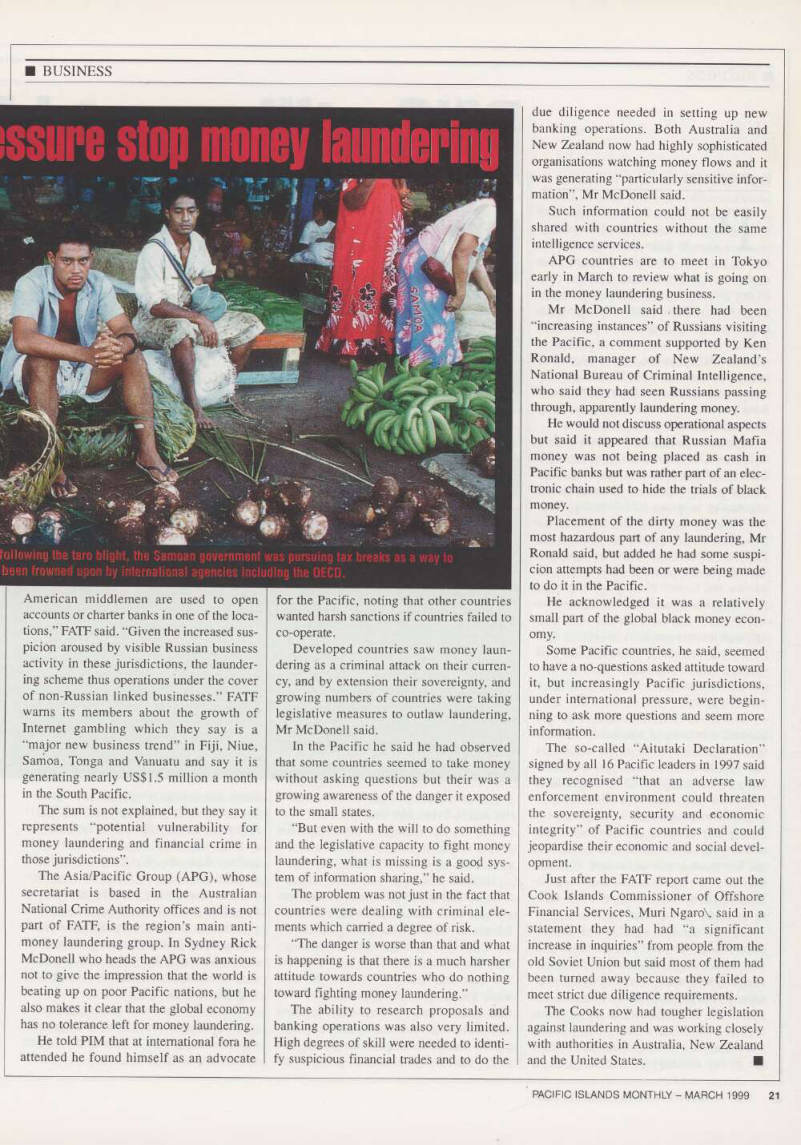
Pacific under p[?]ssure stop money laundering
pp. 20-21 · Read in the full issue
By Michael Field
THIS is not a fairy story and, as the Russian Mafia begin to arrive in the South Pacific, it is something of
a warning.
There was a magically beautiful tropical island that wanted to attract a lot of money from overseas. So they passed a law which said any foreign investor could come and park their money there. No questions asked no matter what form it came in. Even cash.
And no questions how the money was raised. Even from crime.
This considerably irritated the Group of Seven most powerful nations in the world and the Organisation for Cooperation and Development (OECD). Word went out from the treasuries and central banks of all those countries that unless the law changed rapid ’y, this tropical nation was going to find itself effectively cut out completely from the world’s financial system.
It was a heavy but deadly threat and quickly the Seychelles buckled under and decided dealing in dirty money was not worth it.
This month an influential group, part of the OECD, issued a similar warning which, while not nearly so explicit, might well add up to the same thing. “In the Pacific region, a heavy concentration of financial activity related to Russian organised crime has been observed, specifically in Western Samoa, Nauru, Vanuatu and the Cook Islands,” the Financial Action Task Force (FATF) on money laundering said in their report, “Money Laundering Typologies”, published in Paris.
Other countries named as areas of con cern were Fiji, Niue and Tonga. FATF says the offshore financial centres of “non-coop erative countries”, such as the Pacific ones named, showed an unwillingness or outright refusal to cooperate in dealing with money
laundering.
Experts had noted the abuse of offshore financial centres and the “increasing pres ence of solicitors, accountants and other professionals both to set up business entities and facilitate the administration of accounts used in money laundering”.
Informed sources told Pacific Islands Monthly that Russian Mafia money is becoming visible in Pacific tax havens and the major economic powers are becoming increasingly concerned. Sources say Nauru in particular, with a steadfast non-coopera-
tion approach, is risking becoming a global financial pariah with its no-questions asked attitude towards off-shore banking. As that country’s phosphate resources run out, and it becomes dependent on aid and soft-loans from organisations like the Asian Development Bank, Nauru is playing a
risky strategy.
Not many countries are actually named in the FATF report so the naming this time is a signal the heat is about to hit the South Pacific in a way it has not before. Some of the brightest names in world banking and economic development are sending the mes sage and getting one about Pacific moral ity and values that might not be so popular among South Pacific Forum leaders.
FATF’s report followed a meeting last year in London under the chairmanship of Simon Goddard of Britain’s National Criminal Intelligence Service with 21 nations and the European Union represent ed.
Their report, noting the rise in Russian organised crime showing up in the Pacific, made the point that it is not necessarily Russians doing it.
“One delegation mentioned an increas ingly common scheme whereby apparently
After numerous attempls to revie its ec[?] bring invesment into Samao. This howe[?]
American middlemen are used to open accounts or charter banks in one of the loca tions,” FATF said. “Given the increased sus picion aroused by visible Russian business activity in these jurisdictions, the launder ing scheme thus operations under the cover of non-Russian linked businesses.” FATF warns its members about the growth of Internet gambling which they say is a “major new business trend” in Fiji, Niue, Samoa, Tonga and Vanuatu and say it is generating nearly US$l.5 million a month in the South Pacific.
The sum is not explained, but they say it represents “potential vulnerability for money laundering and financial crime in those jurisdictions”.
The Asia/Pacific Group (APG), whose secretariat is based in the Australian National Crime Authority offices and is not part of FATF, is the region’s main anti money laundering group. In Sydney Rick McDonell who heads the APG was anxious not to give the impression that the world is beating up on poor Pacific nations, but he also makes it clear that the global economy has no tolerance left for money laundering.
He told PIM that at international fora he attended he found himself as an advocate
for the Pacific, noting that other countries wanted harsh sanctions if countries failed to co-operate.
Developed countries saw money laun dering as a criminal attack on their curren cy, and by extension their sovereignty, and growing numbers of countries were taking legislative measures to outlaw laundering, Mr McDonell said.
In the Pacific he said he had observed that some countries seemed to take money without asking questions but their was a growing awareness of the danger it exposed to the small states.
“But even with the will to do something and the legislative capacity to fight money laundering, what is missing is a good sys tem of information sharing,” he said.
The problem was not just in the fact that countries were dealing with criminal ele ments which carried a degree of risk.
“The danger is worse than that and what is happening is that there is a much harsher attitude towards countries who do nothing
toward fighting money laundering.”
The ability to research proposals and banking operations was also very limited.
High degrees of skill were needed to identi fy suspicious financial trades and to do the
due diligence needed in setting up new banking operations. Both Australia and New Zealand now had highly sophisticated organisations watching money flows and it was generating "particularly sensitive infor mation”, Mr McDonell said.
Such information could not be easily shared with countries without the same intelligence services.
APG countries are to meet in Tokyo early in March to review what is going on in the money laundering business.
Mr McDonell said . there had been "increasing instances” of Russians visiting the Pacific, a comment supported by Ken Ronald, manager of New Zealand’s National Bureau of Criminal Intelligence, who said they had seen Russians passing through, apparently laundering money.
He would not discuss operational aspects but said it appeared that Russian Mafia money was not being placed as cash in Pacific banks but was rather part of an elec tronic chain used to hide the trials of black money.
Placement of the dirty money was the most hazardous part of any laundering, Mr Ronald said, but added he had some suspi cion attempts had been or were being made to do it in the Pacific.
He acknowledged it was a relatively small part of the global black money econ omy.
Some Pacific countries, he said, seemed to have a no-questions asked attitude toward it, but increasingly Pacific jurisdictions, under international pressure, were begin ning to ask more questions and seem more information.
The so-called "Aitutaki Declaration” signed by all 16 Pacific leaders in 1997 said they recognised “that an adverse law enforcement environment could threaten the sovereignty, security and economic integrity” of Pacific countries and could jeopardise their economic and social devel opment.
Just after the FATF report came out the Cook Islands Commissioner of Offshore Financial Services, Muri Ngaro\ said in a statement they had had “a significant increase in inquiries” from people from the old Soviet Union but said most of them had been turned away because they failed to meet strict due diligence requirements.
The Cooks now had tougher legislation against laundering and was working closely with authorities in Australia, New Zealand and the United States. ■
[?]follwing the taro blight, the Samoan government was pursuing tax breaks as way to [?]been frowned upon by international agencies including the OECD.