Navigating
pp. 50-51 · Read in the full issue
the internet
Story and pictures by SALLY ANDREWS
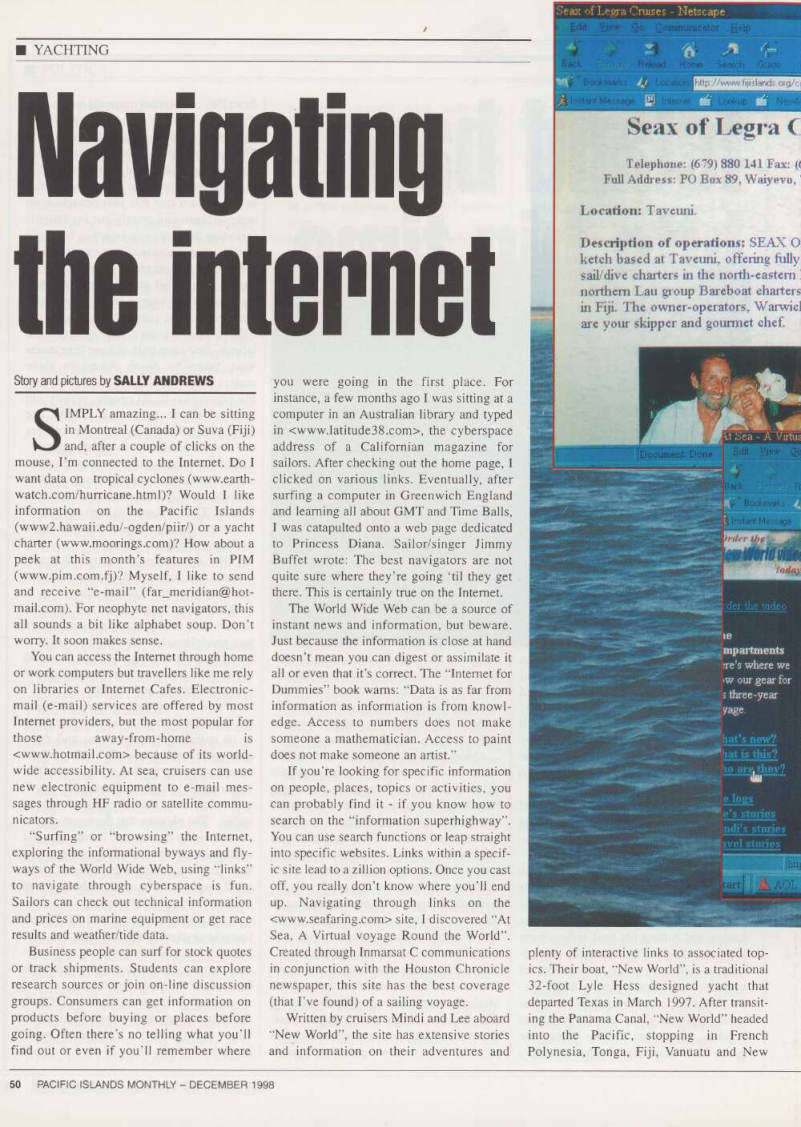
SIMPLY amazing... I can be sitting in Montreal (Canada) or Suva (Fiji) and, after a couple of clicks on the mouse, I’m connected to the Internet. Do I want data on tropical cyclones (www.earth watch.com/hurricane.html)? Would I like information on the Pacific Islands (www2.hawaii.edu/-ogden/piir/) or a yacht charter (www.moorings.com)? How about a peek at this month’s features in PIM (www.pim.com.fj)? Myself, I like to send and receive “e-mail” (far_meridian@hot mail.com). For neophyte net navigators, this all sounds a bit like alphabet soup. Don’t worry. It soon makes sense.
You can access the Internet through home or work computers but travellers like me rely on libraries or Internet Cafes. Electronic mail (e-mail) services are offered by most Internet providers, but the most popular for those away-from-home is <www.hotmail.com> because of its world wide accessibility. At sea, cruisers can use new electronic equipment to e-mail mes sages through HF radio or satellite commu nicators.
“Surfing” or “browsing” the Internet, exploring the informational byways and fly ways of the World Wide Web, using “links” to navigate through cyberspace is fun.
Sailors can check out technical information and prices on marine equipment or get race results and weather/tide data.
Business people can surf for stock quotes or track shipments. Students can explore research sources or join on-line discussion groups. Consumers can get information on
products before buying or places before
going. Often there’s no telling what you’ll find out or even if you’ll remember where
you were going in the first place. For instance, a few months ago I was sitting at a computer in an Australian library and typed in <www.latitude3B.com>, the cyberspace address of a Californian magazine for sailors. After checking out the home page, I clicked on various links. Eventually, after surfing a computer in Greenwich England and learning all about GMT and Time Balls, I was catapulted onto a web page dedicated to Princess Diana. Sailor/singer Jimmy Buffet wrote: The best navigators are not quite sure where they’re going ‘til they get there. This is certainly true on the Internet.
The World Wide Web can be a source of instant news and information, but beware.
Just because the information is close at hand doesn’t mean you can digest or assimilate it all or even that it’s correct. The “Internet for Dummies” book warns: “Data is as far from information as information is from knowl edge. Access to numbers does not make someone a mathematician. Access to paint does not make someone an artist.”
If you’re looking for specific information on people, places, topics or activities, you can probably find it - if you know how to search on the “information superhighway”.
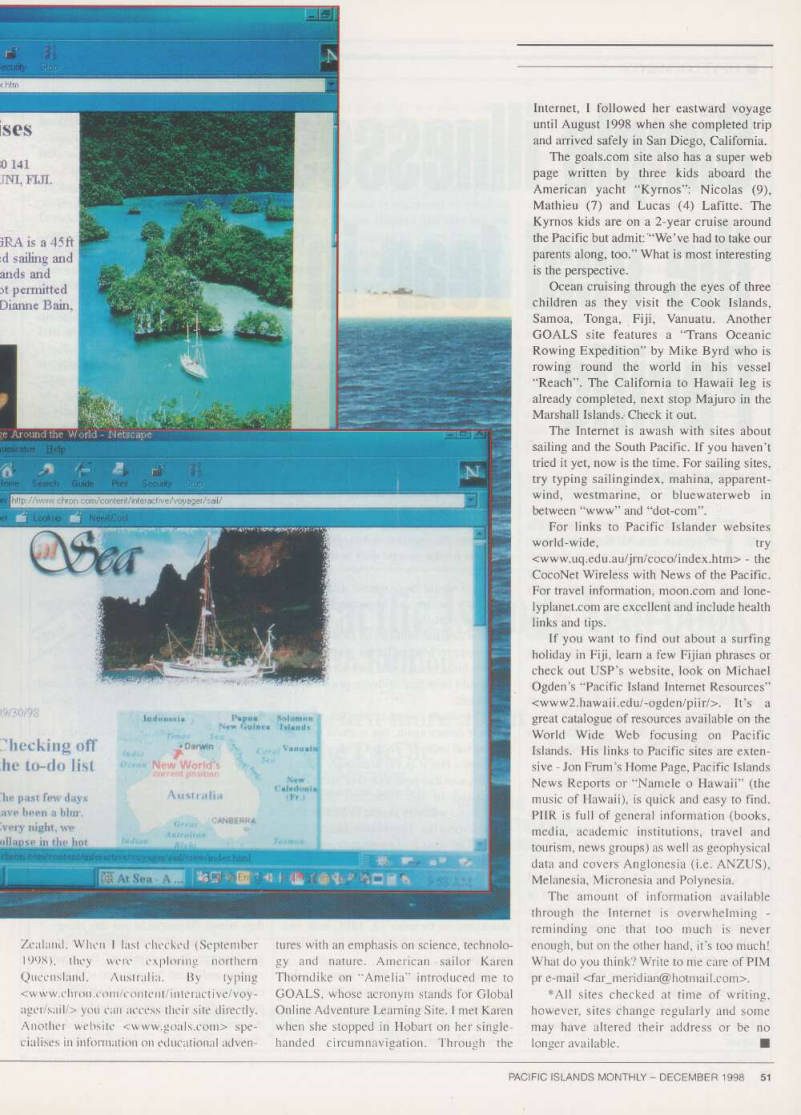
You can use search functions or leap straight into specific websites. Links within a specif ic site lead to a zillion options. Once you cast off, you really don’t know where you’ll end up. Navigating through links on the <www.seafaring.com> site, I discovered “At Sea, A Virtual voyage Round the World”.
Created through Inmarsat C communications in conjunction with the Houston Chronicle newspaper, this site has the best coverage (that I’ve found) of a sailing voyage.
Written by cruisers Mindi and Lee aboard “New World”, the site has extensive stories and information on their adventures and
plenty of interactive links to associated top ics. Their boat, "New World”, is a traditional 32-foot Lyle Hess designed yacht that departed Texas in March 1997. After transit ing the Panama Canal, “New World” headed into the Pacific, stopping in French Polynesia, Tonga, Fiji, Vanuatu and New
Zealand. When I last checked (September 1998), they were exploring northern Queensland, Australia. By typing
<www.chron.com/content/interactive/voy-
ager/sail/> you can access their site directly.
Another website <www.goals.com> specialises in information on educational adven-
tures with an emphasis on science, technolo gy and nature. American ■ sailor Karen Thorndike on ■'Amelia” introduced me to GOALS, whose acronym stands for Global Online Adventure Learning Site. I met Karen when she stopped in Hobart on her single handed circumnavigation. Through the
Internet, I followed her eastward voyage until August 1998 when she completed trip and arrived safely in San Diego, California.
The goals.com site also has a super web page written by three kids aboard the American yacht “Kyrnos”: Nicolas (9), Mathieu (7) and Lucas (4) Lafitte. The Kyrnos kids are on a 2-year cruise around the Pacific but admit: “We’ve had to take our parents along, too.” What is most interesting is the perspective.
Ocean cruising through the eyes of three children as they visit the Cook Islands, Samoa, Tonga, Fiji, Vanuatu. Another GOALS site features a “Trans Oceanic Rowing Expedition” by Mike Byrd who is rowing round the world in his vessel “Reach”. The California to Hawaii leg is already completed, next stop Majuro in the Marshall Islands.- Check it out.
The Internet is awash with sites about sailing and the South Pacific. If you haven’t tried it yet, now is the time. For sailing sites, try typing sailingindex, mahina, apparent wind, westmarine, or bluewaterweb in between “www” and “dot-com”.
For links to Pacific Islander websites world-wide, try <www.uq.edu.au/jm/coco/index.htm> - the Coco Net Wireless with News of the Pacific.
For travel information, moon.com and lone lyplanet.com are excellent and include health links and tips.
If you want to find out about a surfing holiday in Fiji, learn a few Fijian phrases or check out USP’s website, look on Michael Ogden’s “Pacific Island Internet Resources” <www2.hawaii.edu/-ogden/piir/>. It’s a great catalogue of resources available on the World Wide Web focusing on Pacific Islands. His links to Pacific sites are exten sive - Jon Frum’s Home Page, Pacific Islands News Reports or “Namele o Hawaii” (the music of Hawaii), is quick and easy to find.
PIIR is full of general information (books, media, academic institutions, travel and tourism, news groups) as well as geophysical data and covers Anglonesia (i.e. ANZUS), Melanesia, Micronesia and Polynesia.
The amount of information available through the Internet is overwhelming reminding one that too much is never enough, but on the other hand, it's too much!.
What do you think? Write to me care of PIM pr e-mail <[email protected]>. * All sites checked at time of writing, however, sites change regularly and some may have altered their address or be no longer available. ■