Island band
p. 49 · Read in the full issue
hits big time
OF Tokelauan and Tuvaluan blood and heavily influenced by Samoa and New Zealand Opetaia Foa’i is an unlikely revolutionary.
But with his family and the group built around it he is taking the music world by storm. Not just in the Pacific, but in Europe and North America.
And back on Tokelau too.
Suddenly Pacific music, which seemed trapped between ancient tradition chants and a syrupy mix of Polynesian country and-westem is going places again.
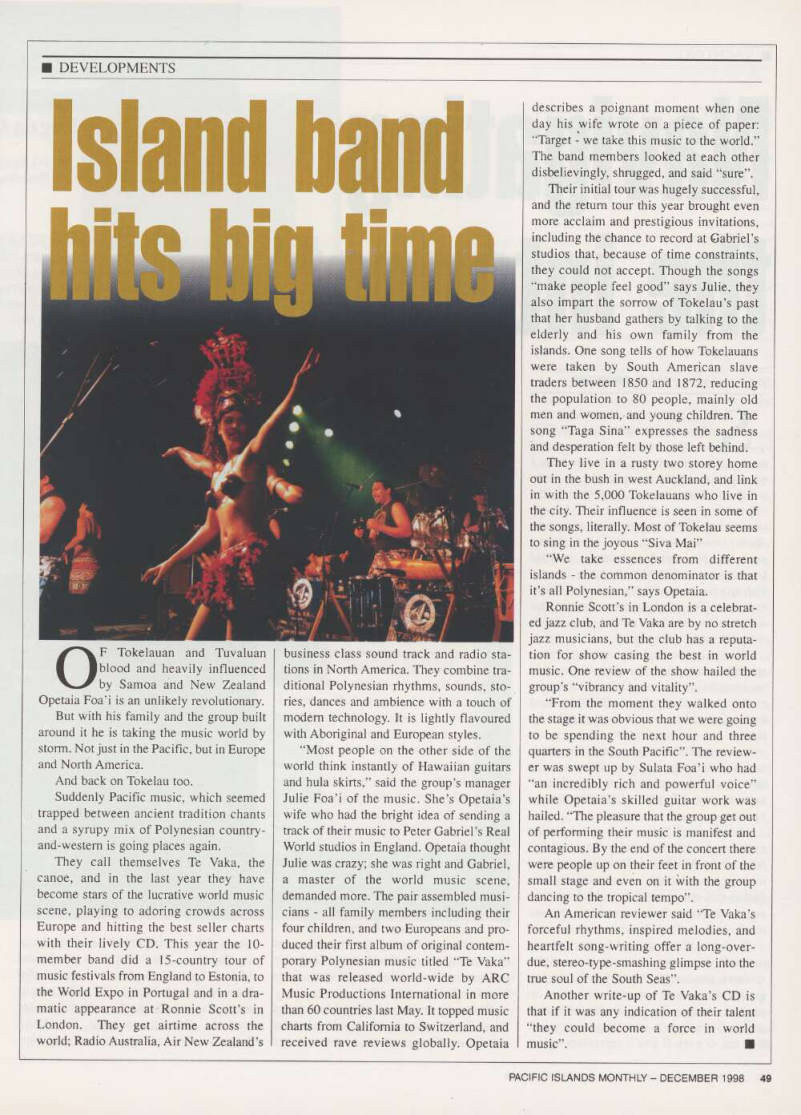
They call themselves Te Vaka, the canoe, and in the last year they have become stars of the lucrative world music scene, playing to adoring crowds across Europe and hitting the best seller charts with their lively CD. This year the 10member band did a 15-country tour of music festivals from England to Estonia, to the World Expo in Portugal and in a dra matic appearance at Ronnie Scott’s in London. They get airtime across the world; Radio Australia, Air New Zealand’s
business class sound track and radio sta tions in North America. They combine tra ditional Polynesian rhythms, sounds, sto ries, dances and ambience with a touch of modem technology. It is lightly flavoured with Aboriginal and European styles.
“Most people on the other side of the world think instantly of Hawaiian guitars and hula skirts,” said the group’s manager Julie Foa’i of the music. She’s Opetaia’s wife who had the bright idea of sending a track of their music to Peter Gabriel’s Real
World studios in England. Opetaia thought
Julie was crazy; she was right and Gabriel, a master of the world music scene, demanded more. The pair assembled musi cians - all family members including their four children, and two Europeans and pro duced their first album of original contem porary Polynesian music titled “Te Vaka” that was released world-wide by ARC Music Productions International in more than 60 countries last May. It topped music charts from California to Switzerland, and received rave reviews globally. Opetaia
describes a poignant moment when one day his wife wrote on a piece of paper: "Target - we take this music to the world.”
The band members looked at each other disbelievingly, shrugged, and said “sure”.
Their initial tour Was hugely successful, and the return tour this year brought even more acclaim and prestigious invitations, including the chance to record at Gabriel’s studios that, because of time constraints, they could not accept. Though the songs “make people feel good” says Julie, they also impart the sorrow of Tokelau’s past that her husband gathers by talking to the elderly and his own family from the islands. One song tells of how Tokelauans were taken by South American slave traders between 1850 and 1872, reducing the population to 80 people, mainly old men and women, and young children. The song “Taga Sina” expresses the sadness and desperation felt by those left behind.
They live in a rusty two storey home out in the bush in west Auckland, and link in with the 5,000 Tokelauans who live in the city. Their influence is seen in some of the songs, literally. Most of Tokelau seems to sing in the joyous “Siva Mai”
“We take essences from different islands - the common denominator is that it’s all Polynesian,” says Opetaia.
Ronnie Scott’s in London is a celebrat ed jazz club, and Te Vaka are by no stretch jazz musicians, but the club has a reputa tion for show casing the best in world music. One review of the show hailed the group’s “vibrancy and vitality”.
“From the moment they walked onto the stage it was obvious that we were going to be spending the next hour and three quarters in the South Pacific”. The review er was swept up by Sulata Foa’i who had “an incredibly rich and powerful voice” while Opetaia’s skilled guitar work was hailed. “The pleasure that the group get out of performing their music is manifest and contagious. By the end of the concert there were people up on their feet in front of the small stage and even on it with the group dancing to the tropical tempo”.
An American reviewer said “Te Vaka’s forceful rhythms, inspired melodies, and heartfelt song-writing offer a long-over due, stereo-type-smashing glimpse into the true soul of the South Seas”.
Another write-up of Te Vaka’s CD is that if it was any indication of their talent “they could become a force in world music”. ■