BPs - the end of an era
p. 43 · Read in the full issue
A ONCE tenacious company that took on Imperial Germany to become the commercial ruler of the South Pacific is retreating from region as it struggles to survive debt and its bankers.
It began trading in trochus shells, beche-de-mer and copra, creating an empire on acrosis atolls and islands.
Now an Australian spice and yeast com
pany, Bums Philp and Co., founded in 1883 has been struggling to cope with 1.5 billion Australian dollars of debt (1 billion US dol lars).
With the October sale of its shares in Bums Philp Toyota, the car dealership joint venture, the company has severed its last links with Fiji and PNG and it had already gone from Samoa and most parts of Micronesia.
Ross MacDonald, now retired managing director for the Pacific BP group, said they developed Pacific trade. For many of the staff, who were part of BPs for many years, the demise of the company is
certainly very sad to see,” he said in Suva.
“Over many years BPs played a major role in developing the commercial sector of the economy and in bringing in skills and business acumen into the community.”
BP was the most aggressive of a num ber of trading companies which historian Douglas Oliver in his 1951 work, The Pacific Islands, called “an all-embracing mercantilism”.
"Whether one was sitting in a native hut or lounging on a club veranda in the British Islands, the conversation sooner or later got around to ‘BP’,” Oliver wrote.
"Notwithstanding many of its critics, BP does not stand for ’Bloody Pirates'.”
The pirates’ sobriquet has been said to stem from the fact that the company, espe
dally in its early years, made no bones about charging what the market would bear for all its goods and services.
Scotsman James Burns established a general store in Townsville, Queensland, in 1872, employing two years later one Robert Philp, a fellow Scot, who became a partner. They then joined another business man, Isidore Lissner, and in 1883 became BP. They began trading in the Pacific, buy-
ing copra from the hundreds of scattered islands setting up plantations, financing small planters and providing freight and merchandising.
Hundreds of Australian men found themselves living in splendid isolation supervising Pacific Islanders on copra plantations. They printed “money” that was used in islands that had no currency.
At the turn of the century the Marshall Islands were under German rule and a Hamburg company, Jaluit Company, had preferential treatment. BP took them on and so Germany imposed crippling taxes on the Australians to drive them out.
Australia protested to Britain who in turn took it up with Berlin. The taxes were abol ished, but Jaluit was then given a heavy
freight subsidy to get their product to Europe. BP still won the battle but in 1914 the islands went to Japan who closed them to outsiders.
Between the wars BP built up a major shipping line and dominated Pacific trade.
They even owned atolls, including lonely Fanning Island. In the 1950 s they had exclusive retail stores through the Pacific, along with wholesaling, shipping, car sales
and inter-island shipping.
In Fiji alone 3000 people worked for BP.
It was another Scotsman, Andrew Turnbull, who as chief executive in the mid 1980 s turned the company’s drift away from the South Pacific into a drive.
He saw the islands trade as declining and incapable of delivering the return on shareholders’ funds the company need ed. In fact in 1985 he remarked in an unguarded moment that the company was involved in some “rubbish” businesses in the South Pacific.
He later (in an inter view with PIM) recanted
but was still determined that the future of Burns Philp lay elsewhere. He planned to make BP the world leader in the spices and yeast industry. In fact, Turnbull left the company in good shape when he retired a few years later.
In September, however, the company announced a 285.4 million Australian dol lar loss, an improvement on the loss of 873.3 million dollars the previous year.
Most of the losses came from spice trading in the United States. Analysts say the com pany is dealing with its mountain of debt and is back from the edge of bankruptcy.
In March the company sold off memorabil ia in a bid to raise funds.
A portrait of Burns and Philp sold for just 90 dollars. ■
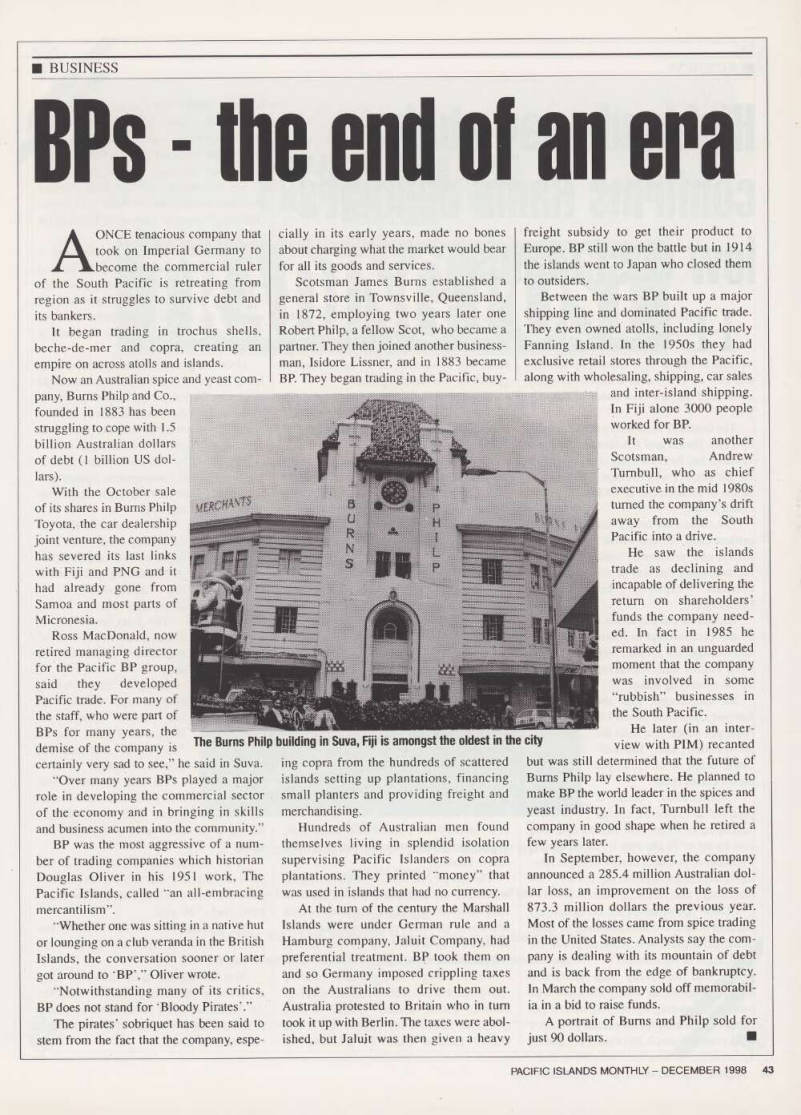
The Burns Philp building in Suva, Fiji is amongst the oldest in the city