legislation up
pp. 40-42 · Read in the full issue
PNG's new legislation up in the air
By Sam Vulum
APOLITICAL uproar is expect ed in Papua New Guinea’s par liament over twin proposals for new oil and gas industry legislation.
With all the political mud-slinging and innuendoes aside, the Opposition-backed separate proposed gas legislation appears to be a winner with landowners.
However, the government is reported to be backing another legislation sponsored by Petroleum and Gas minister Sir Rabble Namaliu.
PNG’s prime minister Bill Skate report edly stated that the proposals were a rea sonable compromise, taking into account interests of the State, provincial govern ments, landowners and investors.
He said the legislation would also give additional benefits to provincial govern ments and landowners.
The separate legislation was drafted by the Southern Highlands and Gulf provin cial governments, and has opposition sup port.
However, the PNG Chamber of Commerce and Industry said the separate gas proposal would put a stop to the PNG gas project and bring an immediate decline in the petroleum industry.
Notices have been given for both pro posals to be introduced for deliberation in the last sitting of the 1998 parliament.
The government is seeking amend ments to the Gas and Petroleum Act while the Gulf and Southern Highlands provin cial governments Oil and Gas Task Force
Committee want approval for a separate
gas legislation.
Joint Task Force Committee chairman and Komo/Magarima MP Alfred Kaiabe, who gave notice for the separate legisla tion, said the main thrust of their efforts was to see a separate gas legislation.
To sell the legislation to the public, Kaiabe, whose Southern Highlands province will be directly affected by the country’s gas development, went live on national television in early November out lining the new legislation and its impor tance to PNG.
Although comments could not be gauged from the government over its amendments to the Act, Kaiabe told PIM that all the MPs from the Southern Highlands and Gulf provinces would sup port the legislation.
He said it would be a numbers game and only time would tell whether the legis lation would become a hot issue on the floor of parliament.
Kaiabe said they have already begun discussions with the government to solicit support for a single legislation.
He said they’ve spent about half a mil lion Kina researching and putting together the legislation and are hoping to see it
passed by parliament.
Gas development is expected to under pin the economy as PNG enters the new millennium with oil exports declining fast and without any significant mineral or oil discoveries yet.
PNG is expected to sign commercial sales agreements with the developers of its
$3.5 billion pipeline project that will bring natural gas from the Southern Highlands province to industrial markets in Townsville and Gladstone in Australia.
Using the Bougainville crisis as an example, the Opposition-backed legisla tion attempts to redress almost all issues close to the hearts of Papua New Guineans involving their land and resources.
The Bougainville Crisis resulted from government and Bougainville Copper Limited’s failure to address landowner grievances over the Panguna copper mine.
As well, a landmark court battle was instigated by landowners in the Ok Tedi copper mine claiming damages as a result of the mining activity.
Amongst other issues, the legislation authors dedicated a section towards addressing compensation, an issue that has become a major stumbling block to many development projects in the country over the years.
It highlights concrete and vivid descrip tion of every little detail connecting the landowners to their land and sur roundings, and its importance
in their lives, which past legislation failed to address.
The 117-page legislation, cited by PIM, says that a licensee shall be liable to pay compensation for; * The deprivation of the use and enjoy ment of the surface of the land or any rights customarily associated with it, except where there has been a reservation in favour of the State; * Severance of the land from any other land of any owner, occupier or person interested in the land; * Rights of way and easements; * Loss of opportunity to make any planned improvement on the land; * And any decrease in the market value of the interest of owners, occupiers and persons interested in the land.
The licensee is also liable to pay for: * Damage to the surface of land, crops, trees, grasses and other vegetation (includ ing fruit and vegetable) and to buildings, structures or works, caused by or which
may arise from prospecting or develop ment operations; * Damage to any fish or animals; * Destruction or loss of, injury to, dis turbance of or interference with stock, caused by the carrying on of operations by the licensee; * Loss of livelihood and lifestyle; * Loss of hunting, fishing, and gather ing; * Social inconvenience; * Any other damage consequential on the licensee’s use or occupation of the land.
On some subsections of the legislation, the compensation shall be payable directly to the landowners, while in others, the pay ment should be made to the provincial gov ernment to be placed in a trust fund to be administered for the benefit of the landowners generally.
The assessment of compensation pay ment shall be made according to Valuer General valuation, no more than five years old; plus 20 per cent of the stated value.
Where the Valuer General’s valuation is more than five years old, 300 per cent is added to the stated value whichever is the
higher amount.
If parties are unable to agree on the amount of compensation to be paid, either party may apply to the courts to have the amount determined.
The legislation says if an ownership dispute arises, an applicant for a licence would have to conduct socio-anthropolog ical and land tenure studies, and such other investigations necessary to determine cus tomary land ownership.
The results of such studies and investi gations would then be provided to the min ister who, in turn, gives a copy to the provincial government.
It said any dispute concerning the cus tomary ownership of land must be deter mined by the court before the minister may grant a gas development licence.
The State and the licensee shall endeav our to resolve any dispute concerning own
ership promptly by amicable negotiation
with all parties to the dispute.
All costs incurred by a licensee or an applicant for a licence and the State in resolving the dispute shall be regarded as a project cost to the development.
In another plus for the landowners, the provincial government and a landowner entity - representing all customary landowners in the project area - would be granted a participating equity of up to 10
per cent (in one half proportions).
After the development licence has been in operation for 10 years, they have the option to acquire a further equity interest of up to 20 per cent of the total (in one half
proportions).
The landowner entity would be man aged and controlled independent of the State or State-owned entity. Any dispute regarding the value of an equity purchase shall be determined by the minister.
The State may acquire at commercial value an interest not exceeding 22.2 per cent. It shall nominate a wholly owned State gas corporation to acquire its interest with the licensee acquiring the remaining shares.
The landowners appear to be heavily favoured, with investors subjected to many stringent conditions, including heavy penalties.
Investors are required to acquire sever al licences, including a licence for hydro carbon, gas retention, gas development, gas processing facility and gas pipeline.
The conditions and requirements for all licences follow the same general format with the minister having the last say on whether to approve a licence.
Among others, for the minister to approve a hydrocarbon licence, the appli cation had to be accompanied by detailed proposals for work and expenditure during the first two years of the term of the licence.
It should also outline proposals for work and expenditure during the remain ing four years, technical qualification of the applicant and employees, technical advice available to the applicant, and financial resources available. The applica tion also has to be accompanied by a fee of K 10,000.
Further, the legislation requires that when gas has been declared in a location, the minister may direct the licensee to carry out feasibility studies on a gas ven ture in the area.
This has to be done within a period of less than six months.
The studies would have to include: * Technical and economic feasibility studies on the recovery, treatment and transportation of gas from the location; * Proposed sites and transportation of gas from the location; * Proposed sites for facilities that would be required by the industry; * Port or berthing facilities, roads,
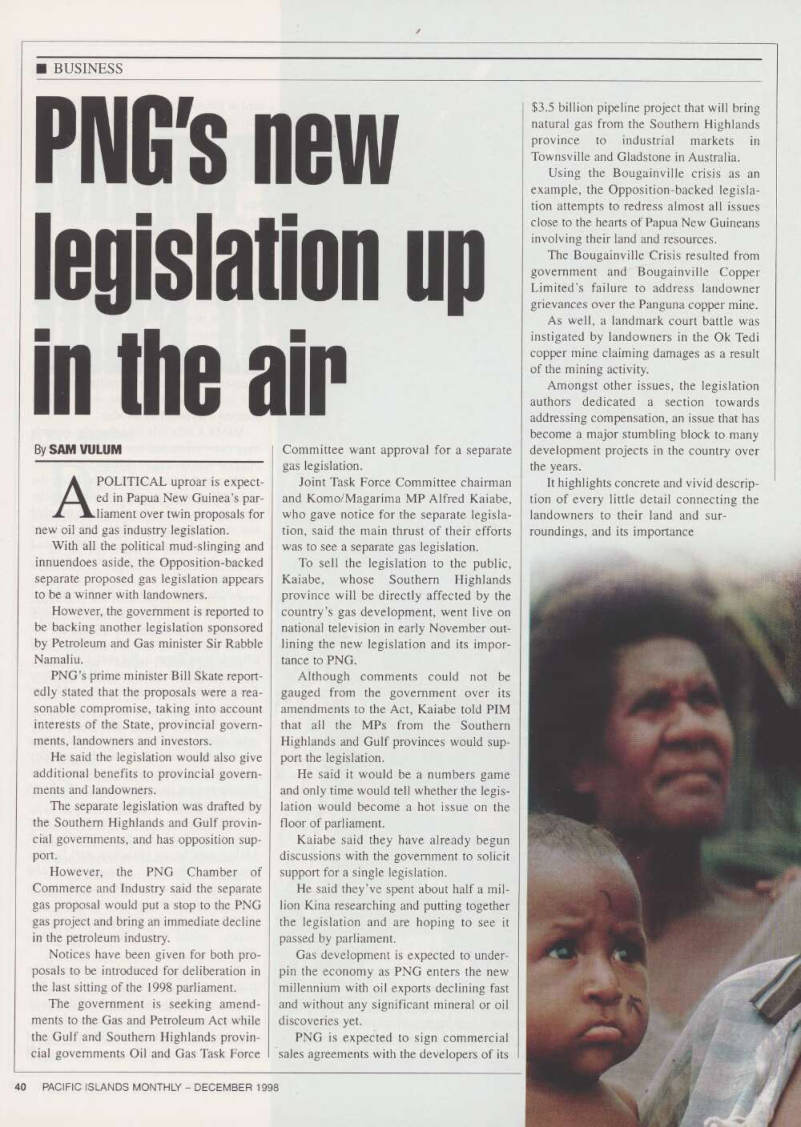
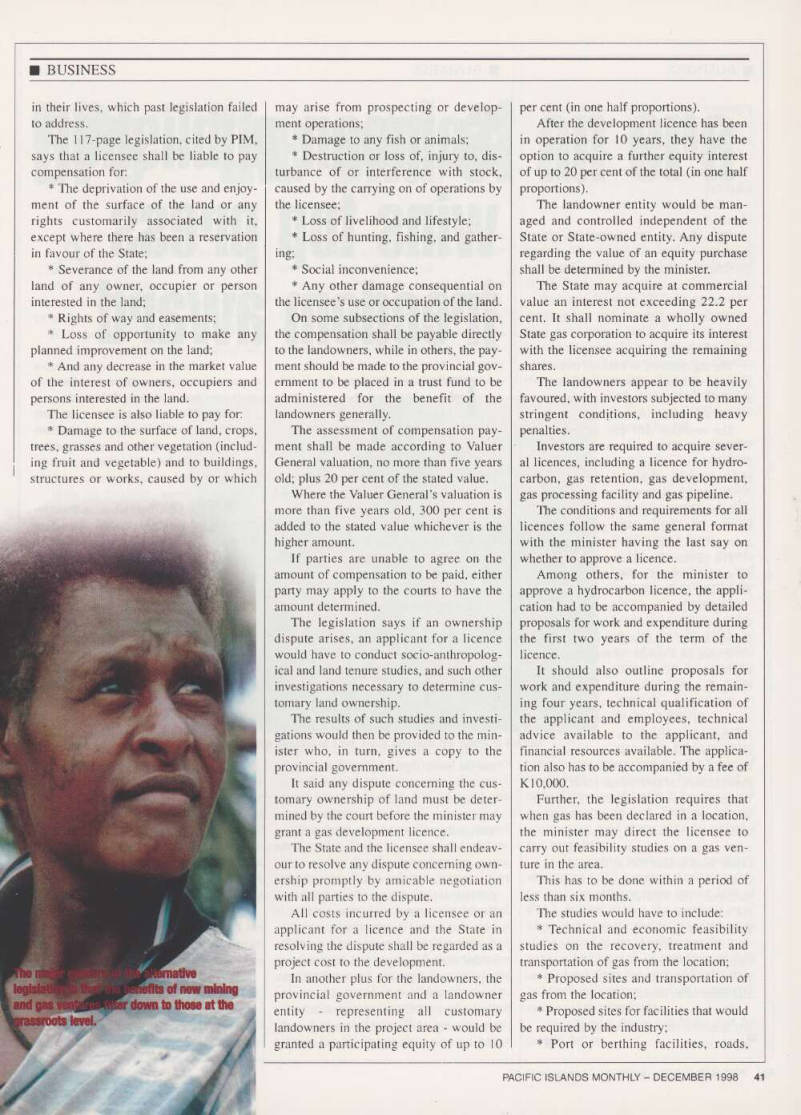
The malor [?] of the attermative legisation is that the bonefits of new mining and gas ventures filter down to those at the greassroots level.
pipelines or other transportation facili ties, water facilities for industrial and town purposes, the location and design of a suitable airstrip and associated landing and terminal facilities if
required;
* Generation and-transmission of electricity; * Development of a suitable town if required; * Design of housing and associated civic, social and cultural facilities; * Future labour requirements; * Possible impact on the environ ment; * Land tenure and ownership.
The legislation also outlines that an investor will face a fine not exceeding K 200,000 if he is caught exploring or recovering gas without a licence.
The investor will pay a fine of K 1,000,000 or has its licence cancelled if it fails to supply all information required by the minister.
Another section requires that when an investor fails to pay an amount due on time, the investor will pay interest calculated at 10 per cent per annum.
The licensee is also required to pay an amount not exceeding K 2,000,000 as security to the minister.
Royalty payment of gas recovered during a royalty period is payable by the last day of the next period.
In case of a failure by the licensee, eight per cent interest per day is charged on the due amount.
Each fiscal year of the term of the licence of a gas development, the licensee shall pay out its own costs to the provincial governments, develop ment levies for the construction and maintenance of provincial roads and bridges, wharves and airports, schools and hospitals, and any other levies determined by national law or agree ment. A provincial government legis lation shall ensure that at least 30 per cent of levies shall be spent in the pro ject area. The legislation also requires the establishment of a Gas Advisory Board to be appointed by the minister.
It should comprise five members, comprising a director who shall be the chairman, the Governor of a province and three other members.
The board advises the minister on any question on matters relating to the legislation. ■