tuna transhipment
pp. 38-39 · Read in the full issue
Majuro s port booms with tuna transhipment
By Giff Johnson
DURING the 19905, Majuro developed a reputation with foreign fishermen as a port to avoid: too much government red tape, high fees, and lethargic bureaucrats.
In the government “reform” parlance currently in vogue, the Marshalls had a lousy “environment” for doing business, especially for tuna boats that view every minute wasted in port as lost revenue.
Yet Majuro is strategically positioned in the central Pacific, not in - but not too far distant from - major fishing grounds, is serviced by international flights from Fiji, Asia and the US, and has excellent con tainer ship service from Matson, PM & O and Kyowa line, among others. But the logistics couldn’t overcome the anti-busi ness climate.
Fast-forward to late 1998. In just two months, during September and October, nine large refrigerated vessels had been parked in Majuro’s lagoon. Tuna was off loaded from nearly 30 Asian purse seiners and transhipped to canneries in Asia.
At the same time, the Marshalls signed deals with Taiwan and Korea for a com bined total of more than 70 purse seiners to get licenses and for transhipment activities
in Majuro.
This sudden rush of fishery’s activity has been aided by the fact that El Nino weather, which changes the temperature of ocean water, forced the schools of tuna out of their traditional grounds in the Federated States of Micronesia-Nauru- Papua New Guinea region and to the East
of the Marshalls and Kiribati.
Having the fish here helps, but Marshalls fisheries’ officials are working hard to cement relations with the Asian fishing industry to use Majuro as an ongo ing transhipment port, regardless of fish migration, because of the potential wind fall to local businesses for refuelling, maintenance, supplies and the hotel, restaurant and bar trade.
“The Taiwanese have always been here but they’ve never bought licenses before,”
Marshall Islands Marine Resources Authority (MIMRA) Director Danny Wase said of the response to the Marshalls’ new welcoming attitude toward the distant water fishing nations.
Last year, MIMRA officials, with the help of Asian Development Bank consul tants, wrote a new national fishery’s policy aimed at making Majuro a transhipment hub for the central Pacific. That was approved by the cabinet in late 1997, and the results are showing already.
“It’s all happening (purse seiner interest in the Marshalls) because the cabinet approved changes in our national fisheries policy,” Wase said. “It’s not even one year later and look what’s happening.”
MIMRA has cut government fees that are charged to visiting boats. For the min imal payment of a $3OO license and $6OO for each transhipment visit, these mother ships can use Majuro to tranship millions of pounds of fish.
In contrast, other ports in the region charge fees per ton of fish transhipped.
This could translate into a cost of thou sands of dollars per visit - depending on
the volume of fish handled. MIMRA has also streamlined its clearance procedures, making it relatively quick for the visiting ships to clear the various inspections on their arrival.
Meanwhile, firms such as the Marshalls Energy Company have hooked the fishing boats with good prices for bulk fuel pur chases, Wase said.
“Fuel sales are right up,” said Marshalls Energy Company’s Bill Roberts. One US purse seiner wanted 50,000 gallons of fuel but “the price was attractive so he went from wanting 50,000 gallons to buying 90,000,” Roberts said, adding that he’s being bombarded with requests for fuel prices from shipping agents and compa nies.
“The good thing is that the crews of these boats have money and they spend it in Majuro,” Roberts said.
“Increasing transhipment activity is a major factor in our agreements (with Taiwan and Korea) because it brings crew changes, visits by families (of crew mem bers) and use of other services,” Wase said.
This is providing business to the air lines, hotels, restaurants and bars besides direct services to the ships.
Spin-off benefits aside, as a direct result of the Korean fishing deal signed three months ago, the Marshalls has netted more than $500,000 for fish caught in its 200 mile exclusive economic zone during September and October - above and beyond the license fees collected for indi vidual purse seiners, Wase said.
Marshall Islands revenue from licens ing foreign fishing vessels, which has hov-
ered at the modest level of under $1.5 mil lion annually for many years, is expected to top $4-million this year, MIMRA fish eries advisor Simon Tiller told a Chamber of Commerce meeting in mid-November.
“General spending in the economy this year (from the vessel visits) is expected to be in the four-to-five million range,” he said.
That’s no small change in a country that is heavily dependent on funding from the United States that is declining.
However, the downside is the pollution that some in the Majuro community claim is occurring.
Local fishermen and divers report hav ing seen instances of effluent being released from at least one refrigerated car rier inside the lagoon, as well as fish dumped overboard by another.
MIMRA officials said that the vessels have been instructed not to discharge any bilge, waste or ballast within the lagoon, and face stiff fines and penalties if they do.
MIMRA staff go onboard the tranship ment vessels and purse seiners to monitor and record the fish loading, but with the sudden boom in activity, MIMRA and other enforcement agencies are also clear ly short-handed.
Additional oversight of the foreign ves sels will be needed to assuage concern in the community, which was heightened by the polluting actions of locally based Chinese long liners in the mid-19905.
It isn’t just El Nino and MIMRA’s new fish friendly attitude that is making Majuro attractive.
The Marshalls is also getting help from other island ports in its quest to become a transhipment hub. Wase said that arbitrary or ad hoc policies at other ports in the Pacific region have forced tuna fleets to look elsewhere for these services.
MIMRA, he said, is attempting to take advantage of this by demonstrating that Majuro can be an attractive port for the Japanese, Korean, Taiwanese and American fleets - regardless of where the tuna schools are located.
“The fleets are looking for a new home,” added fishery’s advisor Simon Tiller.
Because of the complex nature of the fishing industry, "fishing interest can dis appear as quickly as it comes,” Tiller said.
"That’s why we're trying to build a sus tainable base for the future. There’s a lot of work still to be done.” ■
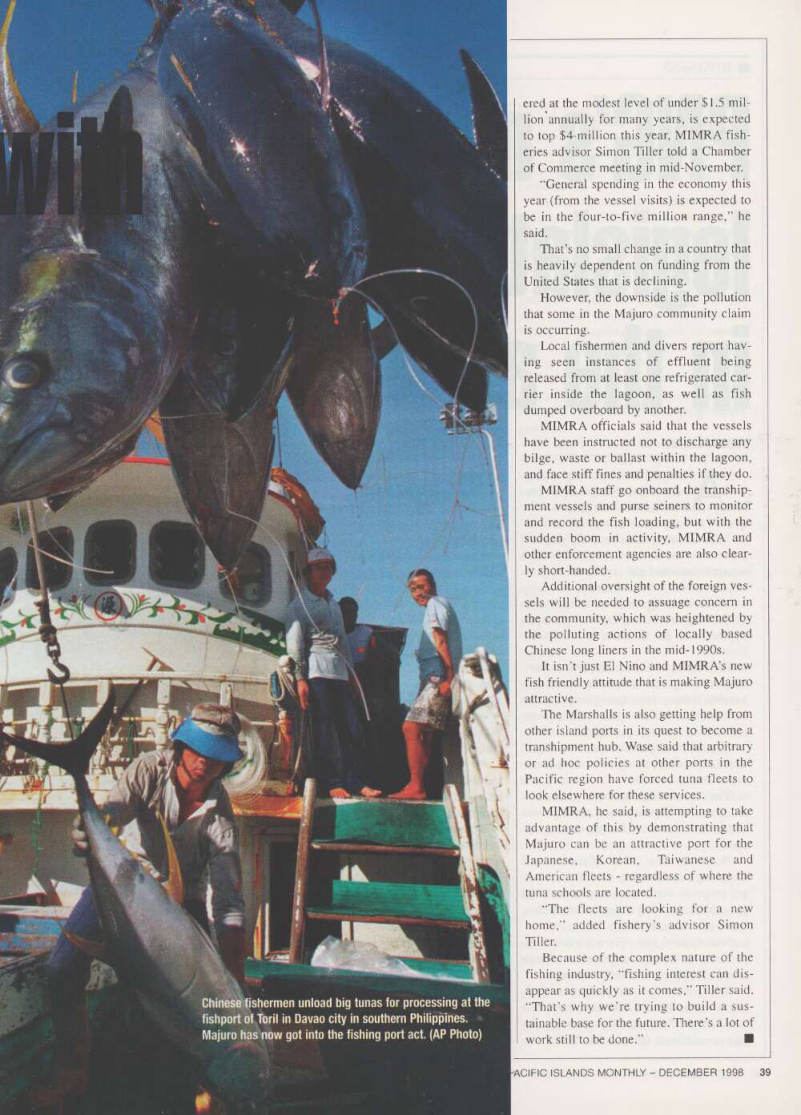
Chinese fishermen unload big tunas for processing at the fishport of Toril in Davao city in southern Philippines.
Majuro has now got into the fishing port act. (AP Photo)