Global capitalism
pp. 50-56 · Read in the full issue
falfing apart just as Pacific embraces it
By Michael Field
ONE of the awkward truths about Tuvalu is that it has not got a national railroad it can sell off to the Americans and Niue does not have an airline it can privatise... No matter, the mantra of the market - privatisation, com petition and deregulation - continue to be hammered into the South Pacific as if it is a truth equivalent to that passed down last century in the Good Book itself.
But there is evidence that after nearly a decade of Canberra and Wellington beat ing up on the Pacific, serious doubts are emerging. One is local, a mild manned aca demic economist, the other global.
Just two weeks after the South Pacific Forum meeting in Micronesia - which issued a communique with the usual code words for monetarism - one of the world’s richest men issued a warning about the very basis of the reform path.
International financier George Soros told US legislators that the world’s capital markets had become a wrecking ball, destroying nation’s economies. “The glob al capitalist system, which has been responsible for the remarkable prosperity of this country in the last decade, is com ing apart at the seams,” Mr Soros said.
The last time the capitalist system came apart was during the Great Depression of the 19305. This was mostly unnoticed by Pacific people at the time, living in subsis tence economies. These days it would be different for people in Suva, Apia and Port Moresby. Dependency on the cash econo my has become endemic.
The future for them might well be seen today in Honiara, capital of the Pacific’s worst economy and showing few signs of improvement. The Forum in Palikir did note the “back drop of region-specific dif-
ficulties” afflicting the region but went on to adopt the entire agenda set out by the Forum Economic Ministers Meetings (FEMM). Much of this is driven by Australia and New Zealand, although offi cials from both countries are now defen sive about this.
The Forum’s dedication to the message was implicit in its theme: “From reform to growth: the private sector and investment as the keys to prosperity”.
Federated States of Micronesia President Jacob Nena warned stagnant economies must endure “a period of struc tural, institutional and even behavioural
change.” He said ”some unfortunate mis takes” had been made and opportunities lost. For those of us who have been involved in policy-making dating back to the 1970’s and 80’s there is cause for humility,” Mr Nena said.
“We must acknowledge that in earlier days some of our basic assumptions and hence many of our policy decisions were flawed.”
Pointedly he noted that they were fol lowing now the recommendations of the same donor partners and institutions who led them down the wrong track last time.
“The truth is that there have been lots of lessons learned by all parties.”
Watching on is the mild manned acade mic economist, Tongan bom Sitiveni Halapua, head of the Pacific Islands Development Program at Hawaii’s East West Center. The FEMM agenda leaves him cold. “I see the same mistakes being made, the same failures of the Five Year Plans that we were all made to write and follow,” Dr Halapua says.
“The people who are telling us we must globalise are also the same people who made us write the Five Year Plans.”
The once celebrated Plans - in Five, Ten and 15 year varieties - were all the rage the 19705. They were the ultimate in wishful thinking - grandiose schemes and dreams which cost hundreds of thousands to write in the first place.
The FEMM agenda has, to Dr Halapua’s way of thinking, also changed the perspective of the Forum itself. Once it represented the voice of the Pacific Islands in the world - a world that was never par ticularly keen to listen in the first place.
The Forum was the little guy among the Super Powers.
Nowadays the Forum has given up that advocacy role and has become a conduit for the world’s vested interests - and they are using it to tell Pacific Islanders what they must do. In the change, the voice of the village and the atoll is lost in the clam our of the FEMM message - “do as we tell you”.
Dr Halapua says he is not opposed to the idea of economic growth so assiduous ly advocated by FEMM. “My comment is more to do with the limitations of the con cept, it is one dimensional and focuses on only the economic factors.”
He traces the philosophy to a reaction
Continued on page 56
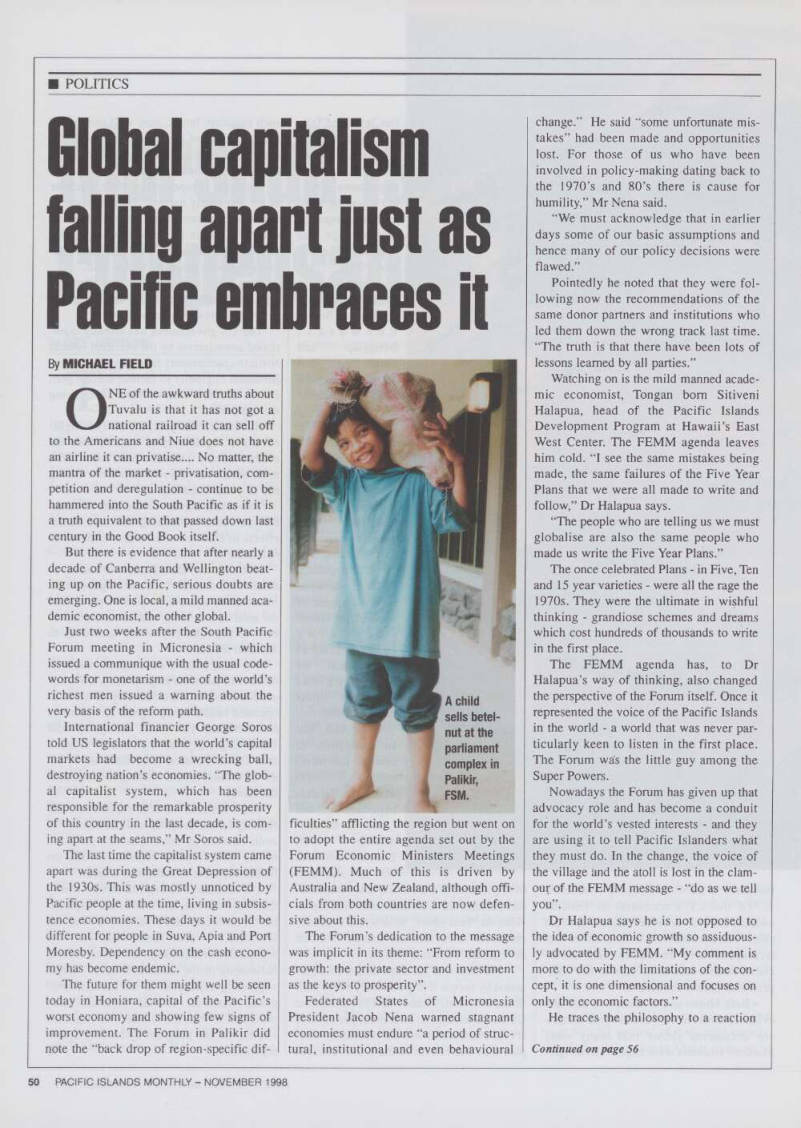
A child sells betel nut at the parliament complex in Palikir,
Fsm.
Continued from page 50
to a World Bank review of Pacific economies in the late 1980 s which high lighted the low or nil economic growth.
Public sector change has been a response to that, and the problem, says Dr Halapua, is that the message which comes with the restructuring is raising false expectations.
“What worries me is that this process will increase the gap between the haves and the have nots.”
He worries too at the way the FEMM agenda pumps up expectations in Pacific states but fails to take into account the capabilities of the communities in the region.
International agencies were being dis honest with their call for public sector reforms. They do not tell people it cannot be afforded; the public sector is simply cut while people try to think up what to do next.
“They push it to the level where they claim that if you have public reform today you will have economic growth tomor row.”
While old style aid has failed to lift liv ing standards countries and governments were continuing to make mistakes. “The quest for more foreign aid and investment continues, except that it’s under the new banner of private sector development and public sector reform,” Dr Halapua says.
The backers however were not consid ering ways in which people and communi ties could participate in the process. And consultation was only taking place once programmes were underway. “We should not decide what to do and then start the consultation. That’s like the capitalistic way of selling a product: you manufacture
something and then go and sell it.”
He has spent a decade conceiving an economic model based on Pacific values and aspirations: “Who you are and what you are capable 0f... The focus has to be on the people, not on resources.” And he added; “If we don’t have the right ques tion, we won’t get the right answers.”
Dr Halapua might just one day manage to become the Pacific’s first Nobel Laureate with his Pacific economic model.
One of its earliest public airings was at the Pacific Leaders Conference in Tahiti in 1991 when Dr Halapua produced a dense paper which included a complex graph and what he called a “7DD matrix” to show that current Pacific aid was going in the wrong direction. He laid out a mathemati cal formula to show how it should be done.
This bought an incredulous reaction from Sir Albert Kipalan, then Papua New Guinea Public Service Minister.
“If we followed what you are saying,” he told Dr Halapua, “we would be out of office very quickly.”
Fiji’s Prime Minister Sitiveni Rabuka agreed . “If we do what is right we may not be voted back in,” he said, “Perhaps there in lies the problem.”
These days Dr Halapua has the dubious pleasure of seeing his words come true.
There are many varied, local reasons why Pacific governments are often struggling to stay in power. But there is a common theme too - the governments of the Cook Islands, Fiji, Marshall Islands, the Solomons and Vanuatu are all pushing the FEMM message. And each government is in strife with its own voters over failure to deliver the goods.
Intriguingly .the most radicalised of the Pacific governments with the FEMM agen da is the one with the greatest instability - New Zealand. ■
A family travels home with their sakau (kava) harvest