compensation increase
pp. 48-49 · Read in the full issue
Marshall Islands seeks compensation increase
By Giff Johnson
THE Marshall Islands is preparing to launch a formal appeal to the US Congress to dramatically increase compensation payments and med ical coverage for islanders affected by American nuclear testing from 1946-1958.
Several developments are building momen tum for the Marshall Islands case to the US: •The apparent unfairness of the Marshalls compensation program when compared to a similar U.S.
Congressionally-approved settlement for Americans living downwind of the Nevada nuclear test site. Although U.S. tests in the Marshalls were 100 times the nuclear yield of the small bombs tested in Nevada, the American “downwinders” are receiving a larger amount of compensation than a Nuclear Claims Tribunal established with U.S. funding for compensating islanders for similar personal injury and land damages. • Marshall Islanders suffering radiation related health problems are not getting full compensation. One third of all Marshallese nuclear claimants have died without receiv ing 100 percent of their awards because the Nuclear Claims Tribunal’s compensation fund is limited to $45 million, and the num ber of claims has pushed awards over $66 million. • Recently declassified U.S. nuclear test studies show, according to Marshall Islands officials, that 22 of 24 atolls and islands in the Marshalls received nuclear test fallout above maximum permissable safety levels.
This information was not provided to Marshall Islands negotiators when the Compact of Free Association, with its $l5O million nuclear compensation settlement, was agreed to in 1983. • As compelling as the Marshall Islands case may be, however, it is likely to be an uphill battle to get the U.S. government to
increase compensation - in view both of the Republican-controlled Congress’ budget cutting attitude and the frequently restated State Department position that the
Compact’s compensation package repre
sents “full and final” payments for nuclear test damage. Marshalls officials are plan ning to formally petition the U.S. Congress when it reconvenes in January 1999, fol lowing the elections this month (November). • The Marshall Islands’ case is aided by a clause in the Compact known as the “changed circumstances” provision. It allows the Marshalls to request the Congress to increase compensation pay ments if the Marshalls can show that new data and circumstances render the compen sation package “manifestly inadequate.”
Marshall Islands Foreign Minister Phillip Muller and Nuclear Claims Tribunal Chairman Oscar deßrum believe there is no question about the matter. Although the U.S. provided a $l5O million trust fund in 1986 to pay nuclear test victims, Muller said in early October that the compensation program “is inadequate to the point of
becoming dysfunctional”.
• The $l5O million was invested in U.S. stocks and bonds to produce $lB million annually, or $270 million over the 15 year life of the Compact. Of the $270 million, the four atolls - Bikini, Enewetak, Rongelap and Utrik - that are recognized as “exposed” by the U.S. are receiving about $lBO mil lion, the Tribunal is receiving $45 million to compensate islanders for personal injuries and land damages, $3O million is going for a health care program, and the remaining funds paid for a nationwide radiological survey and other activities. • The Nuclear Claims Tribunal has awarded $65.5 million - $2O million more than it received from the US - to 1,574 peo ple for personal injuries, but has actually
paid only about half of that amount to the claimants to avoid exhausting the fund while new claims continue to come in.
Indeed, the Tribunal hasn’t yet ruled on pending land damage claims from Bikini, Enewetak, Rongelap and Utrik that are seeking compensation in the hundreds of millions.
No individual claimant has received more than 61 percent of their total awards, said Tribunal chairman Oscar deßrum in
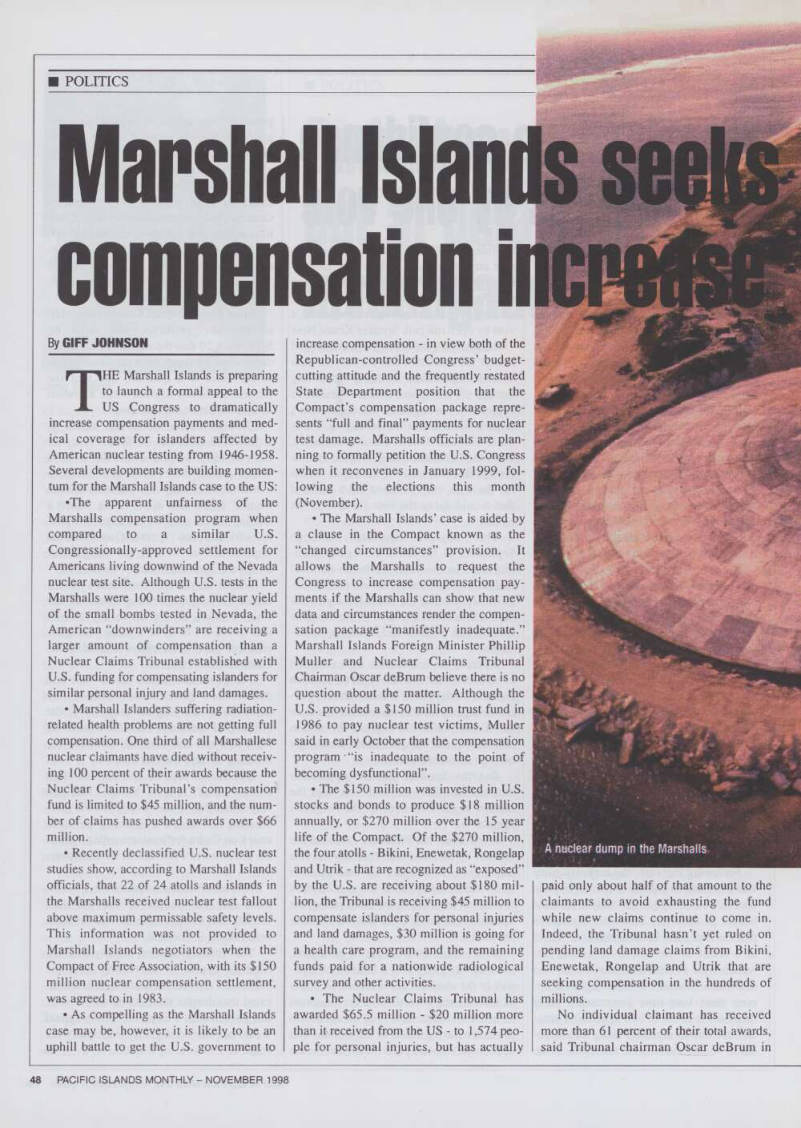
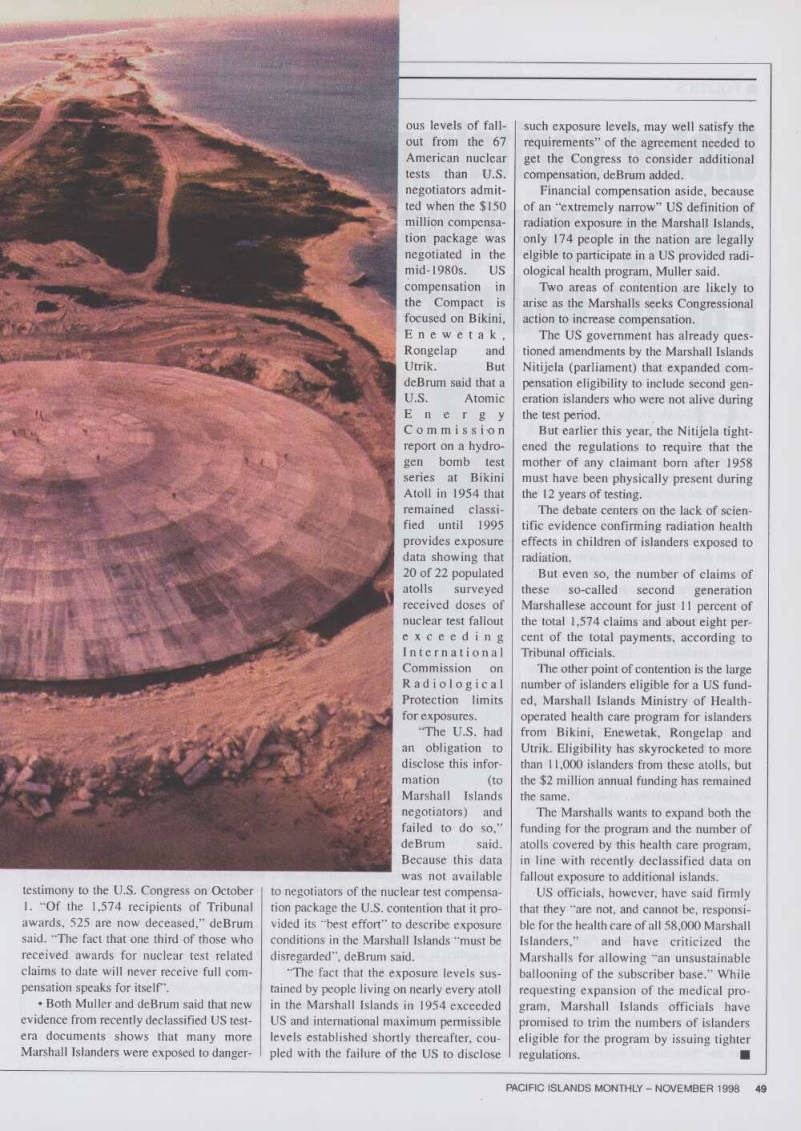
A nuclear dump in the Marshalls
testimony to the U.S. Congress on October 1. “Of the 1,574 recipients of Tribunal awards, 525 are now deceased,” deßrum said. "The fact that one third of those who received awards for nuclear test related claims to date will never receive full com pensation speaks for itself’. • Both Muller and deßrum said that new evidence from recently declassified US test era documents shows that many more Marshall Islanders were exposed to danger
ous levels of fall out from the 67 American nuclear tests than U.S. negotiators admit ted when the $l5O million compensa tion package was negotiated in the mid-1980s. US
compensation in
the Compact is focused on Bikini, Enewetak,
Rongelap and
Utrik. But deßrum said that a U.S. Atomic Energy Commission report on a hydro gen bomb test series at Bikini Atoll in 1954 that remained classi fied until 1995 provides exposure data showing that 20 of 22 populated atolls surveyed received doses of nuclear test fallout exceeding International Commission on Radiological Protection limits for exposures.
“The U.S. had an obligation to disclose this infor mation (to Marshall Islands
negotiators) and
failed to do so,” deßrum said.
Because this data was not available
to negotiators of the nuclear test compensa tion package the U.S. contention that it pro vided its "best effort” to describe exposure conditions in the Marshall Islands "must be disregarded”, deßrum said.
"The fact that the exposure levels sus tained by people living on nearly every atoll in the Marshall Islands in 1954 exceeded US and international maximum permissible levels established shortly thereafter, cou pled with the failure of the US to disclose
such exposure levels, may well satisfy the requirements” of the agreement needed to get the Congress to consider additional compensation, deßrum added.
Financial compensation aside, because of an ‘‘extremely narrow” US definition of radiation exposure in the Marshall Islands, only 174 people in the nation are legally elgible to participate in a US provided radi ological health program, Muller said.
Two areas of contention are likely to arise as the Marshalls seeks Congressional action to increase compensation.
The US government has already ques tioned amendments by the Marshall Islands Nitijela (parliament) that expanded com pensation eligibility to include second gen eration islanders who were not alive during the test period.
But earlier this year, the Nitijela tight ened the regulations to require that the mother of any claimant born after 1958 must have been physically present during the 12 years of testing.
The debate centers on the lack of scien tific evidence confirming radiation health effects in children of islanders exposed to radiation.
But even so, the number of claims of these so-called second generation Marshallese account for just 11 percent of the total 1,574 claims and about eight per cent of the total payments, according to Tribunal officials.
The other point of contention is the large number of islanders eligible for a US fund ed, Marshall Islands Ministry of Health operated health care program for islanders from Bikini, Enewetak, Rongelap and Utrik. Eligibility has skyrocketed to more than 11,000 islanders from these atolls, but the $2 million annual funding has remained the same.
The Marshalls wants to expand both the funding for the program and the number of atolls covered by this health care program, in line with recently declassified data on fallout exposure to additional islands.
US officials, however, have said firmly that they “are not, and cannot be, responsi ble for the health care of all 58,000 Marshall Islanders,” and have criticized the Marshalls for allowing “an unsustainable ballooning of the subscriber base.” While requesting expansion of the medical pro gram, Marshall Islands officials have promised to trim the numbers of islanders eligible for the program by issuing tighter regulations. ■