accumulating
pp. 38-41 · Read in the full issue

PNG's debts still accumulating
By Sam Vulum
THE economic recession is tak ing its toll in Papua New Guinea, with increasing spec ulation over whether the country or not
the country is being virtually mortgaged
to international financial institutions.
PNG has secured a Kl2O million commercial loan, from European bank ing syndicate Kredit Bank, to support the 1998 budget, with negotiations for addi tional funding from the World Bank and the International Monetary Fund contin uing. the country’s current external debt position is quite worrying. There is some degree of burden being placed on the government in repaying its loans. But most disturbing are speculations that the loans sought have not been budgeted for.
Concerned Opposition Leader Bernard Narokobi told PIM that the country was being sold to overseas financial institutions, adding that “this trend must stop”.
Narokobi said the country’s external debt position was about K 5 billion. On top of that, some sources say the official internal debt figure stands at more than K 750 million.
Whatever the official figure is, PNg is having difficulty repaying its current loans, let alone future ones.
Narokobi said the loans had not been budgeted for but were sought to meet the shortfalls in revenue.
“We must reduce recurrent costs, improve revenue collection and live within our means,” he said, “Maski (for get) International Monetary Fund and World Bank loans. Access concessional
developmental loans”.
A senior opposition MP and Central province Governor, Ted Diro, accused government of imposing a debt burden on Pry simply could not afford. Diro said the government had borrowed an addi
tional K 270 million from overseas com mercial banks over the period of a week in October.
“If the interest rate is 15 per cent, as has been claimed, and the loans are for seven years, then the annual interest and repayment costs of these loans will be K6O million,” Diro said.
“The Budget documents tabled in March show that this year the govern ment will have to pay K 365 million in interest, and K2OO million in amortisa tion, or repayment of debt.
“The total of K 565 million is almost one quarter of the National budget for 1998. It is much more than the combined spending on education, health, and the police. It is even greater than the whole Public Investment Programme (PIP) for 1998,” he said.
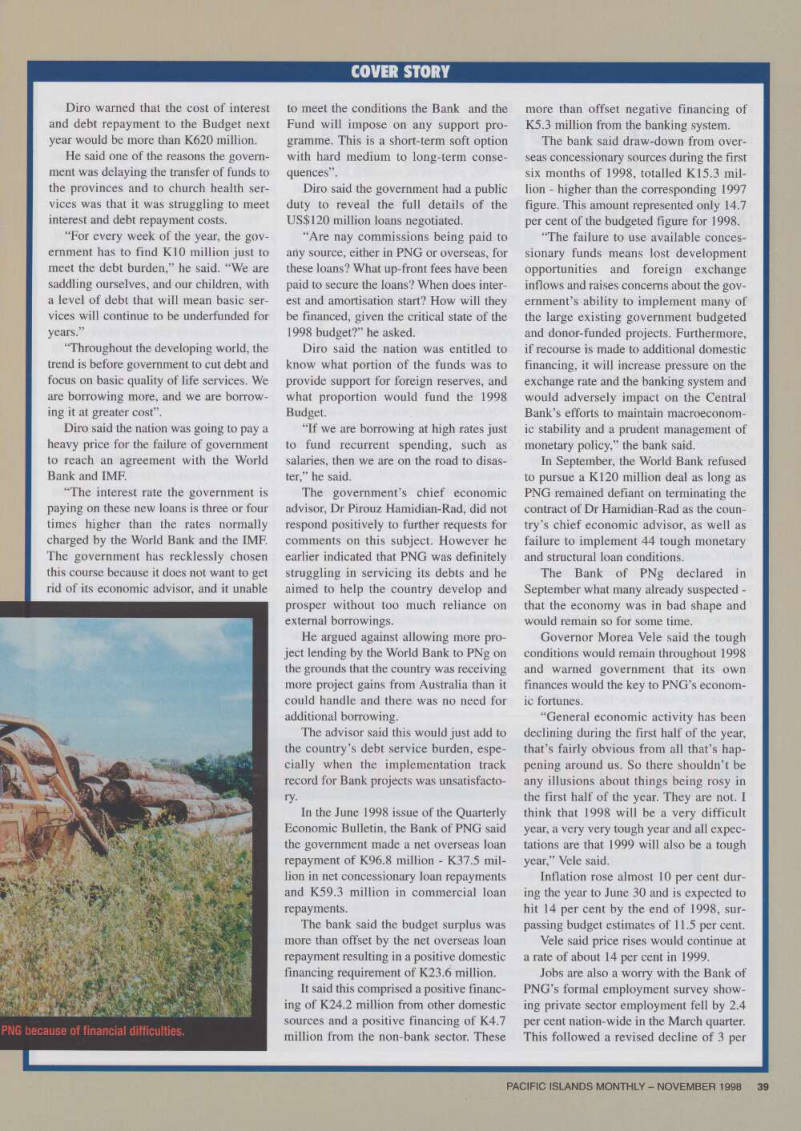
Logging equipment lies idle after investors pulled
Diro warned that the cost of interest and debt repayment to the Budget next year would be more than K 620 million.
He said one of the reasons the govern ment was delaying the transfer of funds to the provinces and to church health ser vices was that it was struggling to meet interest and debt repayment costs.
“For every week of the year, the gov ernment has to find KlO million just to meet the debt burden,” he said. “We are saddling ourselves, and our children, with a level of debt that will mean basic ser vices will continue to be underfunded for years.”
“Throughout the developing world, the trend is before government to cut debt and focus on basic quality of life services. We are borrowing more, and we are borrow ing it at greater cost”.
Diro said the nation was going to pay a heavy price for the failure of government to reach an agreement with the World Bank and IMF.
“The interest rate the government is paying on these new loans is three or four times higher than the rates normally charged by the World Bank and the IMF.
The government has recklessly chosen this course because it does not want to get rid of its economic advisor, and it unable
to meet the conditions the Bank and the Fund will impose on any support pro gramme. This is a short-term soft option with hard medium to long-term conse quences”.
Diro said the government had a public duty to reveal the full details of the US$l2O million loans negotiated.
“Are nay commissions being paid to any source, either in PNG or overseas, for these loans? What up-front fees have been paid to secure the loans? When does inter est and amortisation start? How will they be financed, given the critical state of the 1998 budget?” he asked.
Diro said the nation was entitled to know what portion of the funds was to provide support for foreign reserves, and what proportion would fund the 1998 Budget.
“If we are borrowing at high rates just to fund recurrent spending, such as salaries, then we are on the road to disas ter,” he said.
The government’s chief economic advisor, Dr Pirouz Hamidian-Rad, did not respond positively to further requests for comments on this subject. However he earlier indicated that PNG was definitely struggling in servicing its debts and he aimed to help the country develop and prosper without too much reliance on
external borrowings.
He argued against allowing more pro ject lending by the World Bank to PNg on the grounds that the country was receiving more project gains from Australia than it could handle and there was no need for additional borrowing.
The advisor said this would just add to the country’s debt service burden, espe cially when the implementation track record for Bank projects was unsatisfacto ry.
In the June 1998 issue of the Quarterly Economic Bulletin, the Bank of PNG said the government made a net overseas loan repayment of K 96.8 million - K 37.5 mil lion in net concessionary loan repayments and K 59.3 million in commercial loan repayments.
The bank said the budget surplus was more than offset by the net overseas loan repayment resulting in a positive domestic financing requirement of K 23.6 million.
It said this comprised a positive financ ing of K 24.2 million from other domestic sources and a positive financing of K 4.7 million from the non-bank sector. These
more than offset negative financing of K 5.3 million from the banking system.
The bank said draw-down from over seas concessionary sources during the first six months of 1998, totalled K 15.3 mil lion - higher than the corresponding 1997 figure. This amount represented only 14.7 per cent of the budgeted figure for 1998.
“The failure to use available conces sionary funds means lost development
opportunities and foreign exchange
inflows and raises concerns about the gov ernment’s ability to implement many of the large existing government budgeted and donor-funded projects. Furthermore, if recourse is made to additional domestic financing, it will increase pressure on the exchange rate and the banking system and would adversely impact on the Central Bank’s efforts to maintain macroeconom ic stability and a prudent management of monetary policy,” the bank said.
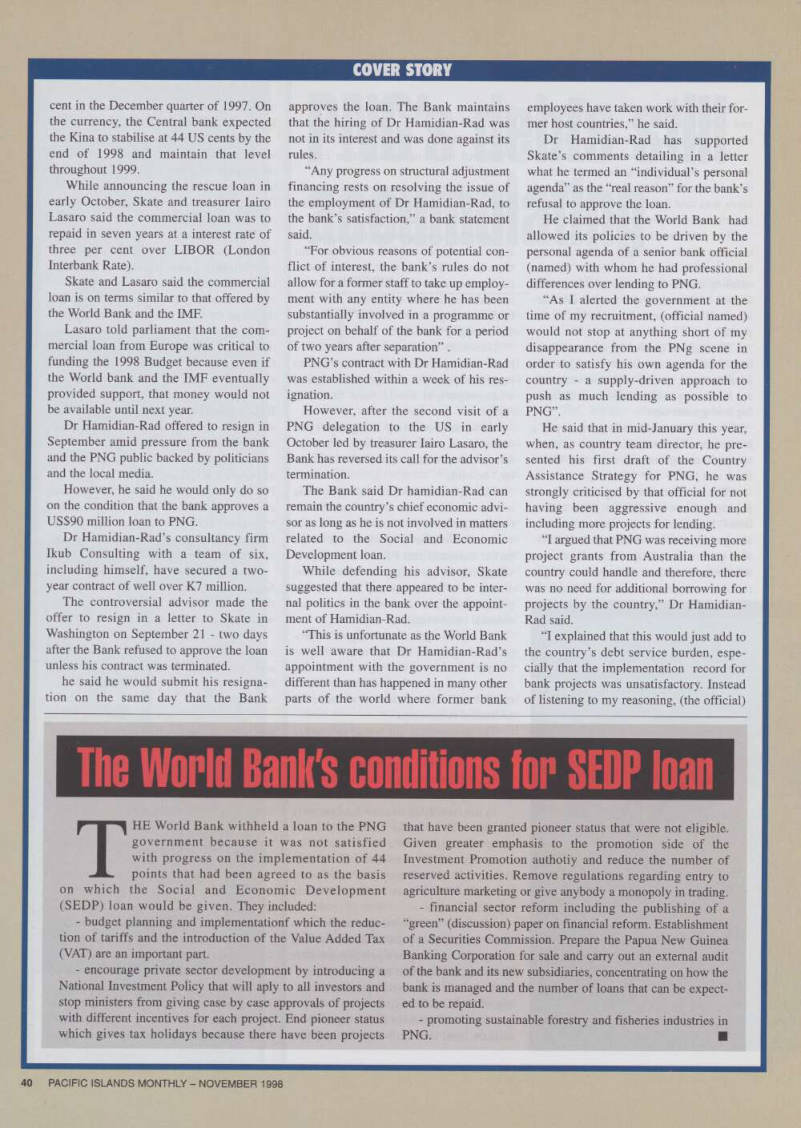
In September, the World Bank refused to pursue a Kl2O million deal as long as PNG remained defiant on terminating the contract of Dr Hamidian-Rad as the coun try’s chief economic advisor, as well as failure to implement 44 tough monetary and structural loan conditions.
The Bank of PNg declared in September what many already suspected that the economy was in bad shape and would remain so for some time.
Governor Morea Vele said the tough conditions would remain throughout 1998 and warned government that its own finances would the key to PNG’s econom ic fortunes.
“General economic activity has been declining during the first half of the year, that’s fairly obvious from all that’s hap pening around us. So there shouldn’t be any illusions about things being rosy in the first half of the year. They are not. I think that 1998 will be a very difficult year, a very very tough year and all expec tations are that 1999 will also be a tough year,” Vele said.
Inflation rose almost 10 per cent dur ing the year to June 30 and is expected to hit 14 per cent by the end of 1998, sur passing budget estimates of 11.5 per cent.
Vele said price rises would continue at a rate of about 14 per cent in 1999.
Jobs are also a worry with the Bank of PNG’s formal employment survey show ing private sector employment fell by 2.4 per cent nation-wide in the March quarter.
This followed a revised decline of 3 per
PNG because of financial difficulties.
cent in the December quarter of 1997. On the currency, the Central bank expected the Kina to stabilise at 44 US cents by the end of 1998 and maintain that level
throughout 1999.
While announcing the rescue loan in early October, Skate and treasurer lairo Lasaro said the commercial loan was to repaid in seven years at a interest rate of three per cent over LIBOR (London Interbank Rate).
Skate and Lasaro said the commercial loan is on terms similar to that offered by the World Bank and the IMF.
Lasaro told parliament that the com mercial loan from Europe was critical to funding the 1998 Budget because even if the World bank and the IMF eventually provided support, that money would not be available until next year.
Dr Hamidian-Rad offered to resign in September amid pressure from the bank and the PNG public backed by politicians and the local media.
However, he said he would only do so on the condition that the bank approves a US$9O million loan to PNG.
Dr Hamidian-Rad’s consultancy firm Ikub Consulting with a team of six, including himself, have secured a two year contract of well over K 7 million.
The controversial advisor made the offer to resign in a letter to Skate in Washington on September 21 - two days after the Bank refused to approve the loan unless his contract was terminated. he said he would submit his resigna tion on the same day that the Bank
approves the loan. The Bank maintains that the hiring of Dr Hamidian-Rad was not in its interest and was done against its rules.
“Any progress on structural adjustment financing rests on resolving the issue of the employment of Dr Hamidian-Rad, to the bank’s satisfaction,” a bank statement said.
“For obvious reasons of potential con flict of interest, the bank’s rules do not allow for a former staff to take up employ ment with any entity where he has been substantially involved in a programme or project on behalf of the bank for a period of two years after separation” .
PNG’s contract with Dr Hamidian-Rad was established within a week of his res ignation.
However, after the second visit of a PNG delegation to the US in early October led by treasurer lairo Lasaro, the Bank has reversed its call for the advisor’s termination.
The Bank said Dr hamidian-Rad can remain the country’s chief economic advi sor as long as he is not involved in matters related to the Social and Economic
Development loan.
While defending his advisor, Skate suggested that there appeared to be inter nal politics in the bank over the appoint ment of Hamidian-Rad.
“This is unfortunate as the World Bank is well aware that Dr Hamidian-Rad’s appointment with the government is no different than has happened in many other parts of the world where former bank
employees have taken work with their for mer host countries,” he said.
Dr Hamidian-Rad has supported Skate’s comments detailing in a letter what he termed an “individual’s personal agenda” as the “real reason” for the bank’s refusal to approve the loan.
He claimed that the World Bank had allowed its policies to be driven by the personal agenda of a senior bank official (named) with whom he had professional differences over lending to PNG.
“As I alerted the government at the time of my recruitment, (official named) would not stop at anything short of my disappearance from the PNg scene in order to satisfy his own agenda for the country - a supply-driven approach to push as much lending as possible to
Png”.
He said that in mid-January this year, when, as country team director, he pre sented his first draft of the Country Assistance Strategy for PNG, he was strongly criticised by that official for not having been aggressive enough and including more projects for lending.
“I argued that PNG was receiving more project grants from Australia than the country could handle and therefore, there was no need for additional borrowing for projects by the country,” Dr Hamidian- Rad said.
“I explained that this would just add to the country’s debt service burden, espe cially that the implementation record for bank projects was unsatisfactory. Instead of listening to my reasoning, (the official)
instructed me to redraft the document according to his instructions, to include projects in agriculture, health and educa tion.
I strongly refused, and said I was not going to be part his supply-driven strate gy because I did not believe that that was what the country needed and the ‘new’
World Bank under Mr Wolfensohn’s leadership was all about”.
Dr Hamidian-Rad said he was called into the official’s office the next day where he was told to put himself in that official’s position.
He claimed the official, who was new in the position, did not have any opera tion to take to the board for 1998 and his other clients were not borrowing. He asked Hamidian-Rad to cooperate and redraft the country assistance strategy the way that was suggested to him.
“My response was simple: the issue of small portfolio was his problem because I did not ask him to take the job,” Dr Hamidian-Rad said.
He said when Skate made a request to the Bank that he be seconded to PNG, that official made it clear he would stop him from taking the position. It is claimed that the official thought Hamidian-Rad would try to stop him from lending for projects to PNG.
Dr Hamidian-Rad said he did not see any problem with his employment with the PNG government because there were at least 31 other cases where former bank staff and managers, including vice-presi dents, worked for governments they had served with within two years of resign ing from the Bank.
He said the main mission of his com pany, Ikub Consulting Pty Ltd, was to help countries and governments in need for economic reforms to develop their own policy agendas rather than be dic tated to by external financiers.
“The government has managed the budget and the economy for the past 14 months without borrowing any funds from overseas or the domestic banking sector. In fact we have managed to reduce stock of foreign debt this period”.
The world Bank, meanwhile, has expressed concern over the lack of progress to date in the implementation of the 1998 budget, on which financial aid by the bank was conditioned, as well as the “extremely low development expenditures” ■