contagion
pp. 35-37 · Read in the full issue
Cover Story
Crisis contagion
Pushing the urgency for reform
By Sophie Foster Hildebrand
WHEN top officials from 182 economies around the globe met in early October, at the 53rd International Monetary Fund and World Bank annual meeting, there was no doubt what was foremost on their minds.
A crisis of global proportions had hit the world’s economies, and these people were charged with finding a solution.
The consensus seemed to show that the problem stemmed from the fact that many economies and financial systems had been drawn into globalisation unprepared.
“We are speaking not just of countries in crisis, but of a system in crisis, a system not yet sufficiently adapted to the oppor tunities and risks of globalisation,” IMF managing director Michel Camdessus told the annual meeting.
He said while “it would be perhaps too dramatic to talk yet of global recession... the evidence of the risks calls for immedi ate action”.
“If we keep a steady nerve, if all coun tries pursue stability, structural adjustment and orderly liberalisation of their economies, this crisis can be overcome...
But for this to happen and for us to respond properly, we must understand clearly what went wrong,” he said.
An IMF statement said: “The outlook for the world economy has worsened con siderably... Recent problems have been aggravated by a general weakening of market confidence, reflecting the greater
prevalence and intensity of contagion in an increasingly globalised economy”.
The international financial crisis that began in Asia and spread to other conti nents “lends urgency to efforts to strength en the architecture of the international
financial system”.
In the Pacific, this need for urgency has been pressed often by international donors including the Asian Development Bank, the IMF and the World Bank.
In the a recent report titled East Asia: The Road to Recovery, the World Bank said of all Pacific Island countries, the region’s three largest economies, the Solomon Islands, Fiji and PNG, had been hardest hit by the Asian crisis.
The Bank said that when the crisis struck, the Pacific was already struggling with the effects of drought, falling com modity prices, reductions in crop yields civil service reforms, political instability and a drop in overseas development activ ity.
Earlier this year, Solomon Islands prime minister Bartholomew Ulufa’alu told PIM that the current crisis was affect ing the Solomons “like everyone else”.
An economist by trade, he believes the Asian currency crisis was caused by the flight of funds from Asia to the former Soviet bloc.
“The developed countries rushed to the former Soviet bloc leaving a vacuum in the economies of Asia. The resources must shift back to Asia so that the global equilibrium is maintained,” he said.
At the time, Mr Ulufa’alu said he did not think the IMF would address the prob lems in Asia.
Taking that point of view, it is quite ironic that the US is now spearheading a solution to a crisis that it was partly responsible for creating.
Since that meeting in Washington, the Solomon Islands has managed to clinch a deal with the World Bank to revitalise its economy.
The World Bank agreed to a US$lO million loan after discussions with Mr Ulufa’alu’s delegation to Washington in early October. The loan will be used to assist the health, education, forest, envi ronment and financial sectors of the Solomon Islands.
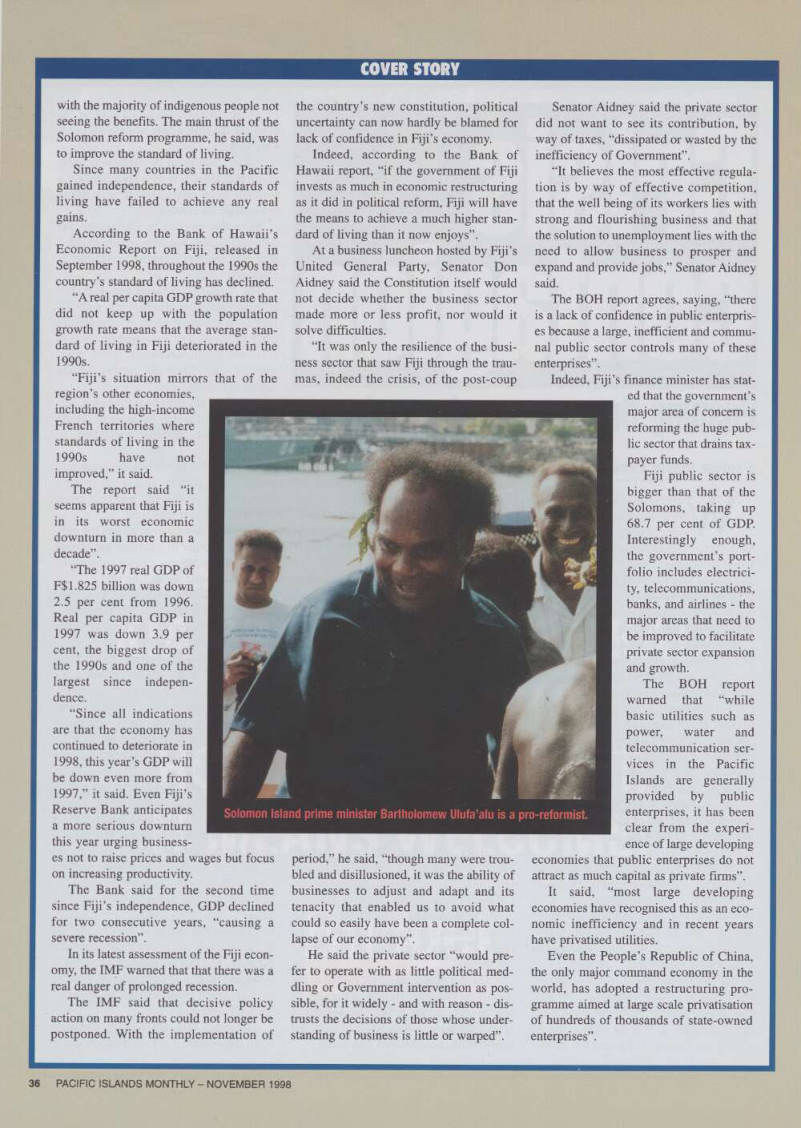
Mr Ulufa’alu is known for being out spoken when it comes to issues of reform and the need for less regulation of economies.
He told PIM that when he came into power, his government had inherited a debt-ridden economy that had been over governed and over-regulated.
His major target was to reform the pub lic sector in order to stimulate the private sector. “The economy cannot support the size of the public sector,” he said.
In the Solomon Islands, as with most Pacific Island economies, the public sec tor makes up about 60 per cent of Gross Domestic Product (GDP).
Because of this situation, much pres sure is placed on the smaller private sector for taxation to fund government projects.
“We have to revert that situation so that over a four-year period, the private sector makes up 60 per cent of GDP, which is the desired situation for any economy in the world,” he said.
Mr Ulufa’alu said during the period from 1981-84 the Solomon Island econo my took off well. However, because there were no structural reforms, the growth could not be sustained.
He said the Solomons badly needed fiscal and monetary reforms to make the most of human resources and public funds.
“During that period of growth, the PM of the day refused to carry out structural reforms. Instead he sustained the weak structure of the economy by exploiting certain natural resources such as logging,”
Mr Ulufa’alu said.
He added that that kind of approach tilted the economy in favour of foreigners
with the majority of indigenous people not seeing the benefits. The main thrust of the Solomon reform programme, he said, was to improve the standard of living.
Since many countries in the Pacific gained independence, their standards of living have failed to achieve any real gains.
According to the Bank of Hawaii’s Economic Report on Fiji, released in September 1998, throughout the 1990 s the country’s standard of living has declined.
“A real per capita GDP growth rate that did not keep up with the population growth rate means that the average stan dard of living in Fiji deteriorated in the 19905.
“Fiji’s situation mirrors that of the
region’s other economies,
including the high-income
French territories where standards of living in the 1990 s have not improved,” it said.
The report said “it seems apparent that Fiji is in its worst economic downturn in more than a decade”.
“The 1997 real GDP of F$ 1.825 billion was down 2.5 per cent from 1996.
Real per capita GDP in 1997 was down 3.9 per cent, the biggest drop of the 1990 s and one of the largest since indepen dence.
“Since all indications are that the economy has continued to deteriorate in 1998, this year’s GDP will be down even more from 1997,” it said. Even Fiji’s Reserve Bank anticipates a more serious downturn this year urging business
es not to raise prices and wages but focus on increasing productivity.
The Bank said for the second time since Fiji’s independence, GDP declined for two consecutive years, “causing a severe recession”.
In its latest assessment of the Fiji econ omy, the IMF warned that that there was a real danger of prolonged recession.
The IMF said that decisive policy action on many fronts could not longer be postponed. With the implementation of
the country’s new constitution, political uncertainty can now hardly be blamed for lack of confidence in Fiji’s economy.
Indeed, according to the Bank of Hawaii report, “if the government of Fiji invests as much in economic restructuring as it did in political reform, Fiji will have the means to achieve a much higher stan dard of living than it now enjoys”.
At a business luncheon hosted by Fiji’s United General Party, Senator Don Aidney said the Constitution itself would not decide whether the business sector made more or less profit, nor would it solve difficulties.
“It was only the resilience of the busi ness sector that saw Fiji through the trau mas, indeed the crisis, of the post-coup
period,” he said, “though many were trou bled and disillusioned, it was the ability of businesses to adjust and adapt and its tenacity that enabled us to avoid what could so easily have been a complete col lapse of our economy”.
He said the private sector “would pre fer to operate with as little political med dling or Government intervention as pos sible, for it widely - and with reason - dis trusts the decisions of those whose under standing of business is little or warped”.
Senator Aidney said the private sector did not want to see its contribution, by way of taxes, “dissipated or wasted by the inefficiency of Government”.
“It believes the most effective regula tion is by way of effective competition, that the well being of its workers lies with strong and flourishing business and that the solution to unemployment lies with the need to allow business to prosper and
expand and provide jobs,” Senator Aidney
said.
The BOH report agrees, saying, “there is a lack of confidence in public enterpris es because a large, inefficient and commu nal public sector controls many of these
enterprises”.
Indeed, Fiji’s finance minister has stat
ed that the government’s major area of concern is reforming the huge pub lic sector that drains tax payer funds.
Fiji public sector is bigger than that of the Solomons, taking up 68.7 per cent of GDP.
Interestingly enough,
the government’s port folio includes electrici ty, telecommunications, banks, and airlines - the major areas that need to be improved to facilitate private sector expansion and growth.
The BOH report warned that “while basic utilities such as power, water and telecommunication ser vices in the Pacific Islands are generally provided by public enterprises, it has been clear from the experi ence of large developing
economies that public enterprises do not attract as much capital as private firms”.
It said, “most large developing economies have recognised this as an eco nomic inefficiency and in recent years have privatised utilities.
Even the People’s Republic of China, the only major command economy in the world, has adopted a restructuring pro gramme aimed at large scale privatisation of hundreds of thousands of state-owned enterprises”.
Solomon lsland prime minister Bartholomew Ulufa'alu is pro-reformist.
In the 19905, the government has been unable to effectively manage these public enterprises and fiscal resources, resulting in huge fiscal deficits.
The Bank of Hawaii report said that deficits of any amount reflect poor fiscal discipline.
“Fiji’s fiscal
deficits became pro
gressively larger in
the late 19905, rising from 3.4 per cent of GDP in 1995 to 9.4 per cent in 1997.
“Recurrent large
deficits cause many
difficulties, the most serious of which is crowding out, when the public sector absorbs resources that would normally go to the private sector”.
Another Pacific country where fiscal mismanagement has been highlighted is Papua New Guinea. However, although PNG’s fiscal deficits are higher than other Pacific economies, as part of GDP the deficits have been relatively small. They have ranged from 0.5 per cent to 6.0 per cent of GDP in the early 19905.
According to Bank of Hawaii regional economist, Wali M. Osman, “PNG’s fiscal health should improve in the years ahead.
Also contributing positively to fiscal health in the future will be royalties and taxes from new mines, including those on Bougainville when they reopen”.
However, even PNG has been under immense pressure to reform by the IMF and the World Bank. During a visit to New York at the United Nations General Assembly, PNG prime minister Bill Skate said that his country was trying to stay afloat through the ripples from the Asian economic crisis.
With a PNG delegation, the Bank agreed on a structural reform programme covering budgeting and financial manage ment, the finance sector, public sector enterprises and privatisation, and indirect taxation.
What seems strange is that although the World Bank knows that PNG needs the US$9O million loan, it has decided to hold it off until the PM’s economic advisor, Dr
Pirouz Hamidian-Rad, is fired.
Apparently former employees of the World Bank are not allowed to take up appointments with governments they worked with during their time at the Bank.
In the midst of crisis contagion, the fact is that this US$9O million loan hinged on the firing of one man.
However, regardless of whether PNG receives that loan or not, the Bank of Hawaii says that PNG’s economy as a whole will most likely grow in a haphaz ard manner for a few more years - at least until an integrated national development plan is in place.
“When the Asian economies emerge from the financial crisis, they will be more efficient and thus more competitive, par tially as a result of the reforms IMF and the global village have imposed on them,” the BOH September 1998 report on PNG said.
“This will raise competitive pressures on the smaller economies, including PNG.
To participate in the emerging regional
economy, PNG needs not only a more effi cient and competitive economy, but also one that is more open”.
With the arrival of the Asian currency crisis and the shrinking of that market, it has become very clear to many Pacific Island countries that they are part of a much bigger system. And that they are vir tually subject to its whims.
“As recent developments in Asia have shown, the interdependence of the region’s economies on each other has
become a double edged sword.
“During econom ic booms, interde pendence helps regional economies expand. During an economic downturn, it exacerbates eco nomic contractions,”
BOH’s Wally M.
Osman says.
At the private East Asia Economic Summit in mid- October, Singapore’s second minister for trade and industry said “in a severe cri sis,’ countries, like individuals, become preoccupied with
survival and become more self-centred and selfish”.
In order to save themselves, the Asian economies need to restructure and stem the contagion, says Hubert Neiss, the IMF’s Asia-Pacific Director.
He said policy changes required strong
political courage at a time when the eco nomic changes themselves caused people to doubt their governments.
These restructurings, which include clearing balance sheets of bad loans, clos ing insolvent banks, refocusing fiscal pol icy on projects that encourage investment and create jobs, and creating social safety nets, “are very difficult to implement and are politically charged”, Mr Neiss said.
The one certainty is that if Pacific Island countries do not make progress towards reforming their public sectors and their fiscal problems, someone else - such as the World Bank or the IMF - will force them to do so.
The writing, as the saying goes, is on the wall.
Many experts are predicting that with in a year to 18 months, the currency crisis will “bottom out” and the Asian economies will emerge stronger than ever.
To be able to compete when that hap pens, Pacific Island economies need to be streamlined, efficient and attractive to investors.
It remains to be seen, however, whether the threat of crisis contagion has spurred island politicians to make the nec essary changes towards that direction. ■
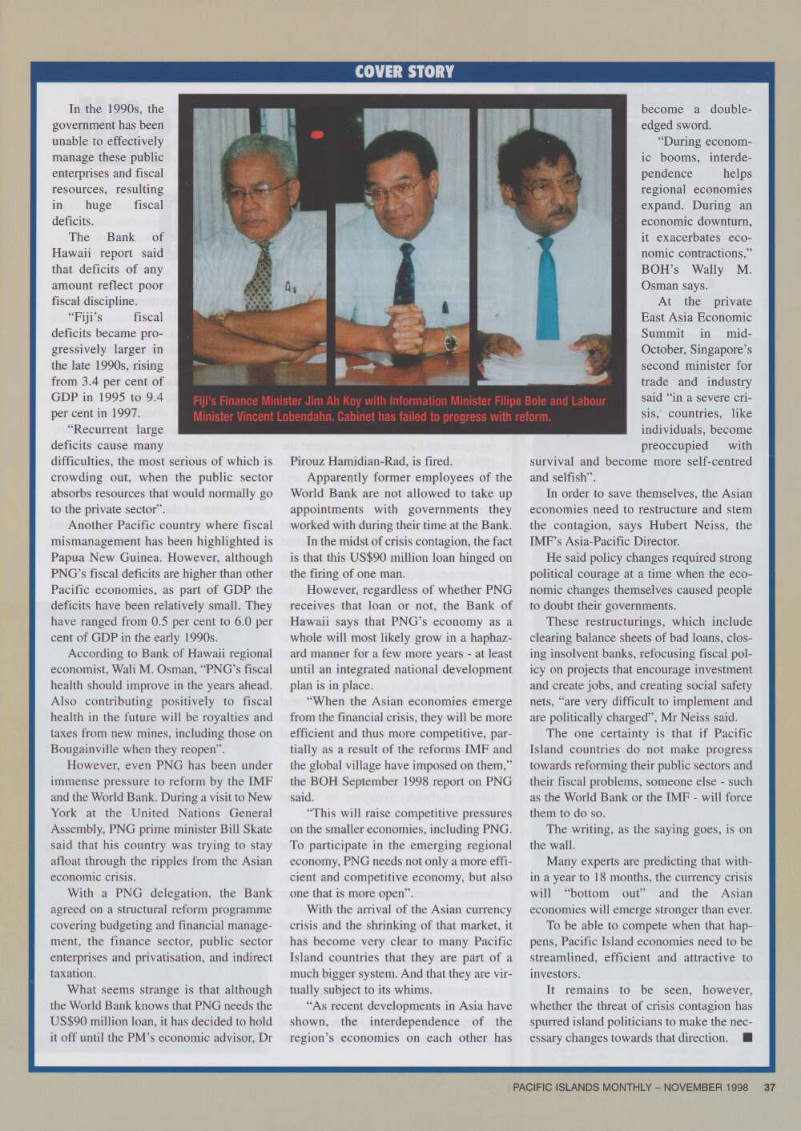
fiji's Finance Minister jim Ah Koy with Information Minister Filipe Bole and Labour Minister Vincent Lobendahn. Cabinet has failed to progress with roform.