Making airline
p. 16 · Read in the full issue
Advertising Feature - Aviation
Making airline travel even safer
ENFIANCED ground prox
imity warning systems
could reduce controlled flight into terrain (CFIT) accidents by as much as 75 per cent, a leading Boeing executive has predict ed. Mr John P Roundhill said the enhanced warning system used newly-available world-wide terrain database and accurate position information from aircraft and satellite-based systems.
This would allow pilots to “see” the path ahead, regardless of lighting or weath er conditions.
Mr Roundhill, Executive Vice President Product Strategy and Development for
Boeing Commercial Airplane Group
in Seattle, made the comments in a paper “Safety Enhancements in Aircraft Design”.
"Commercial air travel today is safe, very safe,” Mr Roundhill said. "If you were bom and lived only on an aircraft, you would have to live about 2,000 years before you were in an accident, and even then, you would have a 50 per cent chance of surviving. “The accident rate is low; flight is safe but we at Boeing are seeking ways to make it even safer.
"We want to see the world-wide acci dent rate reduced by 50 per cent by the year 2007”. Controlled flight into terrain, where a perfectly serviceable airliner crashes because the crew was unaware of high ground, remains a major accident cause.
“Since ground proximity warning systems (GPWS) were installed in virtually all commercial jets from 1974 onwards, the CFIT rate has averaged about four per year, down from 16 a year previously.
"But in spite of this great improvement, CFIT remains a prominent cause of acci dents, so we have worked for a better solu tion. Using a newly
available world-wide terrain database and accurate position informa tion from aircraft and satellite based sys tems, the new Enhanced Ground Proximity Warning System allows pilots to “see” the path ahead, regardless of lighting or weath er conditions.
"What GPWS did primarily in the verti cal dimension, the EGPWS does in three dimensional space, warning of what’s ahead. This system is now being imple mented on all new Boeing models and if also installed on in-service aircraft, may
reduce the current level of CFIT accidents by as much as 75 per cent”. Mr Roundhill said Boeing would also start delivering on new aircraft this year a predictive wind shear system to given pilots up to 70 sec onds warning of dangerous down-flowing micro bursts,.
“Safety also includes the ability to deal with an in-flight engine failure.
“When a twin-engine aircraft proves that it can handle all situations with one engine out, it can be approved for Extended-range Twin-engine Operations (ETOPS)”. This approval allows operators to travel directly over remote areas and on over-water routes, particularly important in the Pacific where all international flights are over water and often quite a distance from any airport. With regard to safe ty, Air Nauru in the Pacific has secured Australian Operating Certificate following the comple tion of heavy maintenance check J|F of its Boeing 737-400 aircraft in fe the Qantas engineering workshops.
The aircraft has resumed service I under Australian registration as VH- P RON. Air Nauru is the only service fly ing direct to the Central Pacific from Australian ports, Melbourne and Brisbane.
After twenty-seven years operating safe jet travel, Air Nauru was excited that the airline, with its new registration, could assure Australian and overseas travellers of the future safe conduct of air travel to the Centra] Pacific region. The Boeing Company is this year celebrating the 30year anniversary of the first 747 to roll out of the factory. Known as the world's first jumbo jet, the 747 is still the world’s largest commercial aircraft. With nearly 1,200 delivered, the 747 is the best selling twin-aisle jet in the industry. ■
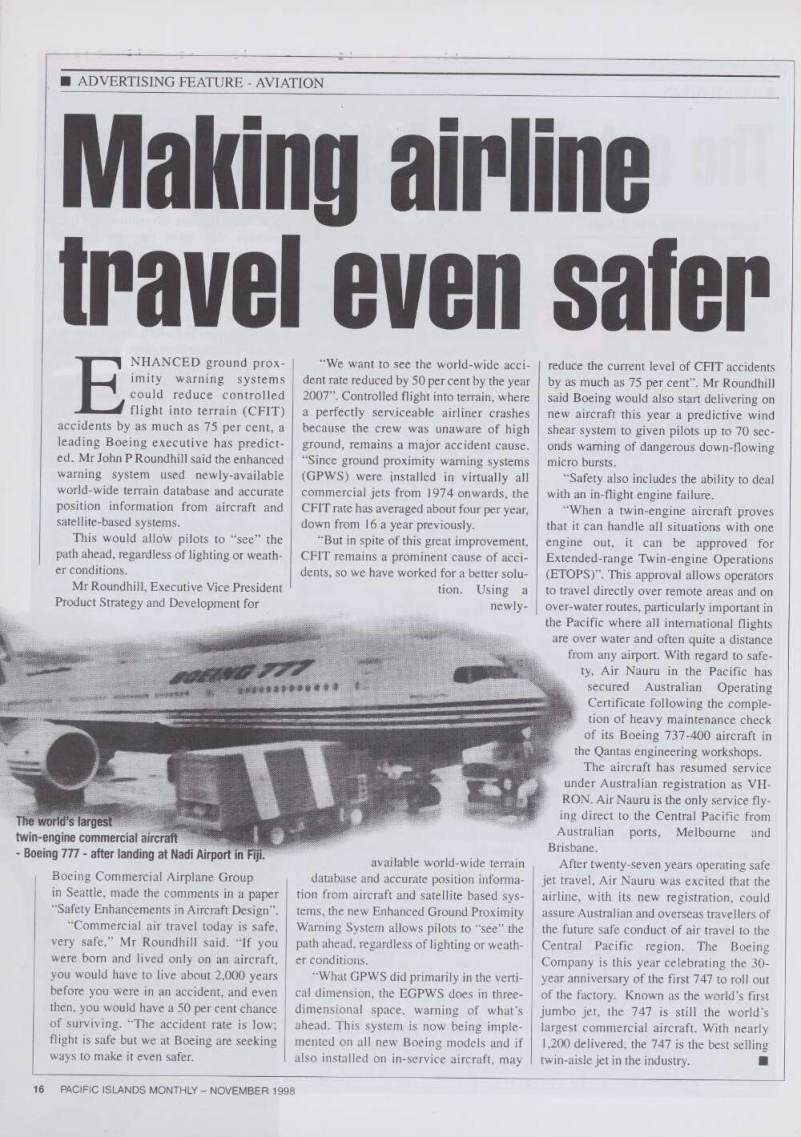
The world’s largest twm-engme commercial aircraft -Boeing 777 - after landing at Nadi Airport in Fiji.