Die out-dated Act of marriage
p. 15 · Read in the full issue
Legislation
By Florence Syme-Buchanan
A SIMPLE amendment to the Cook Islands marriage act had MP’s warning it would result in polygamy, same sex marriages and devil
worshippers getting licensed to perform
marriages in the country.
For once, every MP spoke on a Parliamentary bill - “probably because they’re all married and feel they can speak from experience,” said one listener of
September’s raging debate.
But the emotional debating and extent to which politicians went to oppose updat ing the country’s marriage act left the lis tening public wondering why so much energy was being poured into such a straightforward amendment. Those impas sioned and often ill-informed outbursts were enough to see the amendment substi tuting the words “officiating minister” with “marriage celebrant” thrown out of Parliament.
The bill was reintroduced to the House a second time by Justice minister Tiki Matapo - this time the words “officiating minister and others” were used. Again, dire warnings from the majority of MP’s that the words “others” left the act of solemnis ing a marriage too open to religious cults and immoral practices.
Many of the 25 MP’s wrongly believed that doing away with “officiating minister” meant church ministers would no longer perform marriages. They argued for eight and-a-half days over replacing those words that allowed some non- religious people to solemnise marriages after they get licensed by the Justice Department.
Minister of Justice, Tiki Matapo who introduced the amendment said he was merely trying to simplify and update the 1972 marriage act. His efforts were costly to taxpayers and mostly in vain as just one change went through - allowing Justices of the Peace to officiate at weddings.
“I really felt the MP’s who spoke against it were being hypocritical,” says minister Matapo. Matapo says at the begin ning he “saw the writing on the wall” but persisted with the amendments because he thought some MP’s might change their
mind and see the sense of the changes.
That didn’t happen and after the bill was thrown out twice - the same words “offici ating minister” still remain.
It’s understood the Justice Department contracted a private lawyer to draft the each of the three bills, as the Crown Law Office is already bogged down by other legal work. Live radio broadcast of the Parliamentary debate and other costs would have amounted to about NZ$2OOO a day. Printing the bills in English and Maori totalled almost NZ$6OO. The entire exer cise cost Cook Islands taxpayers over $20,000, an expensive price tag for a coun try limping through an economic crisis.
Asked if he thought it had been public money well spent, Tiki Matapo was can did.
“I think it wasn’t worth it.”
The Court registrars have been able to perform marriages for years in non-reli gious ceremonies. But staff cuts have meant they are often too busy to officiate at weddings after hours or on weekends when most couples prefer to exchange their vows.
Tiki Matapo said if the term marriage celebrants had been upheld, this would have allowed people of “good character who can do weddings for people who do not wish to be married in church.” He said it would have made things easier for peo ple who come to the Cook Islands espe cially to get married.
But that upset some deeply religious and conservative MP’s who said marriages are holy ceremonies and should be per formed by religious ministers in church.
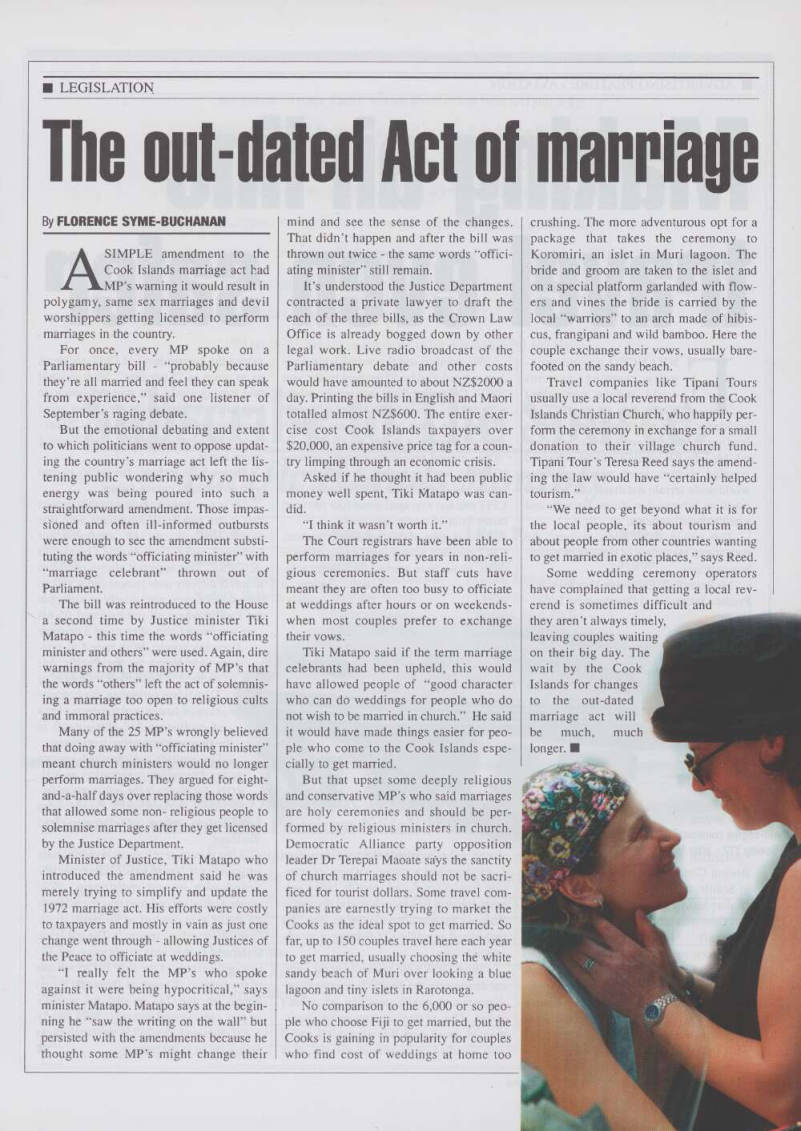
Democratic Alliance party opposition leader Dr Terepai Maoate says the sanctity of church marriages should not be sacri ficed for tourist dollars. Some travel com panies are earnestly trying to market the Cooks as the ideal spot to get married. So far, up to 150 couples travel here each year to get married, usually choosing the white sandy beach of Muri over looking a blue lagoon and tiny islets in Rarotonga.
No comparison to the 6,000 or so peo ple who choose Fiji to get married, but the Cooks is gaining in popularity for couples who find cost of weddings at home too
crushing. The more adventurous opt for a package that takes the ceremony to Koromiri, an islet in Muri lagoon. The bride and groom are taken to the islet and on a special platform garlanded with flow ers and vines the bride is carried by the local ’‘warriors” to an arch made of hibis cus, frangipani and wild bamboo. Here the couple exchange their vows, usually bare footed on the sandy beach.
Travel companies like Tipani Tours usually use a local reverend from the Cook Islands Christian Church, who happily per form the ceremony in exchange for a small donation to their village church fund.
Tipani Tour’s Teresa Reed says the amend ing the law would have “certainly helped tourism.”
“We need to get beyond what it is for the local people, its about tourism and about people from other countries wanting to get married in exotic places,” says Reed.
Some wedding ceremony operators have complained that getting a local rev erend is sometimes difficult and they aren’t always timely, leaving couples waiting on their big day. The wait by the Cook M Islands for changes ■ to the out-dated j marriage act will be much, much longer. ■ Jr