for Chamorro self-determination, home rule
pp. 32-33 · Read in the full issue
Guam marks US Centennial with new push for Chamorro self-determination, home rule
By Evelyn Rechucher
When The Uss
Charleston steamed into Guam’s Apra Harbor in the sum mer of 1898, fired on the fort, and accepted the surrender of a Spanish garrison that was unaware that war had been declared, the indigenous Chamorro people weren’t sure what to make of it.
Had they been liberated or recolonised by the Spanish-American War? Chamorros marked a century under the U.S. flag this past summer, many remain ambivalent about their relationship with Washington, some calling themselves second-class citi zens in a continuing colonial enterprise.
U.S. President Bill Clinton’s message marking the June 21 centennial did little to mollify that frustration and anger.
He touched on all of the critical mile stones, praising the loyalty and bravery of people of Guam during their World War II occupation by Japanese forces, noted that many Chamorros willingly gave up their land for U.S. military bases during the Cold War, and pledged to work with Guam to return excess military land.
“You deserve to be treated fairly and sensitively and consulted as policy is made,” he said. “We have a duty to fully consider your unique situation, your needs, and your proposal. “As you mark the cen tennial of being under the American flag, please know that the entire nation cele brates with you.” But the greeting rang hol low because several months earlier, the Clinton Administration had slammed Guam’s proposal for greater political autonomy, saying the Executive Branch could neither support the Commonwealth Bill’s key elements or even the concepts behind it. The flat out refusal was likely influenced by the fallout from Guam’s con tribution of almost a million dollars to the Clinton reelection campaign and
Democratic National Committee. That generosity embroiled Guam’s status quest in the bitter and partisan debate over illegal campaign financing, especially from Asian sources.
Though Guam’s donors have been exonerated, the accusation of “influence buying” added salt to the wound.
Chamorro leaders used centennial events to build public support for home rule and Chamorro self-determination. At rallies, fiestas, and parades, leaders of the autono my movement railed at long-simmering complaints: the islanders may not vote in U.S. presidential elections; they have no representation in the U.S. Senate and only a delegate with limited powers in the House of Representatives; they may not participate in making the federal immigra tion, tax, and labor laws that many feel constrain Guam’s development.
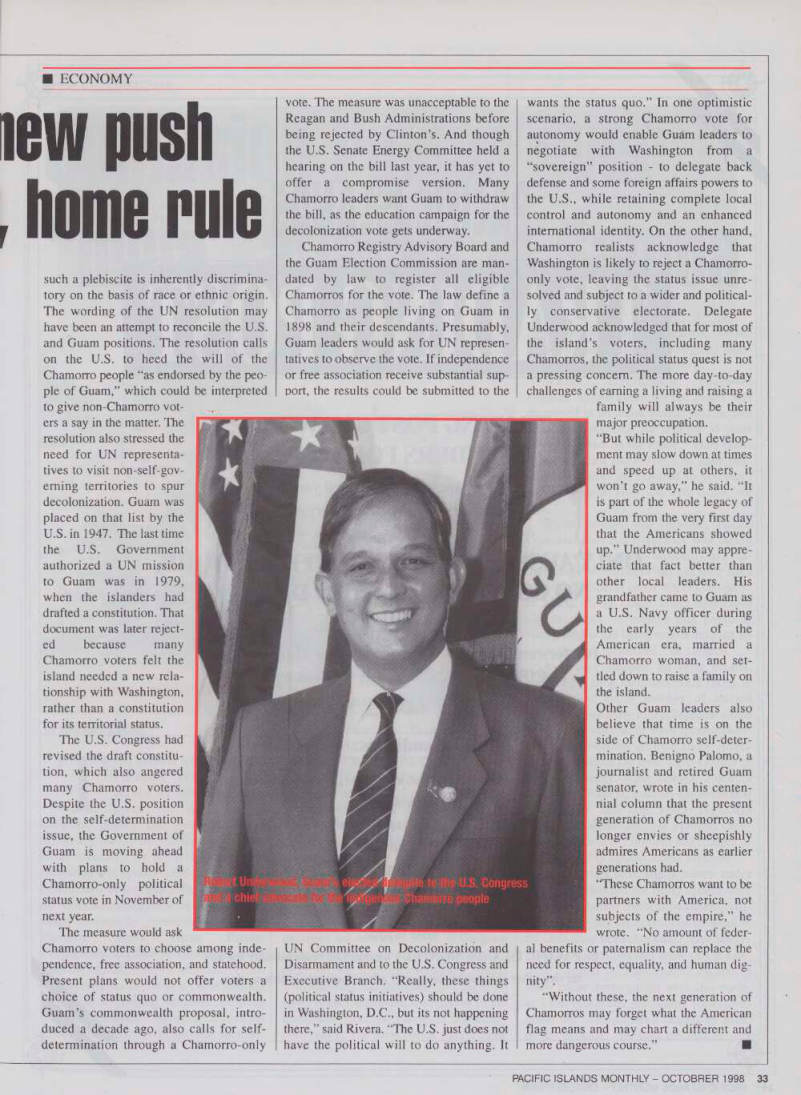
“The core American democratic creed is that the only legitimate form of Government is by the consent of the gov erned,” said Robert Underwood, Guam’s elected delegate to the U.S. Congress and a chief advocate for the indigenous Chamorro people. “How do you deal with the fact that the people of Guam are not participants in the legislative process?” asked Underwood, who can vote in com mittee but not on the House floor. “Any way you call it, we’re a colony and it’s embarrassing. Nothing is in our hands. It’s all in the United States’ hands.” While progress in Washington was negligible during this centennial summer of discon tent, Chamorro rights advocates scored a breakthrough at the United Nations, thanks to help from some of Guam’s South Pacific neighbors. In August, the UN’s Special Committee on Decolonization adopted by consensus a resolution that would direct the United States, as the Administering Power for the island, “to consider the expressed will of the Chamorro people as endorsed by the people of Guam” for a new political status.
The resolution, drafted by representa tives from Papua-New Guinea at the urg ing of Guam’s Commission on Decolonization, marks the first time a UN organisation has specifically referred to the political rights of the Chamorro people.
At the urging of U.S. representatives, all previous resolutions called for self determination by the “people of Guam.”
Residents of Guam who consider them selves ethnically Chamorro account for less than 40 percent of the total population.
A settler population of immigrants from the Philippines and the mainland United States has made Chamorros a minority on their island, which now has about 146,000 residents. This demographic situation leads 'self-determination advocates to compare Guam’s “indigenous versus settler popula tions” issue to New Caledonia’s “kanak versus French immigrants” problem.
U.S. representatives again objected to UN language that singled out the Chamorro people as the “self’ in self determination. The resolution, which also urged the U.S. Government to heed the concerns of the Guam Government regard ing the immigration issue, was forwarded to the UN Committee on Decolonization and Disarmament (the Fourth Committee) for consideration. The General Assembly may take up the resolution in December.
Chamorro rights advocates were elated by the breakthrough. “The U.S. objections don’t stand up to scrutiny,” said Ron Rivera, co-chairman of Guam’s decolo nization commission. The commission was created last year after the Clinton Administration rejected Guam’
Commonwealth Bill. “Chamorro self determination is the cornerstone of the decolonization process, and the U.S. just doesn’t support it,” Rivera said.
The U.S. argues that a Chamorro-only vote would violate the-constitutional rights of non-Chamorro U.S. citizens on Guam by disenfranchising those voters.
Washington’s official view has been that
such a plebiscite is inherently discrimina tory on the basis of race or ethnic origin.
The wording of the UN resolution may have been an attempt to reconcile the U.S. and Guam positions. The resolution calls on the U.S. to heed the will of the Chamorro people “as endorsed by the peo ple of Guam,” which could be interpreted
to give non-Chamorro vot ers a say in the matter. The resolution also stressed the need for UN representa tives to visit non-self-gov erning territories to spur decolonization. Guam was placed on that list by the U.S. in 1947. The last time the U.S. Government authorized a UN mission to Guam was in 1979, when the islanders had drafted a constitution. That document was later reject ed because many Chamorro voters felt the island needed a new rela tionship with Washington, rather than a constitution for its territorial status.
The U.S. Congress had revised the draft constitu tion, which also angered many Chamorro voters.
Despite the U.S. position
on the self-determination issue, the Government of Guam is moving ahead with plans to hold a
Chamorro-only political
status vote in November of next year.
The measure would ask
Chamorro voters to choose among inde pendence, free association, and statehood.
Present plans would not offer voters a choice of status quo or commonwealth.
Guam’s commonwealth proposal, intro duced a decade ago, also calls for self determination through a Chamorro-only
vote. The measure was unacceptable to the Reagan and Bush Administrations before being rejected by Clinton’s. And though the U.S. Senate Energy Committee held a hearing on the bill last year, it has yet to offer a compromise version. Many Chamorro leaders want Guam to withdraw the bill, as the education campaign for the decolonization vote gets underway.
Chamorro Registry Advisory Board and the Guam Election Commission are man dated by law to register all eligible Chamorros for the vote. The law define a Chamorro as people living on Guam in 1898 and their descendants. Presumably, Guam leaders would ask for UN represen tatives to observe the vote. If independence or free association receive substantial sup port, the results could be submitted to the
UN Committee on Decolonization and Disarmament and to the U.S. Congress and Executive Branch. “Really, these things (political status initiatives) should be done in Washington, D.C., but its not happening there,” said Rivera. “The U.S. just does not have the political will to do anything. It
wants the status quo.” In one optimistic scenario, a strong Chamorro vote for autonomy would enable Guam leaders to negotiate with Washington from a
“sovereign” position - to delegate back
defense and some foreign affairs powers to the U.S., while retaining complete local control and autonomy and an enhanced international identity. On the other hand, Chamorro realists acknowledge that Washington is likely to reject a Chamorro only vote, leaving the status issue unre solved and subject to a wider and political
ly conservative electorate. Delegate
Underwood acknowledged that for most of the island’s voters, including many Chamorros, the political status quest is not a pressing concern. The more day-to-day challenges of earning a living and raising a
family will always be their
major preoccupation.
“But while political develop ment may slow down at times and speed up at others, it won’t go away,” he said. “It is part of the whole legacy of Guam from the very first day that the Americans showed up.” Underwood may appre ciate that fact better than other local leaders. His grandfather came to Guam as a U.S. Navy officer during the early years of the American era, married a Chamorro woman, and set tled down to raise a family on the island.
Other Guam leaders also believe that time is on the side of Chamorro self-deter mination. Benigno Palomo, a journalist and retired Guam senator, wrote in his centen nial column that the present generation of Chamorros no longer envies or sheepishly admires Americans as earlier
generations had.
“These Chamorros want to be partners with America, not subjects of the empire,” he wrote. “No amount of feder
al benefits or paternalism can replace the need for respect, equality, and human dig
nity”.
“Without these, the next generation of Chamorros may forget what the American flag means and may chart a different and more dangerous course.” ■
Robert Underwood, Guam's elecled delegate to the U.S. Congress and a chief advocate for the indigenous Chamono people