"ninja" attacks in Samoa
pp. 35-36 · Read in the full issue
Developments
Confusion reigns over "ninja" attacks in Samoa
By Chris Peteru
THE arrests of 33 Samoan villagers styling them selves as Ninja warriors made for ugly scenes between police and gang members allegedly led by one of the most noto rious criminals on the island. The con frontation was sparked after police and an agricultural department officer were fired on while inspecting cattle on a 10,000 acre estate - owned by government under the Western Samoa Trusts Estates Corporation. Located 30 kilometres away from the capital, Apia, the Mulifanua estate has become the centre of a cattle rustling ring, and a thriving cannabis growing industry although a major drug haul has yet to be uncovered. The estate, that includes
Faleolo International Airport, has long been a source of contention between the government and several villages that say the land is rightfully theirs. It is an issue successive administrations have ignored.
Sources say police were first tipped off when a government MP noticed cattle with
government markings being brought to his
abattoir for sale. On inspection at Mulifanua, scores of rotting carcasses were found. A stock count revealed that from a herd of a thousand, just 300 remained.
Following the initial shooting, police
inquiries led to six members of the gang being arrested. But instead of serving as a deterrent, the fighting intensified. Armed with machetes and shotguns, the gang from five villages disguised themselves in ski masks then launched a series of skirmishes with police. The local police station came
under fire on numerous occasions. As the arrests mounted, the gang allegedly made threats to close down the airport.
WSTEC co-ordinator Fuagalive Fugatia, whose home on the estate was destroyed in an arson attack, said he had never seen anything like it in the 35 years he had worked on the estate. “They come with their guns and knives... to scare peo ple. Their faces are covered so you can’t recognise them. They just want cattle,” he said.
While no-one was injured, Police Commissioner Asi Blakelock was taking no risks with his men - especially in a dis trict where two officers had lost their lives in earlier incidents and a WSTEC employ ee killed, on the estate, under suspicious circumstances. “I believe this group of young people are being master-minded by someone very influential,” he claimed.
As police stepped up their efforts, another 25 gang members were taken in and charged on a number of related offences. Appearing in the Supreme Court days later, a number of them sported lacer ations and swelling on their faces. Angry relatives alleged the men were victims of
police brutality. Apia lawyer Toleafoa
Solomona Toialoa, counsel for suspected ring leader and cop killer Tagaloasa Filipaina Faasauvale, has claimed inhu mane treatment of his client and charges of police brutality against others involved.
“These men have rights which under the constitution are not being upheld, they have been denied medical treatment, visi tation rights and the conditions of some of the cells have been shocking,” says lawyer Toailoa. Allegations that some of the gang
were tortured by police using cigarettes
while under interrogation were also made, he said. A woman also came forward to claim her son had been beaten by three police officers. “He told me that he was
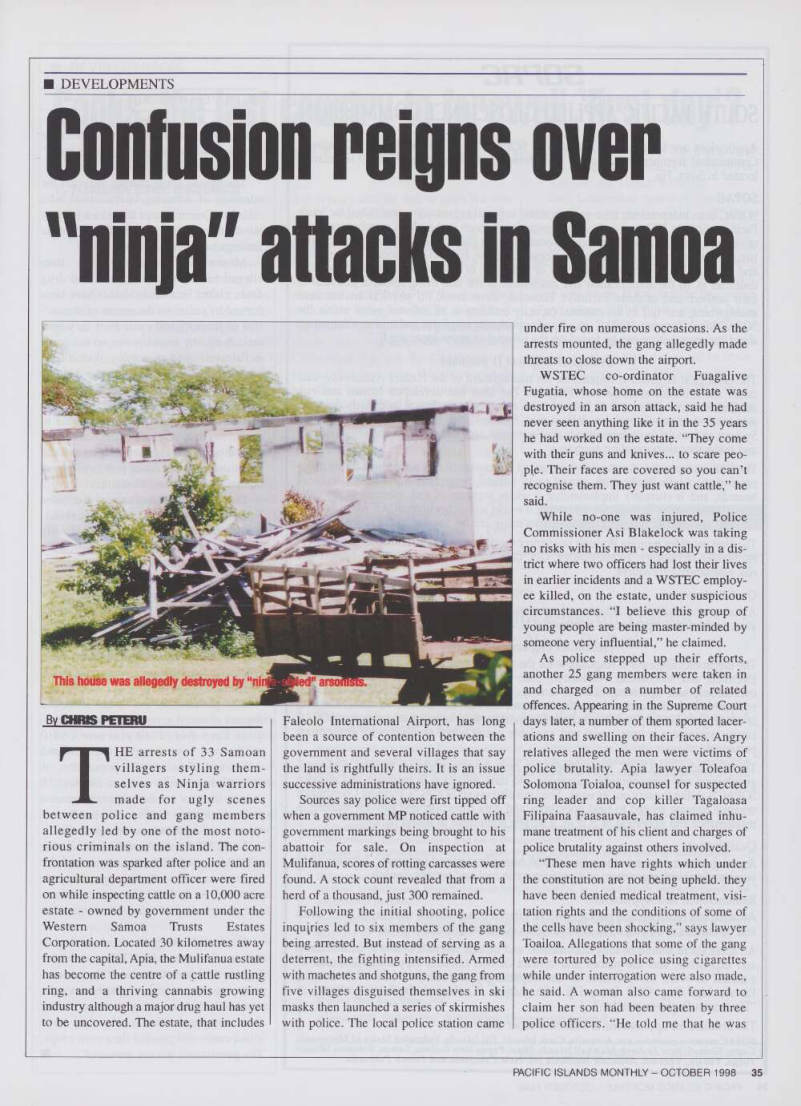
This house was allegedly destroyed by "ninja-styled" arsonists.
held down by two officers while another administered the rock beating to his knee,”
Mrs Faaiiliuli Enoka claimed.
The human abuse charges attracted the attention of Amnesty International who called on Commissioner Blakelock to carry out an investigation. This was done but the findings have yet to be made public.
Meanwhile, Faasauvale, the man alleged to be behind the cattle and drug deals, claims he and his brother have been framed by police on the counts of destruc tion of property and cattle theft they now face. A raid by armed police on his home in Faleatiu turned up nothing. With a fear some reputation, the recently paroled 37year-old father of six said he had put his lengthy criminal past to rest and turned the corner. His change of heart has failed to spread to other members of the Faasaulave clan, in particular his sister Magamoa Satui who threatened any future police raids may be met with force and bloodshed.
Deputy Police Commissioner Kerisome Fetalaiga says police officers in life-threat ening situations are a growing fact of life in Samoa. “Why do people complain when we try and maintain law and order. We were shot at, we did not open fire on any one. The raids were carried out to look for stolen property and weapons in an area with a certain reputation. End of story,” he said. The Criminal Investigation Division remains adamant that substantial cannabis crop exists on the huge estate and is deter mined to uncover it.
The government’s concern over the amount of social unrest is now quietly tan gible. Since July of last year over US$lO million has been pumped into law and order, and although the population of 167,000 has barely risen, in the last 18 months the total number of police firearms and vehicles has trebled. The number of recruits and salaries have also gone up.
Local MP for the Aana Alofi No. 3 dis trict, Afamasaga Toleafoa, dismissed the incident as a one-off. “It’s not a dispute over land. As far as we can make out these are young men just acting like ninjas,” he said.
But, overlooking the remains of what was once his home, WSTEC co-ordinator Fugatia believes otherwise. “The govern ment has been slow to respond to the demands of these villagers in providing them with land. This is why they have killed cattle and planted their own crops.
The government has not answered”. ■