Cook's economy
pp. 30-31 · Read in the full issue
Economy
Cook's economy idle and another "unsustainable" budget
By Florence Syme-Buchanan
THE Cook Islands economy remains motion less while the private sector’s agonises over government, again, failing to put more money into growth prospects.
Two years ago government pointed to the commerce sector saying it would drive the engine of economic growth. Now the much-hoped-for economic growth has stalled.
Prime minister Sir Geoffrey Henry has admitted the econom ic reforms are not producing the growth levels the country so desperately needs to get the economy up and running.
And government appears at a loss to explain why - Sir Geoffrey is now saying they need to thoroughly analyse “all fac tors that contribute to economic growth and why it’s not hap pening.”
The private sector has told government the economy is not growing because not enough money has been put into tourism, marine resources and agriculture. There are no other growth prospects at present.
Chamber of Commerce president Brett Porter, says the zero growth announced in the budget statement was unacceptable to the private sector.
He says government should be investing more money into the three areas that could ensure returns to the country.
Porter says although the government expects economic growth to be private sector-led, it is not increasing funds to the sectors that can help the economy.
This is despite the National Development Council asking for more money to be allocated to tourism, marine resources and agriculture, says Porter, a member of the budget advisory body.
“The response was they passed a budget that didn’t recognise the concerns of the NDC. They’ve passed a budget that’s unsus tainable, and we know that it’s unsustainable because they are already preparing for a supplementary budget before the end of the calendar year”.
Porter says even the then acting financial secretary Tupu Araiti expressed concern about the unsustainability of the bud
get to the NDC, conveying those concerns to government. Porter, an outspoken busi nessman in his forties, says while the prime minister understands what’s needed and what’s at stake, “At Cabinet level there is a lack of understanding of the bigger
economic picture”. This year’s budget is
NZ542.5 million and government hopes to back it up with NZ$44 million in revenues that financial advisers have forecast.
However, business people, the National Development Council and House of Ariki
have written off those fore casts as irresponsible and
over-optimistic.
Last year the government expected NZ$46 million in revenues to pay for a NZ$44 million budget - that didn’t happen and the budget col lapsed.
Minister of Finance Papamama Pokino denied a supplementary budget was being prepared. However on the same day in a separate interview, Health Minister Tupou Faireka said he was “optimistic” there would a supplementary budget out by November or December.
But Minister Pokino says the budget figures are based on actual revenues and “we haven’t fabricated it”.
He said he didn’t care if the government didn’t sell any state assets this financial year because expected rev enue from sales were not included in the budget.
But within his own bud get is a NZ$3 million contri bution from the Cook Islands Investment Corporation, which handles the sale of assets. The result
has been static economic growth. Brett Porter says if government continues on the same tack, “The whole reform programme slows down, it doesn’t collapse... but the reform programme is the only option”.
Economist Vaine Wichman says gov ernment economic advisors had predicted a period of no-growth if all sectors in the economy did not commit themselves to action.
“Action meaning getting out there and
putting money, time and hard work into activities that will make a return.”
But the government resistance, to invest money needed to develop growth sectors, has not helped. She says simple economics suggests the solutions include asset sales or privatisation deals, and more invest ment, whether it be local or foreign.
“Clearly we know now that we need foreign investment, many of our local investors have exhausted their reserves and stretched their limits with their ‘friendly
bank’. Foreign investment brings with it exposure to global markets and means local businesses having to restructure themselves in terms of having to compete
both locally and internationally”.
Wichman says government needs to continue to remove itself from services areas that can be contracted out.
Government continues to hang on to services that the National Development Council has often recommended it priva
tisp. Amongst others, these include proto col and quarantine services.
“But really there is no substitute for people getting out on the land or the lagoon or into the tourist industry and just doing an honest day’s work. In fact this is already happening, but there is a need for individ uals and communities to stop kidding themselves that the economic reform is over and we can go back to the ‘good old days’. There will not be any more ‘good old days’ where government supplied and
we enjoyed.”
The economist believes this period is the lull in the pro cess of trying to get things to grow.
She says there’s nothing bril liant about the fix-it advice the economic advisers are dishing out, it is the simple principles of a good house hold.
“These are the household resources and this is how we are going to use them in order to achieve this and this and this. I find sometimes howev er in our society, that the past ways of spending and receiv ing things for free have dis torted some household eco nomic choices.”
Some people still live beyond their means or believe it is more important to enjoy money now rather than satis fying basic and future needs.
That kind of distortion in pri orities also needs to be reformed, says Wichman.
“The best thing is for every one to revisit their lifestyles and ask how much am I wast ing and how much am I real ly contributing to my house hold, and hence to my nation
and the solid future of my children. That’s my opinion at the broad level”.
But in the immediate to medium term, Wichman advises government to “stay on track with the growth sectors being empha sised”.
“Government also needs to revisit its lifestyle in terms of what’s needed and what’s not, their clients will tell them which services they must have and which they can live without.” ■
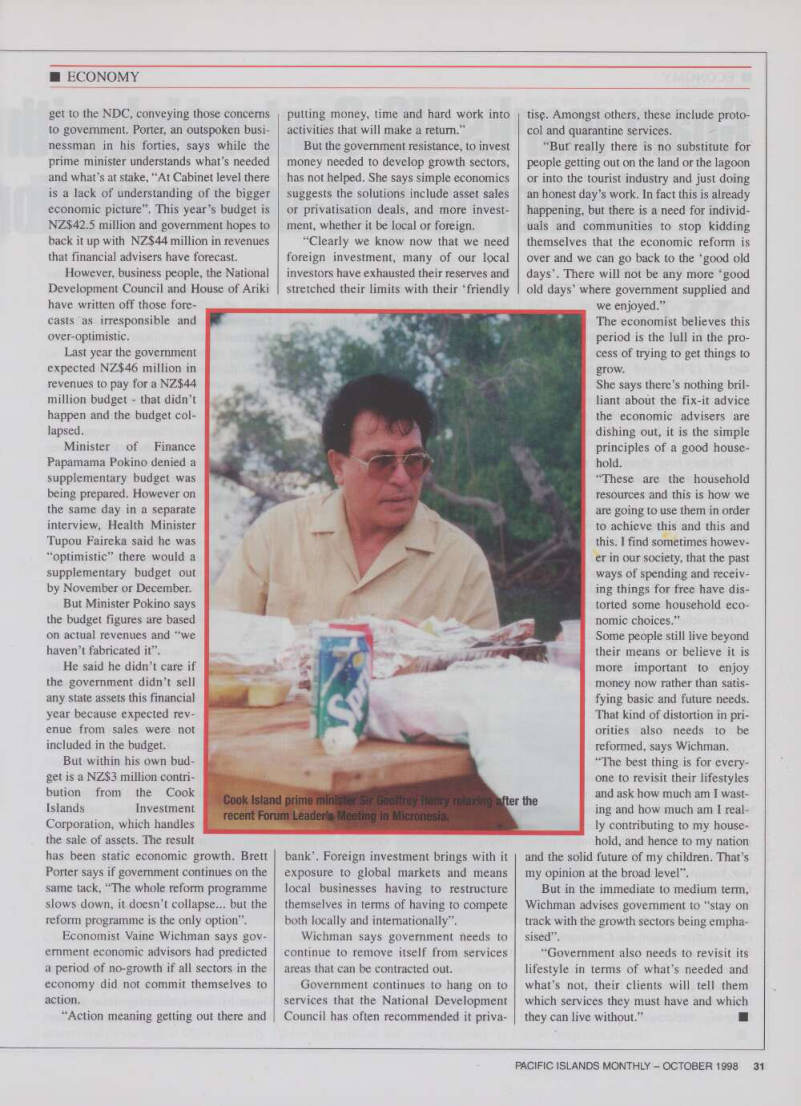
Cook Island prime minister Sir Geoffrey Henry relaxing after the recent Forum Leader's Meeting in Micronesia.