within
pp. 38-40 · Read in the full issue
The enemy within
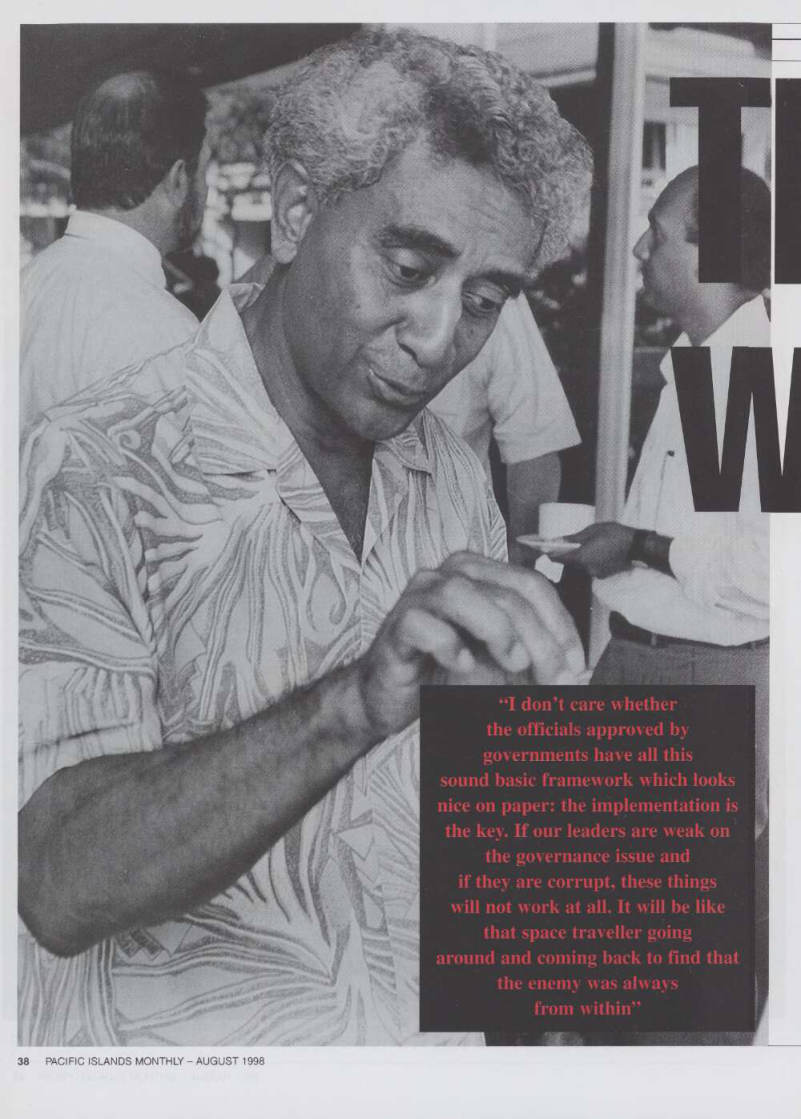
“I don’t care whether the officials approved by governments have all this sound basic framework which looks nice on paper: the implementation is the key. If our leaders are weak on the governance issue and if they are corrupt, these things will not work at all. It will be like that space traveller going around and coming back to find that the enemy was always from within"
Governance
By Sophie Foster Hildebrand
FISCAL mismanagement by officials and lax
implementation of crucial policies on the part of politicians will send the Pacific spiralling into social devastation.
This warning came from the head of the Pacific Operations Centre of the Economic and Social Commission for Asia and the Pacific (ESCAP), Mr Savenaca Siwatibau, in an exclusive interview with PIM. He warned Pacific nations have to wake from their aid induced slumber and discover the political will to make crucial eco
nomic decisions. “It’s quite sad actually. If you look over the last 20 years, in terms of economic performance, it’s been very poor - slow growth and in some of our countries, particularly in Micronesia and Melanesia, high population growth.
So if you look at the income per head, it’s quite static. In some countries it is actu
ally falling.”
He said no country in the Pacific was exempt from the greatest problem facing the region - budget deficits spiralling out of control. Fiji’s problem with the virtual col lapse of the National Bank of Fiji (NBF) showed there was no discipline in control ling these things, he said, and the problem was quite common in the region.
“Large budget deficits eating away the liquidity of the entire country - the banking system. So the private sector is
starved of funds.
They cannot have credit to expand so the process of develop ment and job creation has to come to
a halt. So we have to exercise a lot of dis cipline starting with the fiscal front,” he cautioned. A former governor of the Reserve Bank of Fiji, Mr Siwatibau says he can speak “with some experience” on these matters. He has also been with the interna tional Monetary Fund in Asia.
He says it is worrying that balance of payments problems, coming directly from budget deficits, are making foreign reserves unsustainable.
“Following the Asian crisis, they are running out of foreign reserves, so they cannot move now.
They have to cut back on government expenditure, they have to look at new tax revenues - all politically very unpopular and very difficult,” he said.
Mr Siwatibau hit out at the priorities of Pacific leaders saying “they have to put their resources where their mouth is”.
He warned, “they have to be disciplined about policy-making and about managing and allocating our resources. In this chang ing world of globalisation, if we cannot come to grips with all these problems, I see
things getting worse”.
The rules of the game, Mr Siwatibau says, have changed, and the Pacific needs to change with it.
"Following WTO and the levelling of the playing field, all the advantages that we enjoy under various trading arrangements, such as SPARTECA, are now being steadi ly eroded,” he said.
Using developments in the future of the Lome Convention as an example, Mr Siwatibau says ACP countries, including Fiji, should have been aware of what was happening. He said they are completely aware now that the reality is erosion of advantages under Lome over the next decade.
He said Fiji should already be thinking of what will happen to the sugar cane farm ers and if there are alternative crops that the country should now be talking about.
Fiji should also be thinking of what the prospects are in terms of markets and what kind of investments the country will have to undertake. “If not, then you can imagine what’s going to happen to the economy.
With sugar declining in terms of impor tance over the next ten years, we have to
“they have to put their resources where their mouth is”
substitute for that. We have an expanding population and we have to find economic activities to absorb them. If not, the situa tion will continue to worsen.”
Despite all these seemingly negative comments regarding the current economic status of the region, Mr Siwatibau is opti mistic about the future of the Pacific.
However, he says that political will to implement necessary policies will be cru cial. “First of all, we have to accept that we must grow. We must invest therefore what are the potential areas for investment.
“For most of our countries, tourism has a lot of prospects. We have natural resources. We have very good fishing grounds, particularly in Melanesia and Micronesia.
There is a lot of potential for develop ment but a lot of these developments have to be undertaken by the private sector.” Mr Siwatibau says it is the responsibility of governments to create the framework to encourage the private sector to thrive. He says the answers to these problems are “quite clear” to Pacific leaders already.
Sectors which could lead to a Pacific economic revival include forestry, process ing, manufacturing, mineral resources under the sea and an educated workforce.
He says in the age of technology, a high ly skilled labour force could hold some answers. “In this age of globalisation, con tracts are farmed out all over the world pro vided the atmosphere is right and you have
a skilled labour force”. Mr Siwatibau says governments have to do the thinking, along with the private sector, and learn from what other countries, such as Singapore, have done.
He stressed that island countries need to develop trading arrangements among themselves in order to grow.
The Melanesian Spearhead Group is quite advanced in this respect, however he says one model for the future would be for them to invite Micronesian and Polynesian countries to come into the trade grouping.
“In this globalised world, it gives them a degree of independence.
Collectively they are seen as a market whereas individually, we are small, includ ing Papua New Guinea. But if we are seen as a market, as a group, we could codec -
tively attract more investment from outside into our area. So in terms of bargaining capacity, it really enhances all these things”.
Mr Siwatibau says Pacific coun
tries should work out trading arrangements between themselves before inviting Australia and New Zealand to participate.
He was critical of sceptics of inter
island trading.
‘‘People are saying now ‘oh we are pro ducing the same things, how can we trade?’
But that is a very static way of thinking.
There are various things that we can do for ourselves using our imagination. I think if you look at it in a dynamic sense, look ing forward there are prospects for us to produce things and trade amongst our selves.
Not in the agriculture area - we are talk ing in the manufacturing, high technology area, processed goods”.
Mr Siwatibau says Pacific countries should try such trading arrangements on their own to improve their bargaining capacity in the international forum and with investors.
However, he says if overall action on the economic front is not taken immediate ly, it will all come to nought and the Pacific will be in a serious downspin for decades.
“We must wake up now and do the right things for ourselves and have the political will to act on them.
We should have started yesterday”.
He warned that the Pacific nations have no option but to implement their own solu tions to a self-inflicted problem. Only then, he says, will the enemy within be reformed, if not eradicated. ■