MPs vote for VAT
p. 36 · Read in the full issue
Politics
THE Vanuatu parliament has passed the Value Added Tax Act which brings the new system into force on August 1.
The Act imposes a flat 12.5 per cent VAT levy on all goods and services, thus replacing the import duty system, which provided more than half of the Government’s budget revenue.
Vanuatu’s chamber of commerce and industry (CCI) had earlier petitioned finance minister Sela Molisa, asking him to delay the introduction of the VAT and introduce the rate in progressive steps.
But Molisa told parliament the VAT, which is part of a comprehensive reform programme coordinated by the Asian Development Bank, could not be delayed.
He said the budget for this year, which was finally passed during the parliament’s first ordinary session, included the VAT
projections with the 12.5 per cent rate.
The VAT was also a preliminary condi tion to the 20 million US dollar soft loan agreement signed earlier this year by Vanuatu with the Manila-based ADB.
CCI president Joseph Jacobe said the VAT was far from timely, as a financial and currency crisis, followed by an increase of 5 percent in banking lending rates, had brought many businesses to their knees.
“The current economic climate is extremely volatile”, he said.
In the petition handed to Molisa, he cited the high interest rates, the setback in the tourism industry caused by the recent riots and "uncertainty in the country’s financial stability”.
"Banks are currently not giving any loans and businesses these days are only trying to survive, let alone making profits”, he said. "The expected rise in the inflation rate (caused by VAT) will put a lot of small
businesses out of trade and (...) cheap imports flooding Vanuatu will cause big problems for manufacturers already strug gling and on whom employment of nation als is dependent”, Jacobe added.
He earlier threatened an “organised nationwide strike” if the Government does not recognise the private sector’s concerns.
"Prices should not increase for basic consumer goods, such as rice and bread”, Molisa said.
The producer and distributor of water and electricity in Port Vila and Luganville (Santo), Unelco company, announced last month it could only minimise the increase to some 5 per cent on the average con sumer’s bill. The Government has appoint ed a committee to try and negotiate a status quo on the prices of these essential ser vices.
For telephone users, Telecom Vanuatu announced a 2 per cent increase for those consumers who cannot claim the VAT back.
Molisa told parliament that once the VAT was implemented on August 1, the money then available from the loan would help alleviate the acute financial and mon etary problems this island state hjas faced since earlier this year.
The situation was caused by a spell of instability in Vanuatu over the past two years and a riot in the capital on January 12 by angry contributors to the National Provident Fund which forced the Government to pay back the workers’ com pulsory retirement contributions.
But the influx of cash in the economy and a sudden upsurge of purchases of mainly imported goods also caused signif icant pressure on the national currency, the vatu.
Last May, the Reserve Bank, in order to protect the vatu, increased its official lend ing rates, causing an average loan coast to shoot from 12 to 17 per cent.
The lending rates increase was the only alternative to a devaluation of the vatu. But the devaluation was ruled out by prime minister Donald Kalpokas’s Government when it came to power on March 30. ■
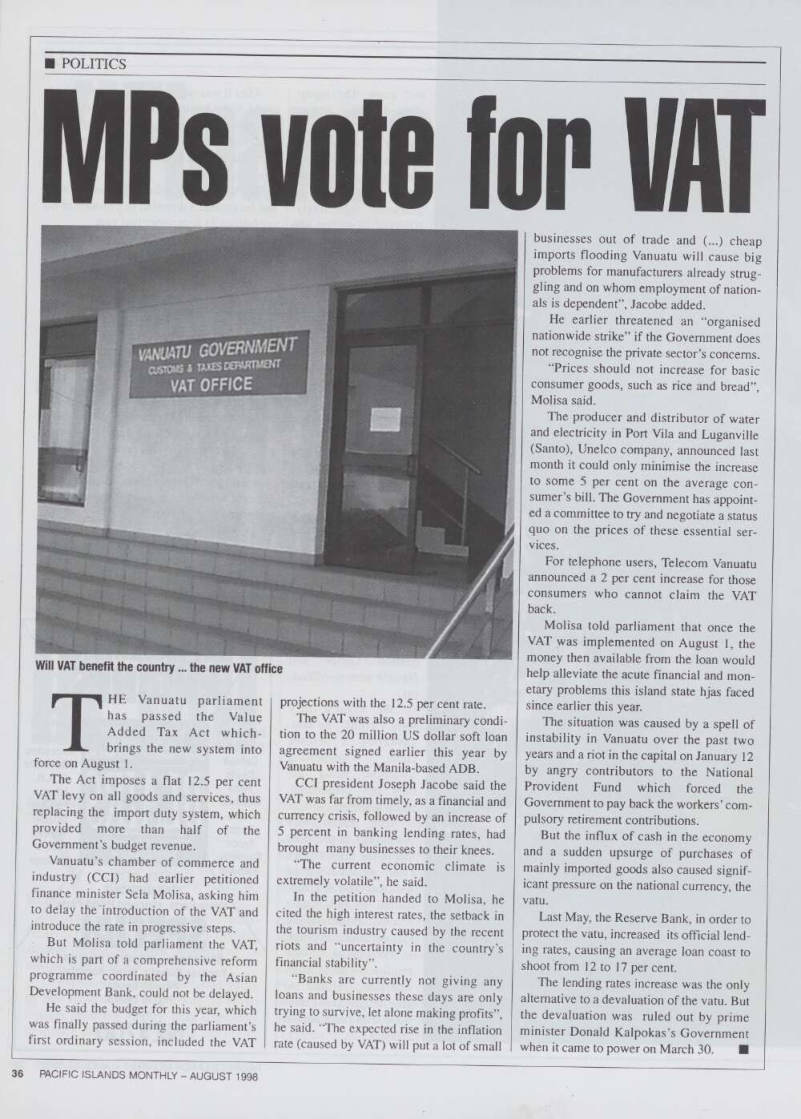
Will VAT benefit the country...the new VAT office