Thousands die in
pp. 12-13 · Read in the full issue
Tragedy
Thousands die in tidal wave terror
WHEN villagers around the Sissano lagoon in Papua New Guinea’s West Sepik province on the night on July 17, life seemed normal. They could hear the sea lapping gently against the sand as it has done for generations. But, a few hours after dark they heard a new sound.
As one local businessman put it: “I woke up and thought ‘what the Hell’s that?' It was a noise louder than thunder over head and it heralded death for up to 2000 people, many of them children.
It was the worst tidal wave the South- West Pacific has seen since records began and it erased practically all traces of four villages in the region near Aitape on the West Sepik coastline.
Damage extended to 2 km inland.
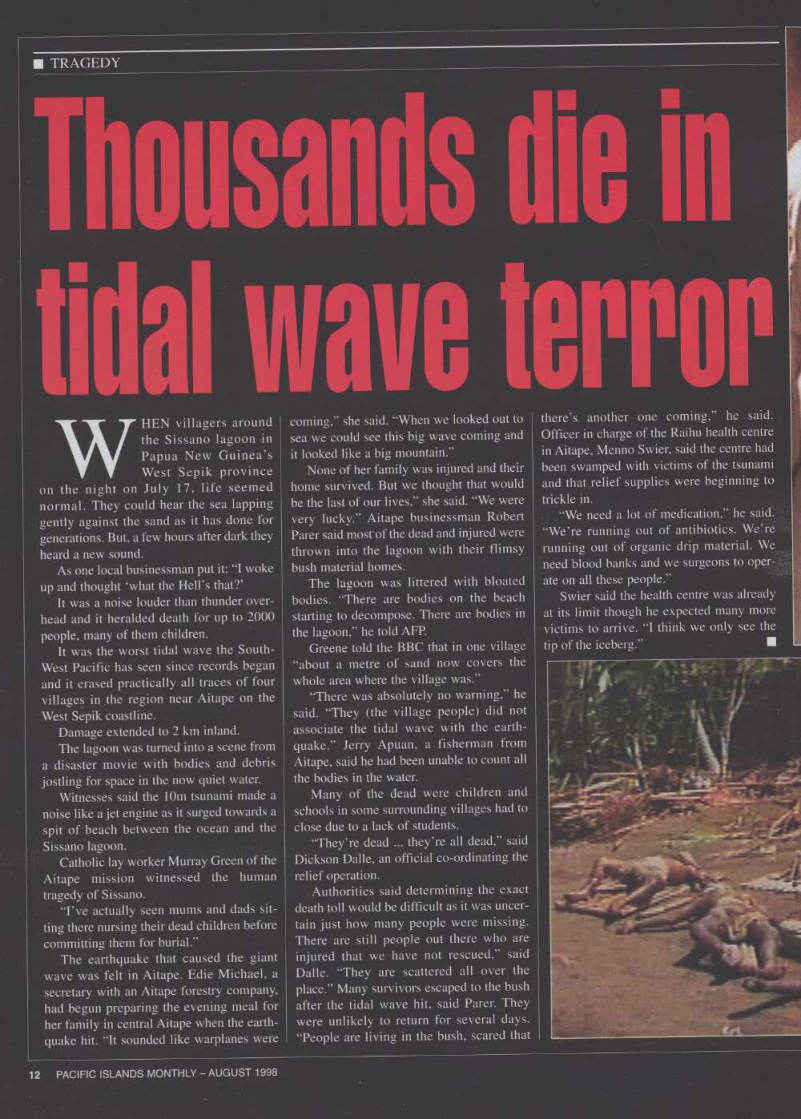
The lagoon was turned into a scene from a disaster movie with bodies and debris jostling for space in the now quiet water.
Witnesses said the 10m tsunami made a noise like a jet engine as it surged towards a spit of beach between the ocean and the Sissano lagoon.
Catholic lay worker Murray Green of the Aitape mission witnessed the human tragedy of Sissano.
“I’ve actually seen mums and dads sit ting there nursing their dead children before committing them for burial.”
The earthquake that caused the giant wave was felt in Aitape. Edie Michael, a secretary with an Aitape forestry company, had begun preparing the evening meal for her family in central Aitape when the earth quake hit. “It sounded like warplanes were
coming,” she said. “When we looked out to sea we could see this big wave coming and it looked like a big mountain.”
None of her family was injured and their home survived. But we thought that would be the last of our lives,” she said. “We were very lucky.” Aitape businessman Robert Parer said most of the dead and injured were thrown into the lagoon with their flimsy bush material homes.
The lagoon was littered with bloated bodies. “There are bodies on the beach starting to decompose. There are bodies in the lagoon.” he told AFP.
Greene told the BBC that in one village “about a metre of sand now covers the whole area where the village was.”
“There was absolutely no warning,” he said. “They (the village people) did not associate the tidal wave with the earth quake.” Jerry Apuan, a fisherman from Aitape, said he had been unable to count all the bodies in the water.
Many of the dead were children and schools in some surrounding villages had to close due to a lack of students.
“They’re dead ... they’re all dead, said Dickson Dalle, an official co-ordinating the
relief operation.
Authorities said determining the exact death toll would be difficult as it was uncer tain just how many people were missing.
There are still people out there who are injured that we have not rescued,” said Dalle. “They are scattered all over the place.” Many survivors escaped to the bush after the tidal wave hit, said Parer. They were unlikely to return for several days.
I “People are living in the bush, scared that
there’s another one coming,” he said.
Officer in charge of the Raihu health centre in Aitape, Menno Swier, said the centre had been swamped with victims of the tsunami and that relief supplies were beginning to trickle in.
“We need a lot of medication,” he said.
“We’re running out of antibiotics. We’re running out of organic drip material. We need blood banks and we surgeons to oper ate on all these people.”
Swier said the health centre was already at its limit though he expected many more victims to arrive. “I think we only see the tip of the iceberg.” •
A grieving villager amid the ruins of his home