Villagers make a buck by
p. 10 · Read in the full issue
Business
Villagers make a buck by watching the trees grow
By Chris Peteru
FROM his simple home on the edge of the remote Falealupo rainforest, cus todian Seulaaia Fafaialii looks across the 30,000-acre preserve with satisfaction, at how the forest was saved and became his village's main revenue earner.
"This has been a blessing for our peo ple” he says simply.
Located at the westernmost point of Savaii island, a 20-minute plane trip from the capital, Apia, Falealupo "where the sun sets” is steeped in Samoan folklore.
"Up to 30 different species of plant and bird life, many not found in other parts of Samoa can be found here.” says Fafaialii "We could easily have lost it ail". "People visiting from Brazil have said we are lucky
to keep our forests intact. Over there its all been turned into houses.”
With over 80 per cent of the islands lowland forest hacked away in a flurry of logging dur ing the last 15 years, Falealupo’s preserve, that stretches 7 kilome tres inland to the sea was set up to go under the miller’s blade as we 11...
Few would have noticed. In the early 90s scores of families living on the coastline were forced to leave, following mas sive damage from two cyclones.
Ten years ago the Government asked the village to build and pay US$2l,OOO (W 5565,000) for a primary school, or face life with no teaching staff. Because paid employment is almost non exis tent and cash flow problems the norm, the village council was resigned to logging a large chunk of the forest to pay for the school. Always keen to help, a local logging company showed
up soon afterwards and offered the exact amount that was needed. Before that an American outfit had already milled the forests of the four surrounding villages.
"We were the only village that had not sold our timber to logging companies.” said chief Aeau Taulapo’o, now a judge in the lands and titles court.
"I advised we should not use the timber in this way because we need it to build our houses. The logging company would take all the good timber and just leave timber that could not be used to build houses.’
In the end, though, the decision to log was reluctantly made. But by chance a vis iting American botanist Professor Paul Cox, who was in Falealupo studying forest ecology offered to secure funding for the school if the council agreed not to turn its forest into a lumber yard. Back in the United States Cox gathered support from
his students at Brigham Young University and several businessmen. Within six weeks the funds had been raised, and a 50-year covenant to protect the forest signed. ‘‘Many didn't understand the meaning of the covenant, and thought the land was going to be taken away from them, so it took time to explain that the land was still ours we just had to be more prudent about the way we used it,” says Taulapo’o.
Twelve months ago Cox and a chief of the village were awarded one of several U 5575,000 prizes from the Goldman Environmental Foundation for “combining their efforts to stop logging in a lowland rainforest, establishing a preserve and building a new school for the village.”
Cox has since written a book describing the events and the medicinal and commer cial potential of local plants.
He also set up financially beneficial arrangements for the Government and Falealupo should tests on Samoan plants be approved and marketed by overseas institutes.
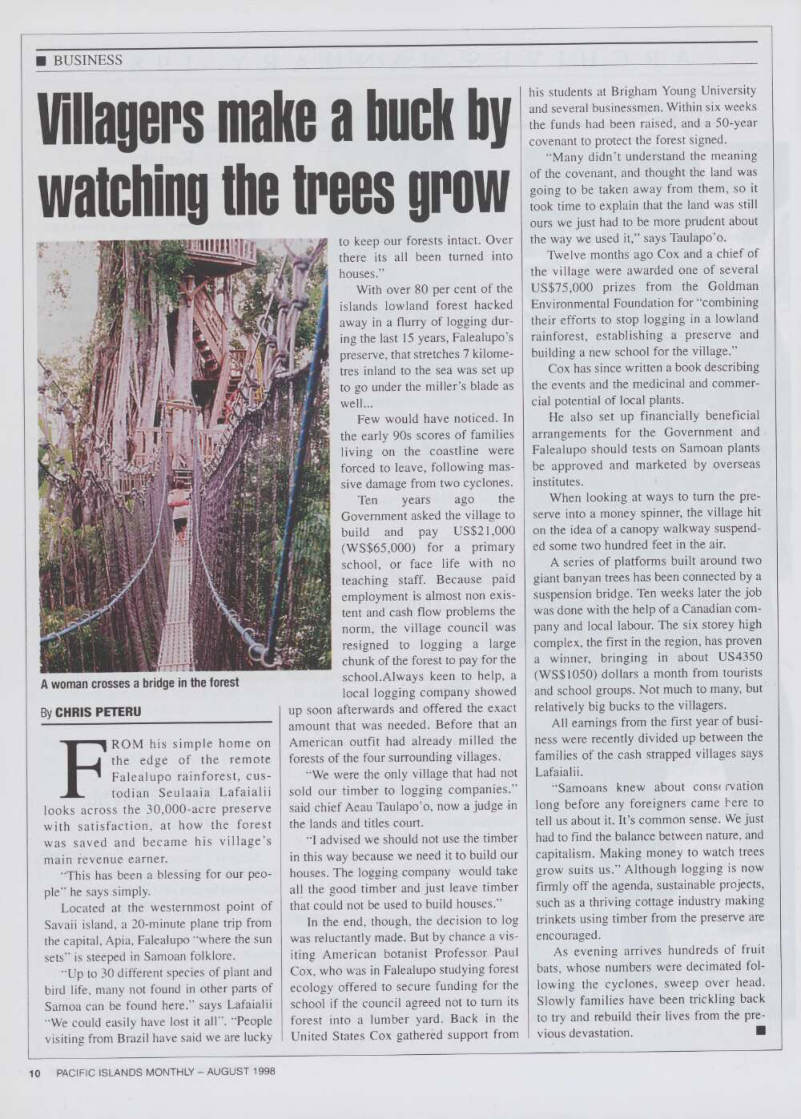
When looking at ways to turn the pre serve into a money spinner, the village hit on the idea of a canopy walkway suspend ed some two hundred feet in the air.
A series of platforms built around two giant banyan trees has been connected by a suspension bridge. Ten weeks later the job was done with the help of a Canadian com pany and local labour. The six storey high complex, the first in the region, has proven a winner, bringing in about U 54350 (WS$lO5O) dollars a month from tourists and school groups. Not much to many, but relatively big bucks to the villagers.
All earnings from the first year of busi ness were recently divided up between the families of the cash strapped villages says Fafaialii.
“Samoans knew about conss rvation long before any foreigners came here to tell us about it. It’s common sense. We just had to find the balance between nature, and capitalism. Making money to watch trees grow suits us.” Although logging is now firmly off the agenda, sustainable projects, such as a thriving cottage industry making trinkets using timber from the preserve are encouraged.
As evening arrives hundreds of fruit bats, whose numbers were decimated fol lowing the cyclones, sweep over head.
Slowly families have been trickling back to try and rebuild their lives from the pre vious devastation. B
A woman crosses a bridge in the forest