Indigenous rights or Indonesia's rights?
pp. 44-45 · Read in the full issue
Politics
By Sam Vulum
WHILE the recent political events in Indonesia saw the downfall of Asia’s longest serving political head President Suharto, it also provided an opportunity for the country’s sepa ratist elements in East Timor and Irian Jaya (West Papua) to boost their inde
pendence struggle.
They wasted no time in driving home their agendas in every possible avenue available to them. While the East Timorese struggle appears to be winning internation al sympathy and support - resulting from publicity mainly in the Australian media for the West Papuans, it is a “lonely bat tle”. It is an old struggle for independence with 35 years under Indonesian rule and its “secret war” causing much suffering, sacri fice of lives, and displacing many West Papuans from their homeland, according to the chairman of the Organisasi Papua Merdeka Revolutionary Council (OPMRC) Moses Werror.
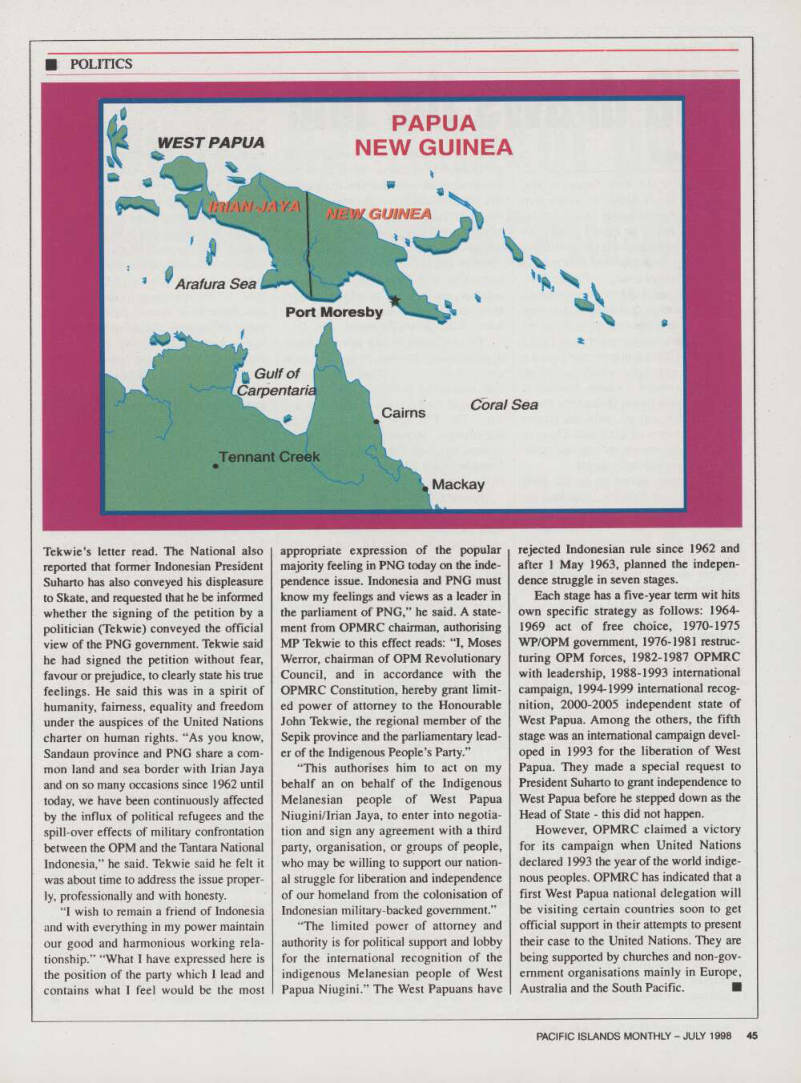
They have been fighting since 1962 after Indonesia took over control of Irian Jaya from the Netherlands. The Indonesians have met with strong popular opposition to their heavy-handed methods of government, resulting in deaths and imprisonment of West Papuans over the years. Some went bush and took up arms against the Indonesian government, giving birth to what is now the OPM freedom fighter’s movement. Many have fled to other countries, mainly in Europe and oth ers crossed the border to PNG, including the OPMRC chairman Werror, taking their struggle with them.
They have made countless representa tions to successive PNG governments.
However, PNG’s official stance is that Irian Jaya remains an integral part of Indonesia. During the height of the Indonesian crisis, two attempts by pro- West Papuan activists and sympathisers to develop official support for the West Papuan independence struggle - failed to have a favourable impact on officials.
Police dispersed the first march and, according to records, threatened to charge
the protesters for organising an illegal gathering. The Indonesian embassy author ities categorically denied the second, although The National recorded the event.
West Papuans supporters marched to the embassy calling for the recognition of Irian Jaya as an independent state. The National newspaper has reported that they were to have presented a petition to this effect signed by pro-independence leaders Michael Kareth and Francis Marino, PNG council of Churches general secretary Reverend Kila Pat and West Sepik Governor John Tekwie, who is parliamen tary leader of Indigenous Peoples Movement Party. The West Papuan sup porters passed on copies of the petition to PNG prime minister Bill Skate and Opposition Leader Bernard Narokobi.
The National also reported that the Indonesian embassy staff said there was no demonstration and denied receiving any petition from the protesters.
“There was no march, no demonstration and we have not received any petition,” an embassy spokesperson said. The petition called on world leaders to “accept, respect and recognise the rights of people of West Papua as an independent state of West Papua New Guinea”.
However, this incident, like many oth ers in PNG’s past, did not deter Werror, the OPMRC chairman and spokesperson for the Melanesian Trust of West Papua, from doing what he feels is right for the future freedom of what he claims to be 1.8 mil lion West Papuans. On the eve of Skate’s visit to Indonesia, Werror sent him a fax from his Madang headquarters in an attempt to win political support in present ing their case before the new president Habibi. The PM’s office did not wish to discuss receipt of the letter nor any action taken on it. However, the letter, given to PIM reads, in part: “I appeal to you to sup port the first United West Papua National Declarations endeavours to secure inde pendence and freedom from Indonesian colonisation.”
“The recent political situation in Indonesia, the first in 35 years, is a bless ing for the indigenous Melanesian people of West Papua as it provides an opportuni ty to pursue the case for independence.”
“I seek your assistance to establish a protocol between the responsible govern ments whose actions 35 years ago denied Melanesian people of West Papua (the) right to be independent.” “I believe the pre sent Indonesian people’s democratic move ment will be supportive towards indepen dence for West Papua.”
“Your support will be seen as a ‘living hope’ for the Melanesian people of West Papua.” The supporters sent copies of the letter and a media statement to all the media organisations in PNG. However, the media, like the government, does not want any blame or be seen helping the indepen dence movement. It is an unwritten approach maintained over the years.
However, the movement has successfully registered the support of outspoken West Sepik MP and Governor John Tekwie - a first ever moves involving a PNG politi cian since independence. West Sepik province shares the PNG/Indonesia border with Irian Jaya. Officially engaged by OPMRC as their spokesperson on 3 June 1995, Tekwie kept quiet until the eve of the recent turmoil in Indonesia. Tekwie’s deci sion to endorse and sign the petition deliv ered during the May 26 protest march, which recognised the independence of Irian Jaya, angered the Indonesian embassy in Port Moresby.
The National reported that the Indonesian Ambassador Major-General Benny Mandalika, wrote to Governor Tekwie protesting against his action. He pointed out that Papua New Guinea recog nises Irian Jaya as an integral part of Indonesia. Tekwie however, in his reply, explained that he had taken the initiative to sign the document as party leader of the
Indigenous People’s Movement.
“My support for the recognition of independence for Irian Jaya is purely a party matter and does not represent the official view of the Sandaun Provincial Government nor the government of the Independent State of Papua New Guinea.”
“I wish to reaffirm my assurance that the position I have taken must not in any way be seen or taken to be having an adverse effect on any official relations, nor is it aimed at creating animosity or hostile relations between PNG and Indonesia,”
Tekwie’s letter read. The National also reported that former Indonesian President Suharto has also conveyed his displeasure to Skate, and requested that he be informed whether the signing of the petition by a politician (Tekwie) conveyed the official view of the PNG government. Tekwie said he had signed the petition without fear, favour or prejudice, to clearly state his true feelings. He said this was in a spirit of humanity, fairness, equality and freedom under the auspices of the United Nations charter on human rights. “As you know, Sandaun province and PNG share a com mon land and sea border with Irian Jaya and on so many occasions since 1962 until today, we have been continuously affected by the influx of political refugees and the spill-over effects of military confrontation between the OPM and the Tantara National Indonesia,” he said. Tekwie said he felt it was about time to address the issue proper
ly, professionally and with honesty.
“I wish to remain a friend of Indonesia and with everything in my power maintain our good and harmonious working rela tionship.” “What I have expressed here is the position of the party which I lead and contains what I feel would be the most
appropriate expression of the popular majority feeling in PNG today on the inde pendence issue. Indonesia and PNG must know my feelings and views as a leader in the parliament of PNG,” he said. A state ment from OPMRC chairman, authorising MP Tekwie to this effect reads: “I, Moses Werror, chairman of OPM Revolutionary Council, and in accordance with the OPMRC Constitution, hereby grant limit ed power of attorney to the Honourable John Tekwie, the regional member of the Sepik province and the parliamentary lead er of the Indigenous People’s Party.”
“This authorises him to act on my behalf an on behalf of the Indigenous Melanesian people of West Papua Niugini/Irian Jaya, to enter into negotia tion and sign any agreement with a third party, organisation, or groups of people, who may be willing to support our nation al struggle for liberation and independence of our homeland from the colonisation of Indonesian military-backed government.”
“The limited power of attorney and authority is for political support and lobby for the international recognition of the indigenous Melanesian people of West Papua Niugini.” The West Papuans have
rejected Indonesian rule since 1962 and after 1 May 1963, planned the indepen dence struggle in seven stages.
Each stage has a five-year term wit hits own specific strategy as follows: 1964- 1969 act of free choice, 1970-1975 WP/OPM government, 1976-1981 restruc turing OPM forces, 1982-1987 OPMRC with leadership, 1988-1993 international campaign, 1994-1999 international recog nition, 2000-2005 independent state of West Papua. Among the others, the fifth stage was an international campaign devel oped in 1993 for the liberation of West Papua. They made a special request to President Suharto to grant independence to West Papua before he stepped down as the Head of State - this did not happen.
However, OPMRC claimed a victory for its campaign when United Nations declared 1993 the year of the world indige nous peoples. OPMRC has indicated that a first West Papua national delegation will be visiting certain countries soon to get official support in their attempts to present their case to the United Nations. They are being supported by churches and non-gov ernment organisations mainly in Europe, Australia and the South Pacific. ■