The Ecothnber solution
pp. 39-40 · Read in the full issue
By Tamsin Vuetiovoni
OVER the past decade, transnational timber companies, particularly from Malaysia, have tar geted Solomon Island forests. These companies seek profit from exploiting the region’s remaining forests not that their own is virtually logged-out.
Most of the companies are effectively mining the forests. This means that logging is going so fast, with methods so destructive, that if the current trend
continues, there could be little or no merchantable forest left by 2005.
Perhaps even more damaging is the
social disintegration logging brings. Thrust
into an unfamiliar situation and wrought by disputes, local communities often become passive onlookers in the destruc tion of their own land and the forest resources on which they depend.
Ecotimber has emerged as one answer to the rampant destruction caused by for eign industrial logging. Villagers in the Solomon Islands have been searching for an alternative path - they desperately want
an income from their forests to pay school and health fees, build new houses, and buy everyday things people in western coun tries take for granted.
“Ecotimber gives landowners a cash return of 10 to 20 times greater than for eign company logging, and they get to keep their forest. It makes good business and environmental sense,” said Grant Rosoman of Greenpeace Pacific.
Sosimo Kuki and his clan at Komuniboli village, eastern Guadalcanal, threw the Korean-based logging giant, Hyundai, off their customary land in 1983.
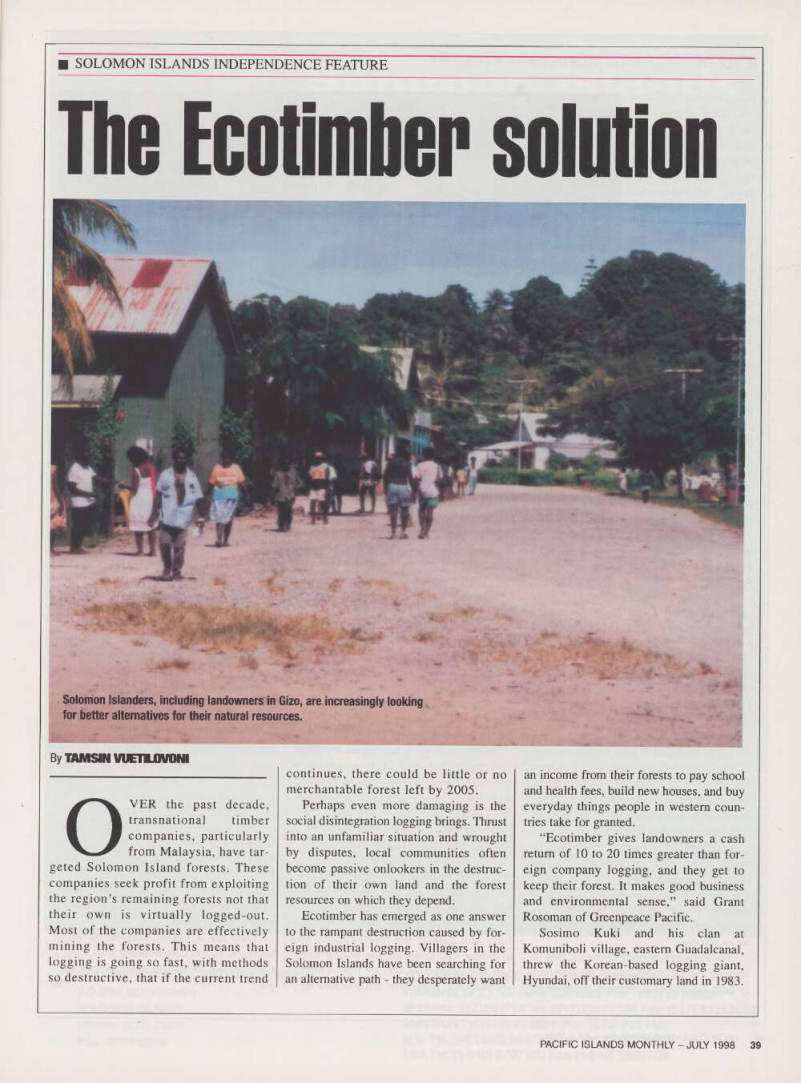
Solomon Islanders, including landowners in Gizo, are increasingly looking for better alternatives for their natural resources.
As Sosimo explains: “We were worried that the company was going to destroy our forests, so we had the idea to man age their forests our selves and cut timber with a chainsaw mill”.
Now, more than ten years later, the Komuniboli’s forests are being managed according to ecological guidelines and the com munity has established
an Ecoforestry training
centre (KTC) that has helped hundreds of landholders learn chain saw milling and forest management. Along the coast from Komuniboli, landholders in the East
Simu Association had been fending off the
big logging companies for thirty years.
Five ecoforestry enterprises are preparing for their first ecotimber export to New Zealand in 1998.
“Generations of my people have said no to logging. We rely on many different bush materials and don’t want logging to dam age them.
But we have now agreed to cut ecotim ber,” said Simon Okai, Zongo clan chief and ecoforestry project. One of the main complaints that both these local communi ties had about industrial-scale logging was that only a small percentage of the value of the felled trees went to the landholders.
Usually this was less than five per cent of log value, with more than half going to the
logging company.
Small-scale sawmilling and the concept of ecoforestry had been around in Solomon Islands for many years, but there were no integrated support programmes that pro vided direct links to nearby New Zealand and Australian markets.
In 1994, a consortium of groups evolved to provide this support: Solomon
Islands Development Trust (SIDT),
Greenpeace, KTC, the NZ Imported Tropical Timber Group (ITTG) and Isabel
Sustainable Forestry Management Project
as an associate.
The Ecoforestry Programme focuses on training and technical support in communi ty land use planning, ecoforestry manage -
ment, milling, and timber grading, support for community organisation and business management, and ecotimber marketing.
The programme aims to link Melanesian village-based ecotimber pro ducers with green consumers in New Zealand through the ITTG. The pro gramme is also timely because of increas ing market demand for “eco-certified” wood products. The New Zealand govern ment Overseas Development Assistance has contributed funding for training and
marketing.
Community support for ecoforestry has grown as a response to the effects of destructive log extraction: heavy bulldoz ers ruining dirt roads, forests degraded into a sea of vines, and waterways turned into muddy holes, no longer fit to drink.
Sosimo says there are several important differences between logging and eco forestry. “One difference is the reading, where with logging they use big machines and dig up all the soil, we just make small tracks by cutting some of the small trees and carry the timber out by man power”.
“Another difference is with milling.
Where we mill it in the forest rather than dragging the log and damaging all the soil like with logging. When we fell a tree we ensure the minimal damage by felling care fully into gaps in the forest canopy and avoiding damaging all the young trees.
Logging contractors who are from a differ ent place don’t care how many or how they
fell the trees.
They don’t think about the future of the forest”. The Zongo have also set aside for est reserves, swamp ecosystems and tambu (taboo) sites. Harvesting is carefully planned in marked one-hectare blocks. All trees are identified and timber volume assessed to calculate the sustainable tim ber.
“With ecoforestry management we go into the bush and mark the big trees we intend to cut. These are only trees over 60 centimetres in diameter and no more than two per hectare. We are careful not to dam age the young trees. We want to replace the ones we have cut,” says Simon Okai.
Ecotimber enterprises appeal to com munities because they offer the opportuni ty to manage their forest ecologically as well as generating an income and employ ment. “Village-based projects like ecotim ber are a good way to employ our young people and protect our forests at the same time,” explains Sosimo Kuki.
These communities in the East of Guadalcanal Island, and those on Isabel Island represent an emerging trend among local Solomon landholders.
Good business and green export mar kets are being linked with good environ mental management.
They are a potent example to other Solomon Island communities who want a
home-grown alternative to large-scale log
ging. ■
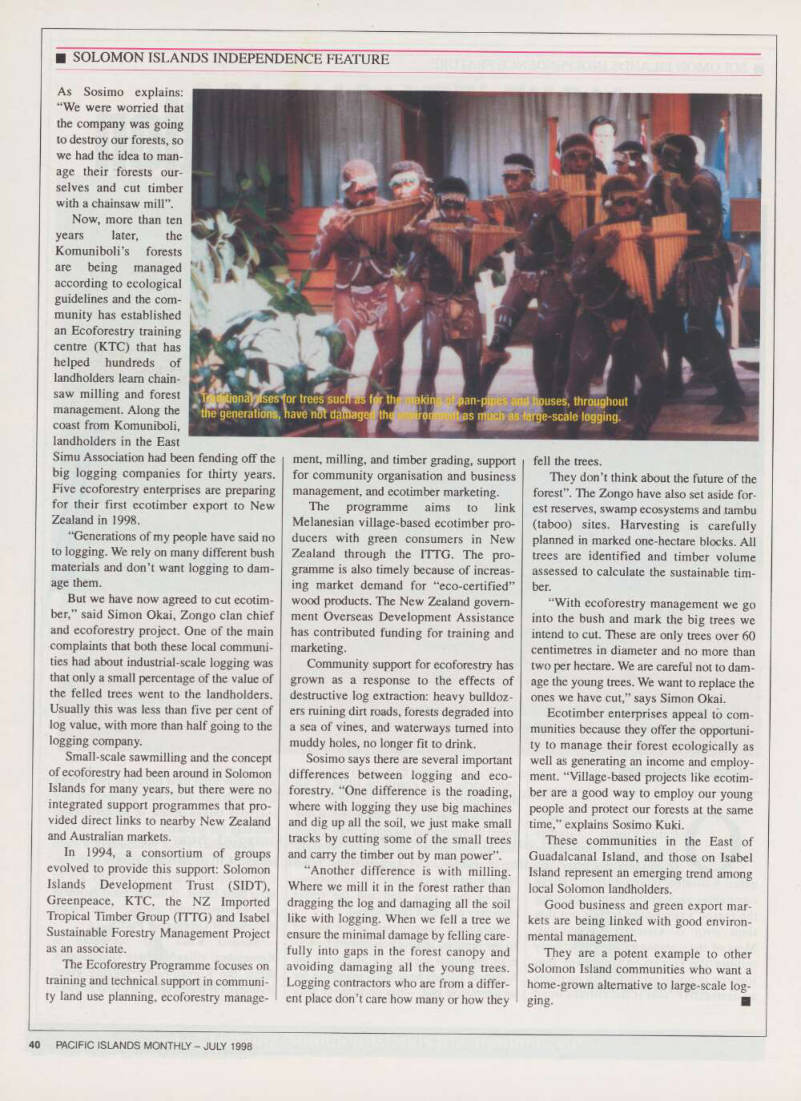
Trad itio nal uses for trees such as for the making of pan-pipes and houses, throughout the generations, have not damaged environment as much as targe-scale logging.