Harmoaising Pacific aviation
pp. 30-34 · Read in the full issue
Aviation Feature
A regional approach to a national responsibility
By Sophie Foster Hldebrand
With the 21st century less than a year and a half away, the chal lenges for aviation are many. Always considered an industry at the forefront of development and high technology, now, more than ever, it needs to adopt a conciliatory attitude.
In putting forward the case for harmon isation of regulation in the Forum region, the Association of South Pacific Airlines (ASPA) says, “As the world’s airways sys tem become more and more crowded, an essential element in any safe operation is harmonisation. This requires not only man agement commitment but also legislation that is compatible between various avia tion states”. ASPA says, “the development
of high technology air navigation systems requires balanced international co-opera tion and co-ordination to prevent any par allel introduction of incompatible systems, which would not be conducive either to safely or to economy”.
“A harmonised regulatory structure would undoubtedly improve the safety and efficiency of air operations, would help to reduce costs and simplify international operations”.
The International Civil Aviation Organisation (ICAO) has identified the persistent need to harmonise safety regula tion universally. “This is to ensure lesser conflicts, higher safety standards and effi cient use and allocation of resources with in the aviation sector.”
Fiji says “A harmonised set of safety regulations takes a concerted effort to
arrive at, however, once this is achieved there will be a wider benefit to the region.
Hopefully, the application of wide discre tionary powers by the regulator will be reduced and a more simplified and work able set of rules put in place”.
Fiji believes that with the liberalised trading principles now regulating major activities between states, harmonisation has an important role to play in arriving at a regional approach to a national responsi
bility.
Although an aviation ministers’ meet ing in Suva has aimed at the adoption of aviation legislation and regulations that are compatible across the region, more politi cal will is necessary for this to become a reality.
The ministers committed themselves to using the “bilateral” system to encourage more flexibility in the way airlines and countries cooperate with each other. They also agree to adopt aviation policies that
encouraged private sector development and enhanced competitiveness in industries such as tourism. This includes the pursuit of open, liberal and transparent policies in
working towards a common goal of free and open trade and investment.
Fijian officials said harmonising avia tion rules has become increasingly impor
tant as the level of trade and economic activities across national boundaries increas es. Even the International Civil Aviation Organisation (ICAO) has identified the “persistent need’’ to har
monise safety regulations
universally “to ensure lesser
conflicts, higher safety stan
dards and efficient use and allocation of resources within the aviation sector”.
According to ASPA, “it is trite to say that countries of the Forum region are diverse but it is immensely true, this diversity tends to militate
against uniformity or stan
dardisation”. “In some states emphasis is given to social development whilst in others emphasis is given to econom ic development. In either case
civil aviation has to fight for a portion of what, in most cases, is a small budget. This limits an island nation’s ability to provide adequate maintenance standards for its
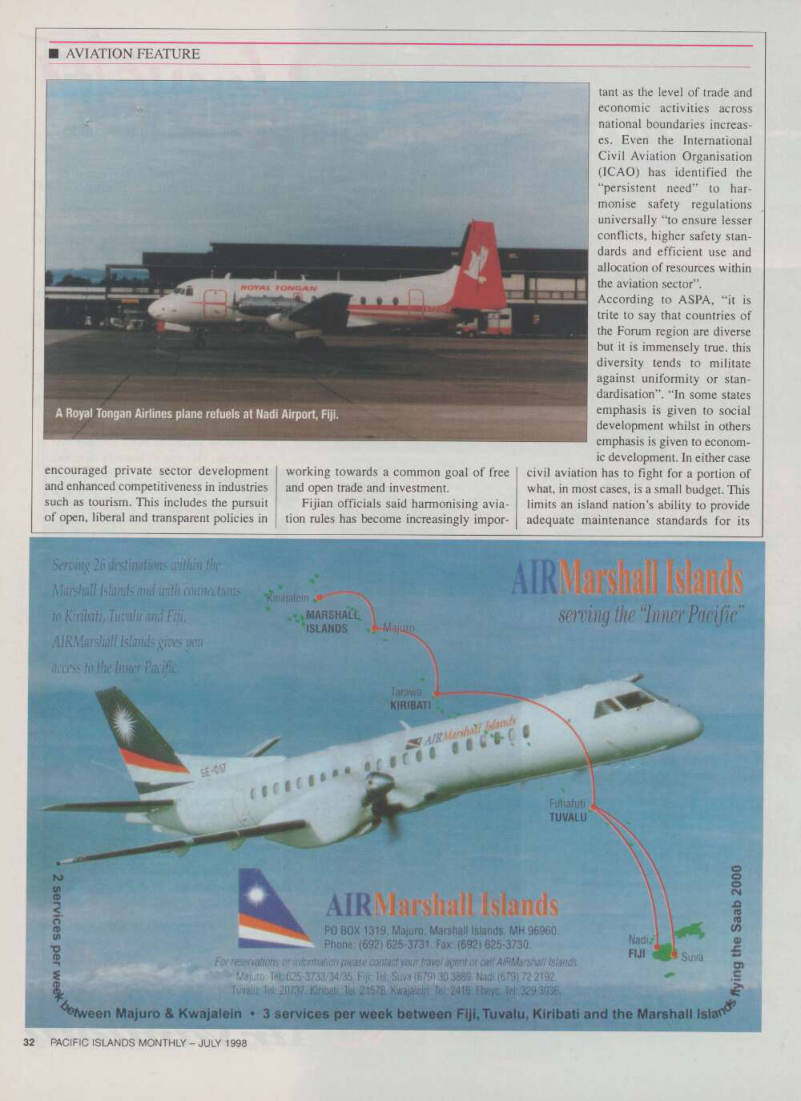
A Royal Tongan Airlines plane refuels at Nadi Airport, Fiji.
navigational aids, airports, or to hire tech nical staff or otherwise respond to its avia tion obligations”. ASPA says the necessity for civil aviation differs from island state to island state.
Comparing Kiribati and PNG, ASPA says in the former, its far-flung boundaries find civil aviation essential to maintain contact with and social support for the inhabitants of those outlying islands.
PNG is a “land of hills” that makes reading an engineering adventure of uneconomic proportions with a potentially detrimental aesthetic and environmental impact, “hence the need for an extensive
airport infrastructure”.
The level of aviation activity varies tremendously as does the quantity and quality of the aviation expertise available to each administration. ASPA says “the death of indigenous aviation personnel in the island states is a real obstacle to devel opment of aviation and to the maintenance of standards”.
Most Forum Island countries are not able to develop and maintain their own skills base for safety inspection and certifi
cation. Because of this a Regional Safety Oversight Programme was adopted in May to help deliver safety services. The govern ment of Australia agreed to provide AUDS 100,000 towards the establishment of this programme.
Aviation today is based on advanced technology requiring international co operation and co-ordination. However, the legal framework for international civil avi ation has not kept pace with the technical advances. Different national safety condi tions add unnecessary expense to air travel and inhibit international traffic and trade.
ASPA says “given that aviation is increasingly international in character, there is good sense in attempting to har monise the regulatory structures of avia tion countries within its own region, that is, the Forum region or the Asia-Pacific region”. Australia and New Zealand are in the process of harmonising their regulatory systems. Both conducted independent reviews of their regulations and concluded that these systems needed to be simplified and rationalised without compromising air safety.
Under the Aircraft Agreement of the General Agreement on Tariffs and Trade (GATT), governments agreed to make sure that civil aircraft certification requirements and specifications on operating and main tenance procedures were not unnecessary barriers on trade.
A harmonised regulatory system would allow for minimum restriction on transfer of aircraft and personnel between coun tries, minimum restrictions on operators operating between countries, and ease administrative detail between countries.
Moreover, components that have under gone maintenance, repair or overhaul in one country will be acceptable in another country, and a common database for defect reports could be instituted between coun tries.
Harmonised regulations will reduce costly incompatibility problems and facili tate more effective competition in interna tional civil aviation.
When all is said and done, creating har mony in air transport matters is essential for the development of an integrated avia tion market in the South Pacific region. ■