Big trouble in little Emalus
p. 29 · Read in the full issue
Education
By Arthur Mccutghan
FIJI hosts the Melanesian
Spearhead Group meeting
at its capital, Suva, this month, and from the amount of publicity received, the situ ation at Emalus Campus will ruffle a few feathers. Last month Fiji government ministers threatened to withdraw its stu dents from the University of the South Pacific Law
School, based in Vanuatu, because of what they called security concerns on and off campus. These made conditions not conducive to studying.
They also com plained about the need for students to understand French if they were to study there. A few days after the uproar, Fiji’s minister for education, Taufa Vakatale, visited Port Vila to see for
herself what was going on. Over the next few days she spoke to student representa tives and met with school officials and counterparts in the Vanuatu government.
While all this diplomatic manoeuvring was happening, students were going about their normal routine on campus.
Unless you spoke to individual stu dents, it seemed everything was as it should be. The uproar began after a series of affairs between law students and local Ni-Vanuatu people. One resulted in a brawl outside the Flamingo night-club, while the other blew up with two attacks on school property. Crowbars, pinchbars, stones and a beer can were used to smash in two rooms in the campus dormitory.
Pro-Vice Chancellor Professor John Lynch said, “the campus is unfenced but apart from these two attacks, the campus
has been trouble-free”. In response to criti cism about French being criterion for studying at the campus, he said, “that’s totally untrue”. “There’s only one French speaking lawyer here. The court system at high level operates in English, so French is not used in the legal system at all,” he said.
In any case, students don’t do much practi cal work in Vanuatu. Most of that is done in their home countries. Earlier in the year,
there was much debate about the location of the law school. Fiji was keen to have it.
Pro-Chancellor and head of the Council of the USP, Savenaca Siwatibau, said it was too late now for Fiji to bring up the issue.
“The decision to have the law school here was made by the governing body of the university and Fiji has the largest number of council members.” Fiji is also the most developed nation of the 11 countries served by USP.
In May the Council convened a meeting in Tonga where smaller countries expressed the concern that Fiji was bene fiting the most from the university. “From experiences overseas in similar arrange ments of regionalism, the benefits tend to accrue to the largest economic countries.
Fiji is interested in cementing regionalism and the only way for us to do that is to see
that this arrangement is fair to all, particu larly to each of the smaller countries,” Mr Siwatibau said. He warned Fiji against try ing to monopolise since it would weaken the agreement that holds the USP together.
"We have to keep looking to the future because the benefits to Fiji will be wider. If we are alone, we are just a small nation but with the other 11 beside us, the impact we can make internationally will be much big
ger,” he said.
Unless Vanuatu said it does not want the school on its soil, there is no chance that it will be moved any where else. The president of the Law Students Association, Jolame Uludole, said if Fiji pulls out of Vanuatu, Tonga, Tuvalu, and Samoa would most likely follow suit.
“The curriculum of these countries is similar to Fiji.
They can continue to run the school in
Port Vila but then the Vanuatu government would have to foot a bigger portion of the bills,” he said. Head of the law school, Professor Bob Hughes said a new comput
erised teaching system being developed by
the university would make location a non issue.
“What we have been doing is develop ing course material on the Internet so in future student scan study from any part of the Pacific, no matter where the school is”.
Everything a law student would need to complete the law course would then be available through the Internet. “Shortly after that we will integrate voice technolo gy so that the student can hear the lecturer as he or she takes them through the notes,”
Professor Hughes said. The system has been tested on third-year students with a positive response. ■
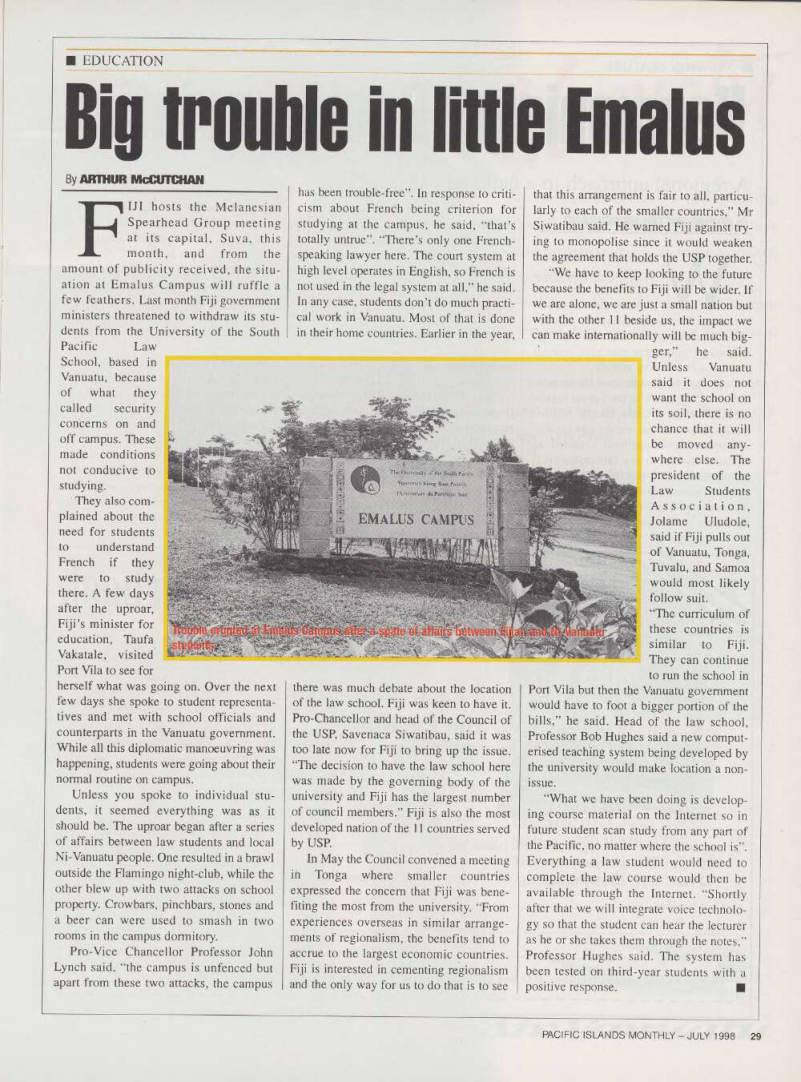
Trouble erupted at Emalus Campus after a spate of affairs between fijian and Ni-Vanuatu Studens.