Marshalls economy continues to slow
pp. 22-23 · Read in the full issue
Cover Story
By Giff Johnson
SIGNS of the times: The Marshall Islands cabinet announced on June 16 that effective July 1, the salaries of all government workers will be cut 12.5 percent. More than 100 Marshall Islands government workers are set for termination in July
as part of the government’s continuing reduction in force program. A govern ment memo in early June announced that no interna tional travel would be allowed for the rest of the fiscal year, through September 30. Many con tractors now demand pay ment in advance from the government before provid ing services. Delays in lay ing off workers scheduled to be terminated last October are pressuring the government’s ability to muster cash for its bi weekly payroll.
However, high level offi cials observe that if they thought this year was tough, economically, wait until the new fiscal year starts on October 1 - when government ministries are girding for another round of heavy spend
ing cuts.
Though the private sector in the Marshalls is relatively large, it is primarily oriented to services that survive from
recirculating government paycheques and spending. As the fortunes of the govern ment have dwindled, so have those in the
private sector. Although the Compact of
Free Association with the United States continues to provide funding to the gov ernment - of approximately $5O million annually, and other US programmes esca late that figure even higher - about 25 per cent of the national budget is now spent
paying off debts incurred during the free spending early days of the Compact. The Compact’s guarantee of US funding ends in 2001, a date that island leaders are eye
ing with increasing nervousness.
In case anyone needed proof of the eco nomic implosion that is observably evi dent, two recent reports by the Bank of Hawaii and the Pohnpei-based Micronesian Seminar confirm the econom ic problems and give little hope for short term optimism. A key element in the cur rent state of malaise in the Marshalls is that
there is little evidence of direction on the economic front by the government - even as an economic crisis looms. Though the government is gearing for re-negotiation of the Compact with the US, supposed to begin in 1999, an economic strategy is a key missing link. The Bank of Hawaii’s economic report exhorted both the Marshall Islands and Federated States of Micronesia to seize on the 1999 talks with
the US as an opportunity to improve their economic situation. To do so, these island countries need “to offer a credible business plan,” said Bank of Hawaii economist Wali Osman. “The plan must be realistic. The negotiations offer an opportunity to make a business plan work, to create a self-sus taining market economy within the resources that you have and need,” he told Majuro business and government leaders while presenting the updated report in late April. The Bank of Hawaii report empha sises reduced US interest in the Pacific
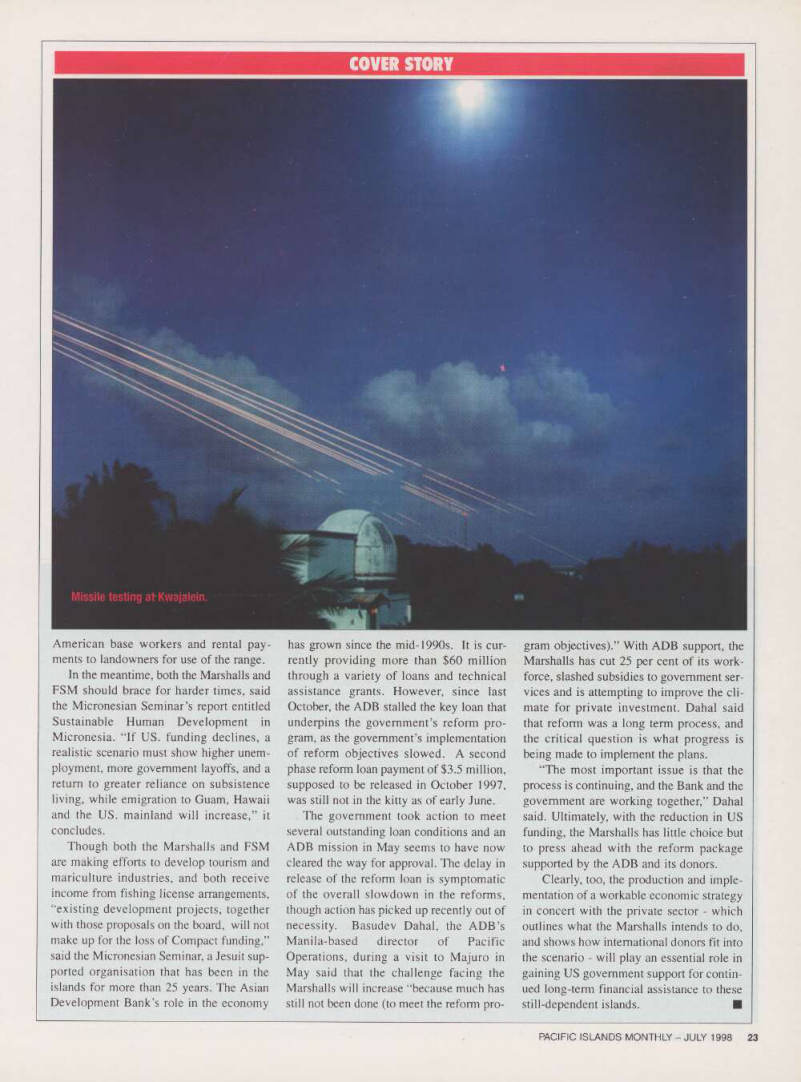
since the demise of the Cold War. However, the report said the US still has a substantial strategic interest in maintain ing long-term relations with the Marshall Islands, which play host of the US missile testing range at Kwajalein.
“It is highly unlikely that Washington would be as gen erous with its aid and rent payment as it was at the peak of the Cold War in the 1980 s.
However, it is also unlikely that the US will end its spe cial relationship with the Marshall Islands beyond 2001 and create a power vacuum in the area.” The Kwajalein mis sile range will continue to be
an important bargaining chip
for the Marshalls. In actuality,
while the Compact’s general
provisions expire in 2001, the US has the option to renew the lease for use of Kwajalein for an additional 15 years.
Since President Ronald
Reagan’s grandiose “Star
Wars” announcement in the early 1980 s, Kwajalein has focused heavily on develop
ing a deployable “theater missile defence system” to protect a limited area, such as a city or battle field.
Billions of dollars in US research fund ing continue to pour into Kwajalein and it is unlikely that the American government’s interest in missile defence will end in three years. The base itself contributes about $25 million to the Marshall Islands economy in Marshallese worker salaries, taxes on the
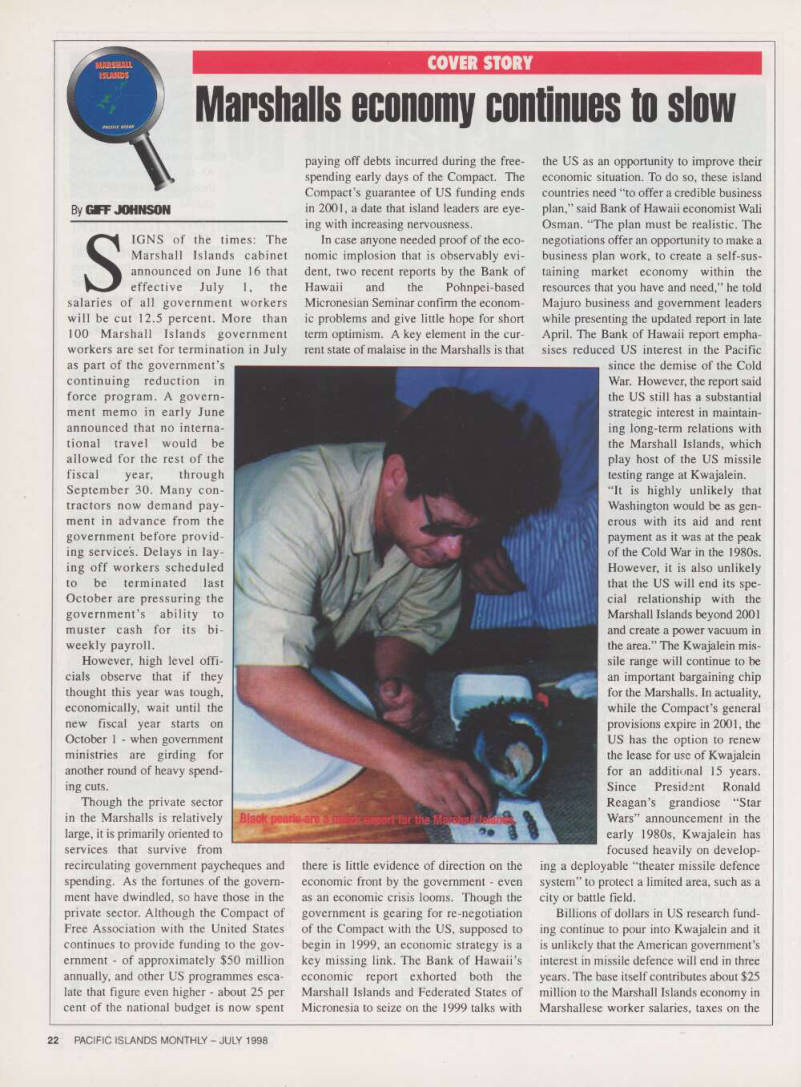
Black pearls are a major export for the Marshall Islands.
American base workers and rental pay ments to landowners for use of the range.
In the meantime, both the Marshalls and FSM should brace for harder times, said the Micronesian Seminar’s report entitled Sustainable Human Development in Micronesia. “If US. funding declines, a realistic scenario must show higher unem ployment, more government layoffs, and a return to greater reliance on subsistence living, while emigration to Guam, Hawaii and the US. mainland will increase,” it concludes.
Though both the Marshalls and FSM are making efforts to develop tourism and mariculture industries, and both receive income from fishing license arrangements,
“existing development projects, together
with those proposals on the board, will not make up for the loss of Compact funding,” said the Micronesian Seminar, a Jesuit sup ported organisation that has been in the islands for more than 25 years. The Asian Development Bank’s role in the economy
has grown since the mid-19905. It is cur rently providing more than $6O million through a variety of loans and technical assistance grants. However, since last October, the ADB stalled the key loan that underpins the government’s reform pro gram, as the government’s implementation of reform objectives slowed. A second phase reform loan payment of $3.5 million, supposed to be released in October 1997, was still not in the kitty as of early June.
The government took action to meet several outstanding loan conditions and an ADB mission in May seems to have now cleared the way for approval. The delay in release of the reform loan is symptomatic of the overall slowdown in the reforms, though action has picked up recently out of necessity. Basudev Dahal, the ADB’s Manila-based director of Pacific Operations, during a visit to Majuro in May said that the challenge facing the Marshalls will increase “because much has still not been done (to meet the reform pro
gram objectives).” With ADB support, the Marshalls has cut 25 per cent of its work force, slashed subsidies to government ser vices and is attempting to improve the cli mate for private investment. Dahal said that reform was a long term process, and the critical question is what progress is being made to implement the plans.
“The most important issue is that the process is continuing, and the Bank and the government are working together,” Dahal said. Ultimately, with the reduction in US funding, the Marshalls has little choice but to press ahead with the reform package supported by the ADB and its donors.
Clearly, too, the production and imple mentation of a workable economic strategy in concert with the private sector - which outlines what the Marshalls intends to do, and shows how international donors fit into the scenario - will play an essential role in gaining US government support for contin ued long-term financial assistance to these still-dependent islands. ■
Missile testing at Kwajalein.