Log industry in crisis
pp. 20-21 · Read in the full issue
Nationally owned businesses, dependent on the industry for cash income, to pay expenses and repay loans, are seeing their cash flow and business opportunities dry up as income from timber exports falls to pre-1992 levels,”
By Sam Vulum
CONTINUING depressed
log prices and stringent World Bank conditions have been proving disas trous for the future survival of the for est industry in Papua New guinea.
As if the falling log price - resulting from the Asian economic crisis - was not enough a burden, their industry is now also fighting to survive against the World Bank
conditions. Among others, the bank strong ly opposes any interim industry relief measures, including export tax rate reduc tions. This has forced most timber opera tions to shut down, as reported in the February issue of Pacific Islands Monthly.
However, the forecast is even worse to come, at least for the rest of 1998.
According to the PNG Forest Industry Association, the World bank conditions continue to erode the sustainability of the industry.
The association, which represents about 85 per cent of log producers in the country, said the bank’s conditions have directly contributed to losses in employment, landowners’ payments, export income, and foreign exchange earnings. The association said more than 5000 employees have lost their jobs in the industry and the service industries that support it. It said the contin uing falls in production volumes also resulted in lost cash payments, royalties and premiums to rural communities. Lost royalties alone in the first quarter of 1996 were K 2.5 million. The association said that the export volumes in the first three months of this year have also experienced a tremendous fall compared with the same period in 1997. The volume of 275,000 cubic metres in January 1997 fell to 222,000 in the same month this year. In February it fell from 284,000 cubic metres to 150,000 cubic metres. In March the fall was from 210,000 to 108,000.
It said market reports have indicated that the value of export, in the first quarter, has fallen from US$39 million in 1997 to US$32 million this year. This amounts to a loss of foreign exchange earnings for PNG of about US$4.7 million every week.
Meanwhile, executive members of the Association of Forest Resource Owners, representing timber landowners, meet in Port Moresby in June to seek urgent gov ernment help to save the industry.
They called on the government to come up with a new export duty calculation that was more realistic, fair and effective as this had forced developers to close down log ging activities throughout the country, affecting many resource owners. They said unless the Government took remedial action, more developers would leave the country and buyers turn top other countries for logs. The resource owners said logging activities nation-wide closed down eight months ago. The repercussions include developers abandoning the projects, spin off benefits at a standstill and many resource owners left in debt. The FIA has also reported that rural communication net works, health and education services sup-
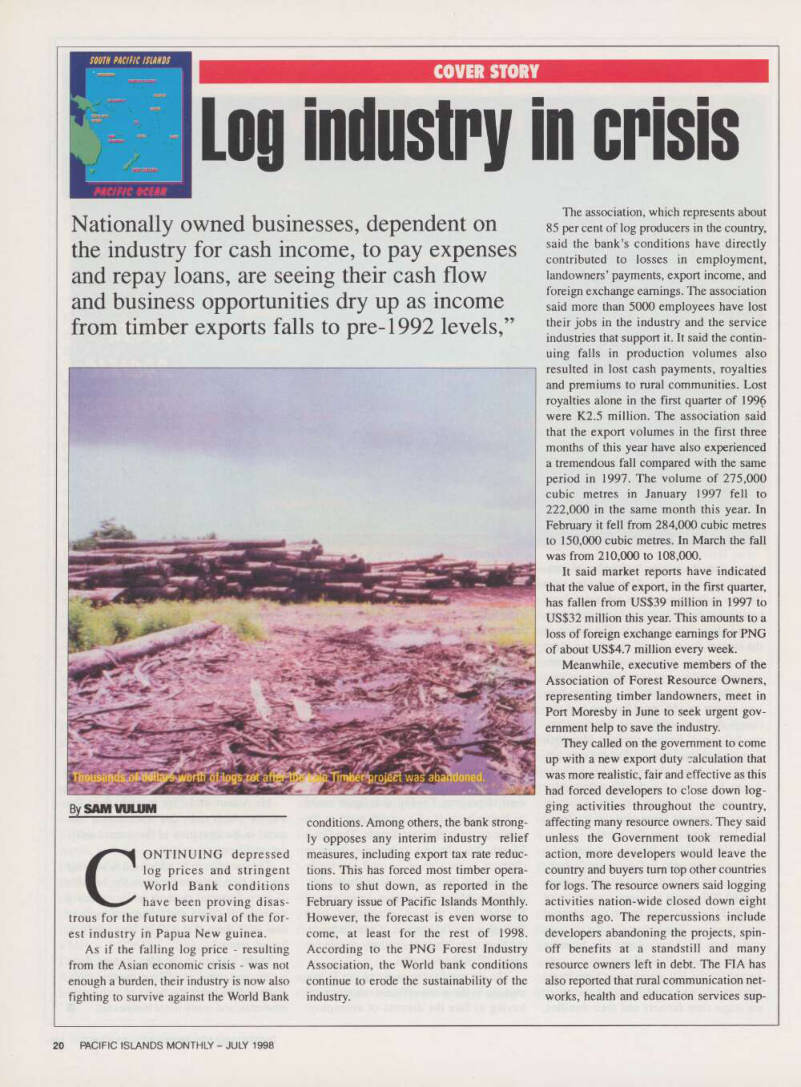
Thousands of dollars worth of logs rot Timber project was abandoned.
ported by the industry are also being closed as timer companies continue to suspend operations. It said shipping, and aircraft services are being withdrawn from areas where timber operations have ceased.
“New infrastructure developments, new schools, aid posts, roads and community centres have ground to a halt or been deferred as development funds dry up.
More than 200,000 people in rural areas are dependent on the industry for their livelihood; as the industry collapses their means of support are at risk. Nationally owned businesses, dependent on the indus try for cash income, to pay expenses and repay loans, are seeing their cash flow and business opportunities dry up as income from timber exports falls to pre-1992 lev els,” the association said. A typical exam
pie is the Lolo timber project in Cape Gloucester, West New Britain Province that Pacific Islands Monthly visited in late April. The landowner company is Lolo
Development Corporation.
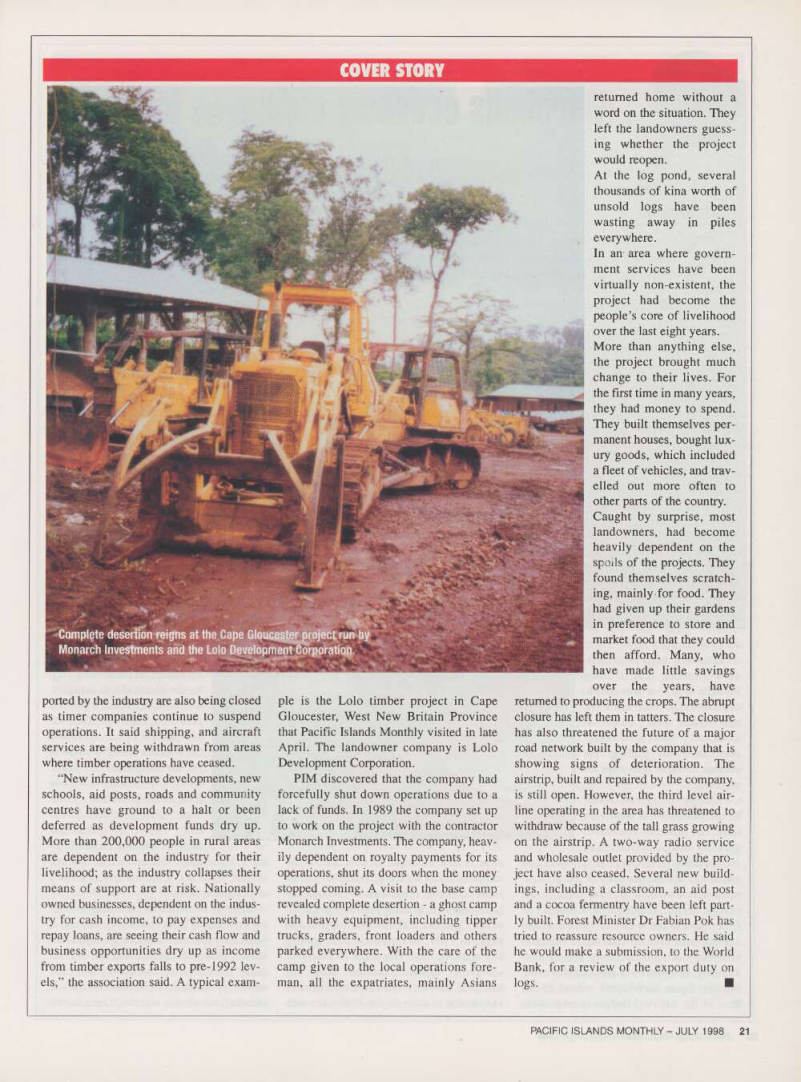
PIM discovered that the company had forcefully shut down operations due to a lack of funds. In 1989 the company set up to work on the project with the contractor Monarch Investments. The company, heav ily dependent on royalty payments for its operations, shut its doors when the money stopped coming. A visit to the base camp revealed complete desertion - a ghost camp with heavy equipment, including tipper trucks, graders, front loaders and others parked everywhere. With the care of the camp given to the local operations fore man, all the expatriates, mainly Asians
returned home without a word on the situation. They left the landowners guess ing whether the project would reopen.
At the log pond, several thousands of kina worth of unsold logs have been wasting away in piles everywhere.
In an area where govern ment services have been virtually non-existent, the project had become the people’s core of livelihood over the last eight years.
More than anything else, the project brought much change to their lives. For the first time in many years, they had money to spend.
They built themselves per manent houses, bought lux ury goods, which included a fleet of vehicles, and trav elled out more often to other parts of the country.
Caught by surprise, most
landowners, had become heavily dependent on the spoils of the projects. They found themselves scratch ing, mainly for food. They had given up their gardens in preference to store and market food that they could then afford. Many, who have made little savings over the years, have
returned to producing the crops. The abrupt closure has left them in tatters. The closure has also threatened the future of a major road network built by the company that is showing signs of deterioration. The airstrip, built and repaired by the company, is still open. However, the third level air line operating in the area has threatened to withdraw because of the tall grass growing on the airstrip. A two-way radio service and wholesale outlet provided by the pro ject have also ceased. Several new build ings, including a classroom, an aid post and a cocoa fermentry have been left part ly built. Forest Minister Dr Fabian Pok has tried to reassure resource owners. He said he would make a submission, to the World Bank, for a review of the export duty on logs. ■
Complete desertion reigns at the Cape Gloucester project run by Monarch Investments and the Lolo Development Corporation.