How independent is Samoa?
pp. 32-33 · Read in the full issue
As Samoa cele brates her 36th year of indepen dence this month, through four Prime Ministers and twelve adminis trations, the tiny island state (pop 107,000) has had a con stant battle to stay afloat financially and more recently social problems have begun to mount.
Economically, Samoa , which was the first Pacific nation to become independent, has gone some way toward financial inde pendence.
The Human Rights Protection Party finance minister Tuilaepa Malielegaoi has favoured a free market approach which has had some success. In that vein, tradi tional sources of export revenue in the past, namely copra and taro, have been overtaken by fishing, tourism and light manufacturing.
Although cattle farming, niche
markets for cocoa and kava are also emerging, the move away from focusing on agricultural products was due to a combination of cyclones and disease which led to export produce being shoul dered off overseas markets. This forced the economy to diversify or drown.
Since 1991 Malielegaoi embarked on an economic programme that raised taxes, froze wage increases for most public ser vants and increased the cost of living.
He also encouraged the growth of pri vate sector which has resulted in the emer gence of individual and collective business initiatives on a scale never before seen.
Over the past five years, real economic growth has averaged around five percent, the highest in the region.
“People no longer have to queue in the shops for goods before they run out as was the case when the opposition was in gov ernment and the changes... you can see them all around you,” he asserts. For the
12 months to last December, Samoa posted SUSI2.B million in exports while import ing SUSB7 million of goods - which by local standards is encouraging.
Central bank Chief Tommy Scanlan says the real concern is keeping the rate of inflation, currently riding around the ten percent mark in check.
A huge dependency on remittances that, last year, totalled $U536.6 million and overseas aid remain the key money spin ners. What the economy needs now is stim ulation, says the ANZ managing director Peter Kelsh.
“I feel the economy is going along quite we 11... but needs something to give it a
spark along.” Investor confidence in Samoa is quite high says Australian High Commissioner Paul O’Callaghan.
“There is great interest in the Australian business community to develop the rela tionship between the two communities.
The reputation Samoa has is very good,” he says. “Australian companies are keen to do business here”.
That reputation should be further bol stered when some of Treasury’s tens of millions of dollars in unaudited accounts for the past eight years are finally tabled this month in parliament.
Still those measures have brought some kind of stability to a market that was an
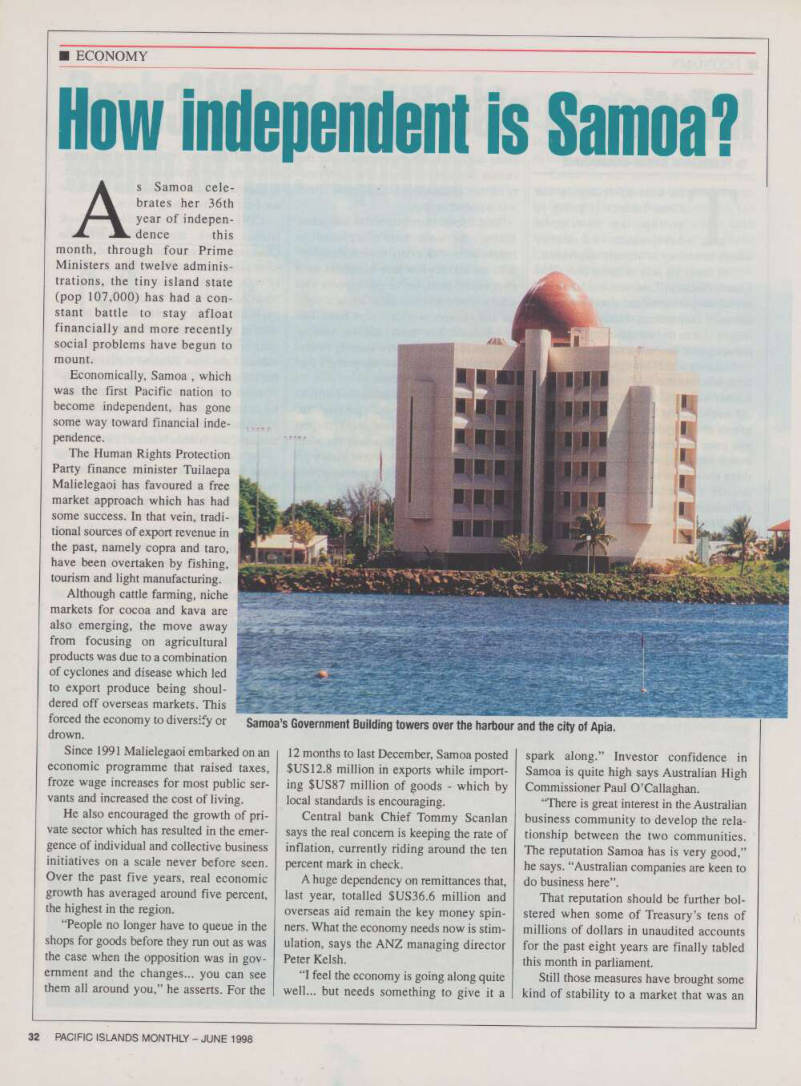
Samoa’s Government Building towers over the harbour and the city of Apia.
accountant’s version of Elm Street.
However, thousands of Samoans are struggling to survive in the new fiscal cli mate the changes have produced.
Although happy to accept the kudos for the apparent financial turnaround, the emerging social fallout is being ignored by the government whose position seems to suggest that if they do not identify a prob lem, there is no problem.
Even four years ago the sight of chil dren and adults begging for money was unheard of.
Now people young and old scavenge rubbish bins for whatever they can find.
Once the domain of the large transvestite community, prostitution now increasingly involves teenage girls and adolescent boys.
Unemployment amongst young adults is rampant. Although no statistics are kept, the size of the problem was witnessed recently when officials from a fish cannery in American Samoa came to Apia looking for 50 factory workers and were alarmed to find more than a thousand people who promptly stormed their offices when the doors opened the next morning.
A minimum wage of SUS6B per month, high unemployment, and little hope for the future suggests the formula for a rise in crime involving theft and property has been established.
Prime Minister Tofilau Eti Alesana maintains there is no poverty in Samoa and his administration has responded in kind.
But this is a one-dimensional view of today’s Samoan society.
Election promises to improve run-down health and education systems have been a joke as they have largely fallen away to a user-pays system.
This has seen expensive private schools for privileged children, shocking failure rates for national examinations and a huge decline in the standards of public educa tion, guaranteeing a generation of under achievers.
A health insurance scheme casually announced this year means more bills for families flying their relatives overseas for treatment, and the spectre of forking out at home for a seriously malnourished health service.
It is not uncommon for a hundred or more patients to seek help from one spe
cialist in a day.
Meanwhile costs for medicines and ser vices have, like everything else, soared skywards.
A bottomless supply of crooked deals, scams and financial ineptness has marked past and present administrations since the independence flag was raised in 1962.
The national motto “Samoa was found ed on God” has become an oxymoron.
In reality Samoa is an island state where, sadly, the once spectacular indepen dence celebrations have for the past four years been given economy class treatment by the government in favour of their tourism festival in September.
That festival has proven a total flop.
Thirty-six years on, as many of her citizens struggle to make ends meet. Prime Minister Alesana ordered a SUSSOO,OOO prayer temple to be built on a hillside over looking the capital.
If prayers asking for strength to over come political deceit and greed are offered unconditionally, changes for the better could still come to pass.
In Samoa, as the locals say, anything is possible. ■