Inflation to rise again in the Cooks
p. 31 · Read in the full issue
Economy
By Florence Syme-Buchanan
The cost of living in the Cook Islands is going to go up, an unwelcome development in a country whose economy is already depressed.
The country’s only shipping line. Cook Islands National Line, announced it had been forced to introduce a seven per cent currency adjustment factor (CAE) to freight, due to the strengthening of the US dollar against the New Zealand dollar.
Shipping lines throughout the Pacific have effected the CAE, and in the Cook Islands which relies mostly on imports, it means everything from a tin of corned beef to cars go up in price. Although they envis age price increases to be less than five cents, importers say price hikes are last thing consumers need. Most affected will be the outer islands. Chamber of Commerce Importers Council Chairman Don Beer Jnr says in the northern islands where prices are already “unbelievable”, it certainly doesn’t look good.
Prices in the outer islands will be most affected. Beer says they “accept the CAE and have got an explanation from Cook Islands National Line on this”. What they don’t accept is government’s procrastina tion on issuing other shippers with licens
es to operate in the Cooks. Don Beer says the Council believes its making some progress on its two year-long push for govern ment to deregulate the shipping industry.
The Council believes other shippers would be able to ser vice the country between 20 to 30 percent more cheaply than Cook Islands National Line.
The Chamber of Commerce has repeatedly said this would mean a saving of up to SNZ2 million for Cook Islands con sumers.
The Importer’s Council esti mates the Cooks’ freight bill to be $6.5 million a year and the seven percent freight hike repre sents an extra S4SO,(XX) annual ly. “That $450,000 has got to
come out of the community and under the current (economic) climate, this communi ty cannot sustain that sort of cost,” Beer
was reported saying.
Don Beer says despite world fuel prices falling, the same hasn’t happened to freight costs. “Our only hope at this stage is to see another line here to operate on a competitive basis, we’ve got shippers who want to come here and are offering a regu lar and cheaper service,” says Beer. The government has been stalling issuing licenses to other shippers wanting to ser vice the Cook Islands on the precept that others have tried and failed.
Thirty percent of Cook Islands National Line is owned by the government.
Ministry of Trade, Labour and Transport spokesman Aukino Tairea says the main
points to government’s recent policy on
the shipping industry are to encourage and establish regular shipping services to the Cooks and accord priority to locally based
companies.
Don Beer says the Importer’s Council will be closely monitoring the US and New Zealand dollars over the next few months. “Should the New Zealand dollar begin to increase we will be ensuring that the CAP will decrease,” says Don Beer.
But just how much effective pressure importers can place on Cook Islands
National Line to readjust freight rates, should the New Zealand currency stabilise, is uncertain as the shipping line holds the ace card of a monopoly service.
CINL director George Ellis told Cook Islands News that they share the Chamber’s concerns that increased freight costs cannot be sustained by the communi ty. “All shipping lines operating out of New Zealand to the South Pacific were applying a seven per cent CAP on freight rates in an effort to set off increased oper ating costs due to the rapidly depreciating value of the New Zealand dollar against the US dollar,” Ellis said in the local daily.
In an earlier interview with PIM, minis ter of tourism and transport Tupou Faireka rubbished claims that government is pro tecting Cook Islands National Line.
At the time he said he’s reluctant to issue any licenses until he’s completely satisfied this wouldn’t jeopardise the ser vice the Cook Islands people presently have from CINL.
“If the monopoly is working for the Cook Islands, then we will leave it as it is.”
Meanwhile, in northern Manihiki where a 2.2 kg packet of chicken already costs upwards of $lB compared to around $ll in Rarotonga, consumers there can expect to be paying even more for refrigerated goods. ■
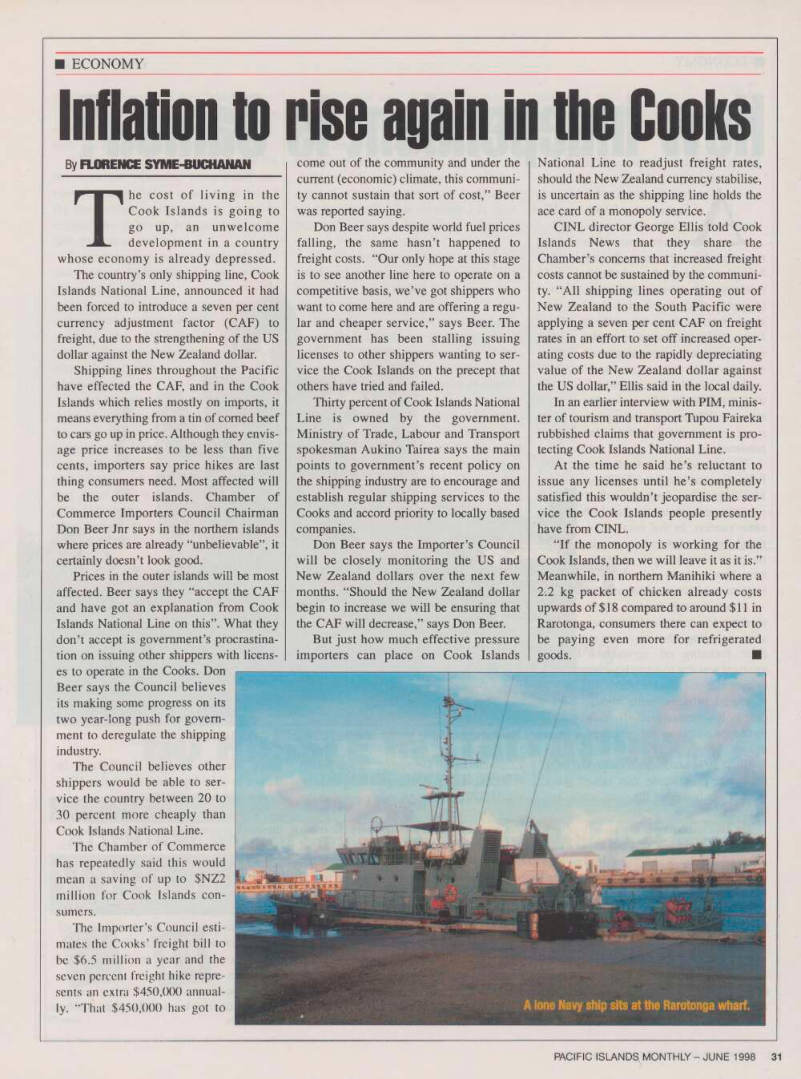
A lone Navy ship sits at the Rarotonga wharf.