ANZAC rivalry heats up on Bougainville
p. 10 · Read in the full issue
By Michael Field
By even the celebrated standards of Pacific speech-making, the peace ceremony on Bougainville was an endurance event.
Twenty speeches, all of them saying much the same thing, were mostly in the melodious Tok Pisin (Pidgin). Fiji Foreign Minister Berenado Vunibobo was probably the day’s hero his speech was over in less than a minute.
Bougainville Transitional Government Premier Gerard Sinato needs some work on technique, and timing. He called for four minutes silence in honour of the 15,000 dead.
The silence, marked by the squealing of pigs under the stage that were soon to give their life at a peace banquet and the sound of a helicopter patrolling the hills, lasted less than a minute.
One of the more jarring tensions at the day was that between Australia and New Zealand.
Wellington broke most of the major diplomatic rules in engineering the war’s end and it is known now that Canberra and Port Moresby initially sent a barrage of angry cables protesting at the way things were being done.
But it worked so well that now Australian Foreign Minister Alexander Downer claims it was, surprisingly, Canberra’s initiative.
Peace Day on Bougainville began in Port Moresby with Anzac solidarity. Two RAAF Hercules and an RNZAF Hercules ferried ministers, officials and journalists on the two and a half hour flight to Aropa, Bougainville. For most it was the toughest flight of their lives.
On arrival an Australian officer insisted on briefing people on their behaviour. As the engines were still running and heli copters landed nobody trapped in the hot RAAF plane could hear a thing. A New Zealand Army officer took care of the media and immediately introduced a calm kiwi approach to life. The PNG media were represented in force but the interna tional media were thinly represented Agence France-Presse, Australian
Associated Press, Australian
Broadcasting
Commission, the
Australian, Fiji
Review, the Financial Times of London, Pacific Islands Monthly and Television New Zealand. And a crew from Korea
Broadcasting who
seemed not to know all day where they were or what it was all about, spent the
day filming every speech.
After an exciting low-level helicopter dash up the coast the VEPs were assembled; New Zealand Foreign Minister Don McKinnon in an All Black’s hat, Downer wore an orange floppy hat from the Truce Monitoring Group (TMG).
Vunibobo, with his stock of white hair, didn’t wear a hat in the pounding hot sun.
He seemed everybody’s friend that day.
The evening before he had been in a
remarkably casual diplomatic exchange
when, over champagne, Downer walked up to him and said, almost incidentally, that Canberra was happy to accede to Fiji’s request for a change in the rules of origin over textile exports.
It was a big deal for Fiji, yet it was just slipped into conversation apropos of noth ing in particular. Downer by Peace Day had dropped his line about his personal invention of peace on Bougainville but only in an almost dismissive way, acknowledged in his speech that New Zealand had done some of it.
Peace Day saw the command of the TMG switch from New Zealand to Australia. The Australian soldiers were tense and unhelpful; the kiwis were tired and homesick. The Fijians and the ni- Vanuatuans seemed content and unfazed by the tensions in the Anzac ranks.
But the New Zealanders had something special. The haka. When all the sides first met at the Burnham Army Camp on a cold
frosty morning last year, the infantry per formed a haka. Coming from warriors to warriors, and showing a Pacific solidarity, it made a mark on the Bougainvilleans.
McKinnon gave his speech, blessedly cut down from the official version handed out earlier, and then the Kiwis came for ward.
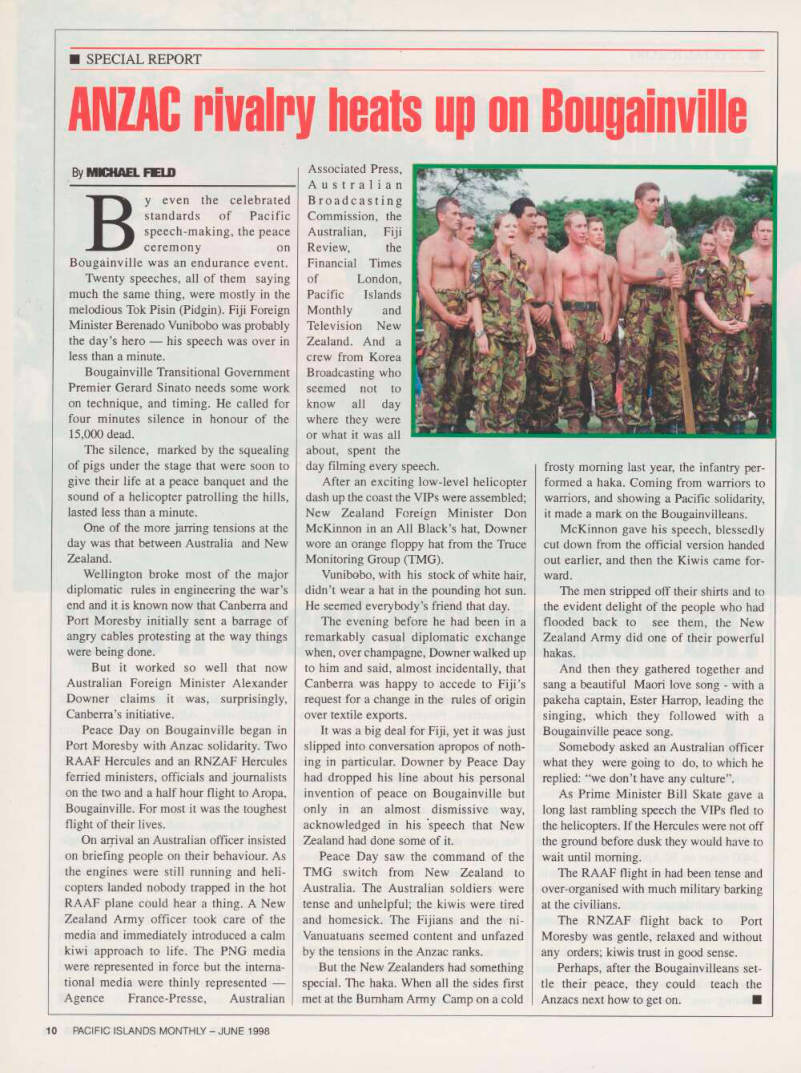
The men stripped off their shirts and to the evident delight of the people who had flooded back to see them, the New Zealand Army did one of their powerful hakas.
And then they gathered together and sang a beautiful Maori love song - with a pakeha captain, Ester Harrop, leading the singing, which they followed with a Bougainville peace song.
Somebody asked an Australian officer what they were going to do, to which he replied: “we don’t have any culture”.
As Prime Minister Bill Skate gave a long last rambling speech the VIPs fled to the helicopters. If the Hercules were not off the ground before dusk they would have to wait until morning.
The RAAF flight in had been tense and
over-organised with much military barking
at the civilians.
The RNZAF flight back to Port Moresby was gentle, relaxed and without any orders; kiwis trust in good sense.
Perhaps, after the Bougainvilleans set tle their peace, they could teach the Anzacs next how to get on. ■