The Bougainville Peace Treaty
By Michael Field
It is a five page document
signed with a cheap ball-point
pen taken from a Port Moresby hotel. And it is one of the more important statements in modem Pacific history. Part One, Cease-fire, opens with this: “ A permanent and irrevocable cease-fire will come into effect on Bougainville at 2400 hours on 30 April 1998.” From that time “all parties will continue to refrain from all hostile acts or the carriage or pos session and the use of arms, ammunition, explosives and other instruments of death, injury or destruction on Bougainville.
“No one will manufacture, trade or dis tribute weapons in Bougainville. “The par ties will co-operate in reporting and pre
venting use, manufacture, importation.
sale, trade and exchange of weapons and ammunition. People will be allowed to move freely without hindrance in Bougainville.” Part Two set up a regional peace monitoring group made up of Australia, Fiji, New Zealand and Vanuatu with the mandate to monitor and report on compliance with all aspects of the cease fire and to promote and instil confidence in the peace process. The United Nations Secretary-General was invited to send an observer mission.
Part Three set up a mechanism for con sultation and a committee made up of the UN and the states contributing to the peace monitors. Part Four dealt with a neutral zone in Arawa and the rescinding of PNG’s call-out or state of emergency order over
Bougainville.
The document was signed by PNG State
Negotiator Sir John Kaputin, Minister of Bougainville Affairs Sam Akoitai, Bougainville Transitional Government Premier Gerard Sinato, Bougainville Interim Government Vice President Joseph Kabui, Bougainville Resistance Force chairman Hilary Masiria, Bougainville Revolutionary Army commander General Sam Kauona and PNG MPs for Bougainville John Momis, Michael Ogio and Michael Laimo.
The document was witnessed by Solomon Islands Prime Minister Bartholomew Ulufa’alu, New Zealand Foreign Minister Don McKinnon, Australian Foreign Minister Alexander Downer, Fiji Foreign Minister Berenado Vunibobo, Vanuatu Acting Foreign Minister Clement Leon and United Nation’s Representative Frances Vendrell. ■
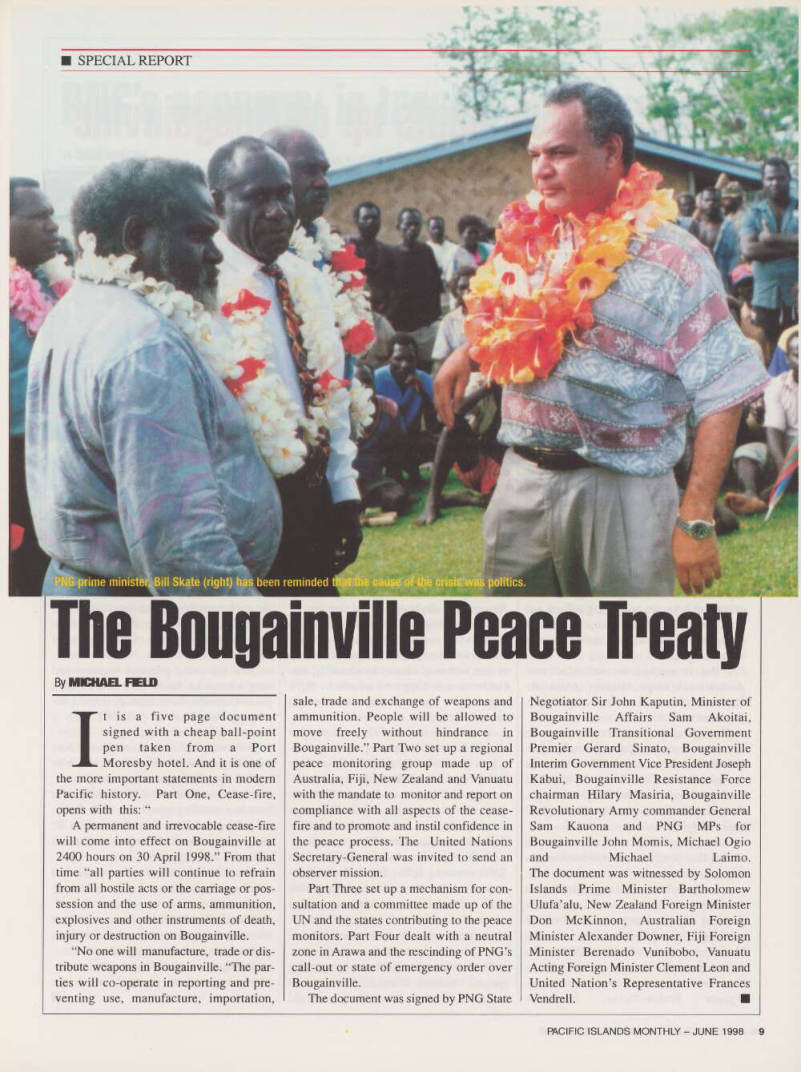
PNG prime minister, B ill Skate (right) has been reminded that the crisis was politics.