Food and body shape, a Polynesian issue
pp. 22-23 · Read in the full issue
Health
Food and body shape, a Polynesian issue But now the talk is shifting to diet and exercise
By Michael F[?]Eld
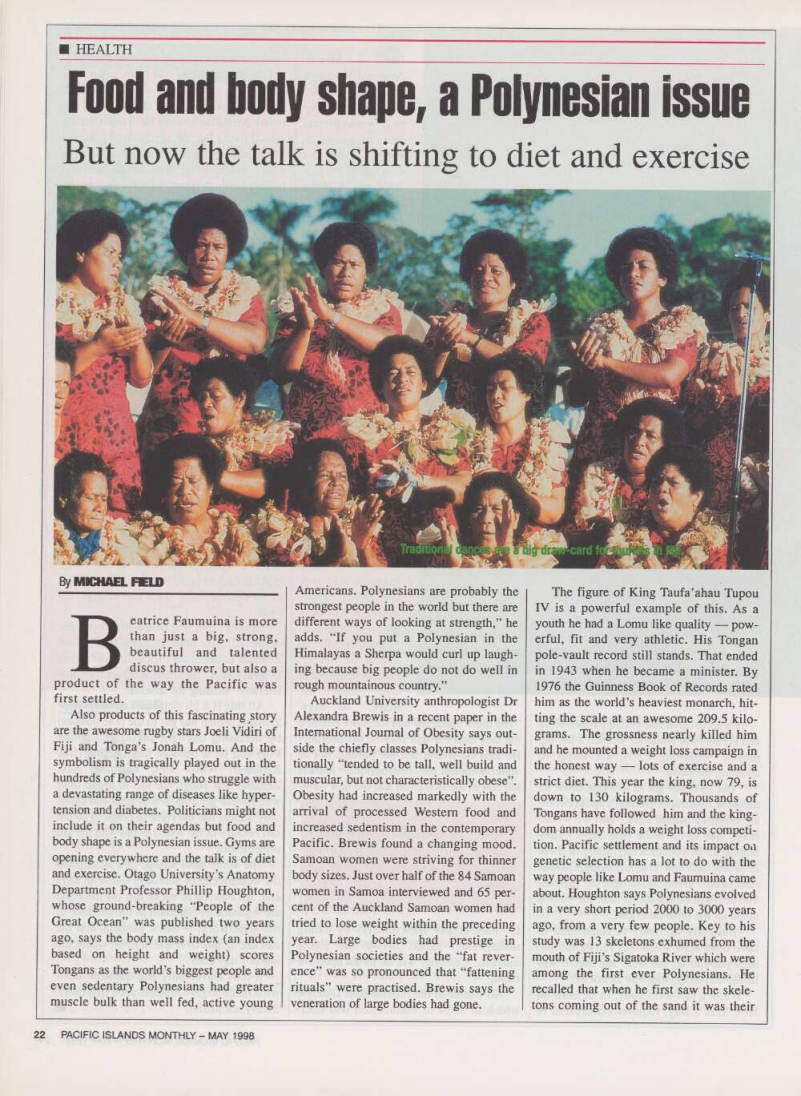
Beatrice Faumuina is more than just a big, strong, beautiful and talented discus thrower, but also a product of the way the Pacific was first settled.
Also products of this fascinating story are the awesome rugby stars Joeli Vidiri of Fiji and Tonga’s Jonah Lomu. And the symbolism is tragically played out in the hundreds of Polynesians who struggle with a devastating range of diseases like hyper tension and diabetes. Politicians might not include it on their agendas but food and body shape is a Polynesian issue. Gyms are opening everywhere and the talk is of diet and exercise. Otago University’s Anatomy Department Professor Phillip Houghton, whose ground-breaking “People of the Great Ocean” was published two years ago, says the body mass index (an index based on height and weight) scores Tongans as the world’s biggest people and even sedentary Polynesians had greater muscle bulk than well fed, active young
Americans. Polynesians are probably the strongest people in the world but there are different ways of looking at strength,” he adds. “If you put a Polynesian in the Himalayas a Sherpa would curl up laugh ing because big people do not do well in rough mountainous country.”
Auckland University anthropologist Dr Alexandra Brewis in a recent paper in the International Journal of Obesity says out side the chiefly classes Polynesians tradi tionally “tended to be tall, well build and muscular, but not characteristically obese”.
Obesity had increased markedly with the arrival of processed Western food and increased sedentism in the contemporary Pacific. Brewis found a changing mood.
Samoan women were striving for thinner body sizes. Just over half of the 84 Samoan women in Samoa interviewed and 65 per cent of the Auckland Samoan women had tried to lose weight within the preceding year. Large bodies had prestige in Polynesian societies and the “fat rever ence” was so pronounced that “fattening rituals” were practised. Brewis says the veneration of large bodies had gone.
The figure of King Taufa’ahau Tupou
IV is a powerful example of this. As a youth he had a Lomu like quality pow erful, fit and very athletic. His Tongan pole-vault record still stands. That ended in 1943 when he became a minister. By 1976 the Guinness Book of Records rated him as the world’s heaviest monarch, hit ting the scale at an awesome 209.5 kilo grams. The grossness nearly killed him and he mounted a weight loss campaign in the honest way lots of exercise and a strict diet. This year the king, now 79, is down to 130 kilograms. Thousands of Tongans have followed him and the king dom annually holds a weight loss competi tion. Pacific settlement and its impact on genetic selection has a lot to do with the way people like Lomu and Faumuina came about. Houghton says Polynesians evolved in a very short period 2000 to 3000 years ago, from a very few people. Key to his study was 13 skeletons exhumed from the mouth of Fiji’s Sigatoka River which were among the first ever Polynesians. He recalled that when he first saw the skele tons coming out of the sand it was their
bigness that made him realise Polynesians had been subjected to a ruthless maritime selection process. It was the cold that did it. The Pacific can actually be a very cold place, especially for people who were exploring it at sea with Neolithic technolo gy and little protection from the cold winds and wet weather,” Houghton says.
Polynesians survived by evolving quickly
into big muscular people; the bigger you are the more muscle you have, the more heat you can generate.
“What you see is the selection process of evolution... You can show quite neatly that if you are big and muscular you can survive a few nights of cold at sea in a small boat, but if you are thin and light
you’ll die of exposure quite quickly.”
Houghton’s work is controversial but an associated explanation for Polynesian shape is because of the way droughts and hurricanes affected the food supply.
Auckland Institute of Technology anatomy and physiology lecturer Elaine Rush stud ied metabolic rates and found in Polynesian women it was lower than that of the Caucasian and therefore they were
using less energy. Certain races had evolved to store fat. In times of famine those are the ones who survive and that’s how it used to be in the islands, when hur ricanes came through and wiped out the food supply,” Rush says. Nowadays food is less of a worry as a flood of western foods arrived and some of the worst, in terms of fat, assumed a cultural status, as Samoa’s High Commissioner to New Zealand, Feesago Fepule’ai, noted at a recent Pacific medical conference. The ultimate prize on the acceptance and inte gration of these foods into our way of life must surely go to my own Samoa where for many years now our young and the not so young lovers have serenaded their sweethearts with the sweet refrain that praises that most desirable of cuisine the Hellaby corned beef.” Quoting from the United Nations Children’s Fund he noted “these foods are killing or disabling
our people...
“There is a very clear moral dimension here; many of these foods are simply dumped on our people by the food proces sors of developed countries,” Feesago said.
“We all pay a price in obesity, high blood pressure, diabetes and other life style diseases which impose a greater and longer burden on us than something like AIDS has or will.”
Auckland’s Metro magazine recently noted the “The Polynesianisation of Sport” in New Zealand and quoted then All Black trainer Jim Blair explaining that the
Polynesian is basically mesomorphic,
tending to be big-boned, muscular, of aver age height, wide shoulders, thin waist.
“They have a higher proportion of fast twitch muscle fibre which is the source of their explosive style and the reason they are fast over short distances and the reason you don’t see Polynesian marathon run ners.” And the point is that with a good diet, good coaching and money for resources, Polynesians could take over some world sports easily. That’s why somebody like Beatrice Faumuina, who won gold at this year’s world athletics championships in Athens, is both an inspi rational role model and awesome warning to other sports people that the Polynesians are coming. ■