Millennium's first child a
pp. 20-21 · Read in the full issue
Millennium
Millennium's first child a Pacific island celebrity?
By Michael F[?]Eld
While everybody
argues about where the Millennium’s first rays will strike, the really intriguing question is: Who will be the first citizen of the new age? And will she be a Pacific Islander? Or maybe he, although the odds slightly favour a girl, bom into the world soon after midnight on First of January, 2000.
Conceived in the autumn and bom into the height of the summer, a life-time of celebrity awaits the child - provided the birth has not been too contrived. Maybe she will arrive at Nukualofa’s Vaiola Hospital, or Suva’s Colonial War
Memorial Hospital, although the smart money will be Auckland’s National Women’s Hospital, New Zealand’s busiest birthing centre. Or perhaps, poetically, in a bure on Taveuni, in Fiji where the 180 degree line runs across dry land.
It is a fair chance that, for the Pacific millennium, the child will be a Pacific Islander. The day’s first light always falls first across Fiji (with its hour of daylight savings added), Tonga and New Zealand two to three hours before Australia even departs the old century.
On average New Zealand produces six infants an hour, Fiji two and Tonga one child every three hours.
Of New Zealand’s newborns, one every hour is indigenous Maori while a new
Pacific Island New Zealander arrives every two hours. The lonely Chatham Islands, 860 kilometres east of New Zealand will first greet the Millennium, which is 45 minutes ahead of Fiji with dayligh t savings and one hour 45 minutes ahead of Tonga.
The Chatham’s hospital handles four births a year. None of them are first boms and any threat of complications sees the pregnant mother put on a plane for New Zealand. Not so in Taveuni where they have around 30 births a month and could easily produce the first child.
Although a French television network was recently in Taveuni, the problem for the first child there is that it is likely to be an obscure event, uncovered by the world’s media.
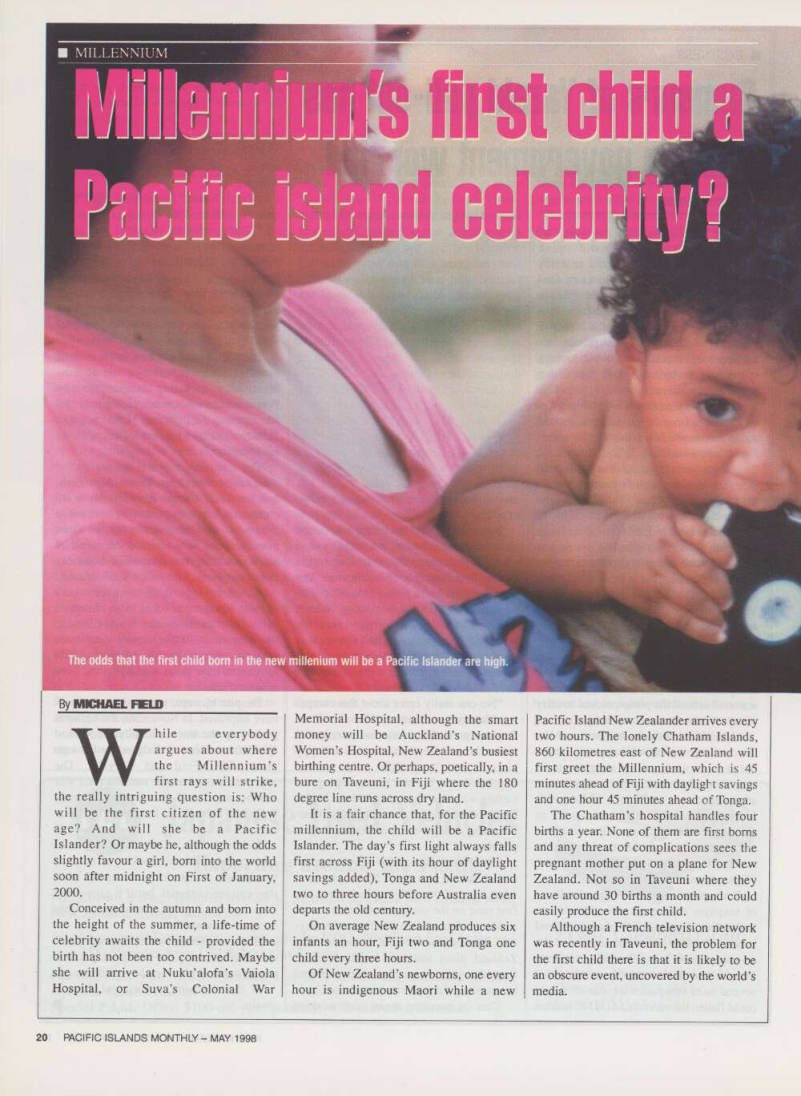
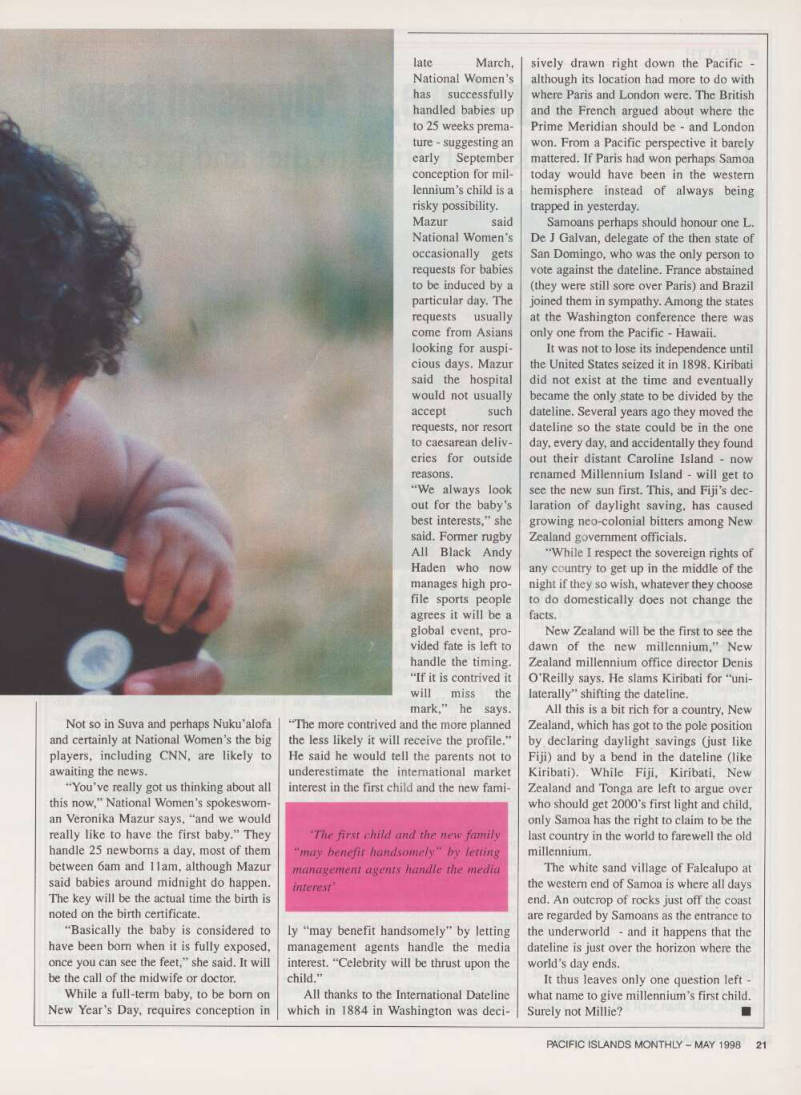
The odds that the first child bom in the new millenium will be a Pacific Islander are high.
Not so in Suva and perhaps Nuku’alofa and certainly at National Women’s the big players, including CNN, are likely to awaiting the news.
“You’ve really got us thinking about all this now,” National Women’s spokeswom an Veronika Mazur says, “and we would really like to have the first baby.” They handle 25 newborns a day, most of them between 6am and 11am, although Mazur said babies around midnight do happen.
The key will be the actual time the birth is noted on the birth certificate.
“Basically the baby is considered to have been bom when it is fully exposed, once you can see the feet,” she said. It will be the call of the midwife or doctor.
While a full-term baby, to be bom on New Year’s Day, requires conception in
late March, National Women’s has successfully handled babies up to 25 weeks prema ture - suggesting an early September conception for mil lennium’s child is a
risky possibility.
Mazur said National Women’s
occasionally gets
requests for babies to be induced by a particular day. The
requests usually
come from Asians looking for auspi cious days. Mazur said the hospital would not usually accept such requests, nor resort to caesarean deliv eries for outside reasons.
“We always look out for the baby’s best interests,” she said. Former rugby All Black Andy Haden who now manages high pro file sports people agrees it will be a global event, pro vided fate is left to handle the timing.
“If it is contrived it will miss the mark,” he says.
“The more contrived and the more planned the less likely it will receive the profile.”
He said he would tell the parents not to underestimate the international market interest in the first child and the new fami
‘The first child and the new family “may benefit handsomely” by letting management agents handle the media interest’
ly “may benefit handsomely” by letting management agents handle the media interest. “Celebrity will be thrust upon the child.”
All thanks to the International Dateline which in 1884 in Washington was deci
sively drawn right down the Pacific although its location had more to do with where Paris and London were. The British and the French argued about where the Prime Meridian should be - and London won. From a Pacific perspective it barely mattered. If Paris had won perhaps Samoa today would have been in the western hemisphere instead of always being trapped in yesterday.
Samoans perhaps should honour one L.
De J Galvan, delegate of the then state of San Domingo, who was the only person to vote against the dateline. France abstained (they were still sore over Paris) and Brazil joined them in sympathy. Among the states at the Washington conference there was only one from the Pacific - Hawaii.
It was not to lose its independence until the United States seized it in 1898. Kiribati did not exist at the time and eventually became the only state to be divided by the dateline. Several years ago they moved the dateline so the state could be in the one day, every day, and accidentally they found out their distant Caroline Island - now renamed Millennium Island - will get to see the new sun first. This, and Fiji’s dec laration of daylight saving, has caused growing neo-colonial bitters among New Zealand government officials.
“While I respect the sovereign rights of any country to get up in the middle of the night if they so wish, whatever they choose to do domestically does not change the facts.
New Zealand will be the first to see the dawn of the new millennium,” New Zealand millennium office director Denis O’Reilly says. He slams Kiribati for “uni laterally” shifting the dateline.
All this is a bit rich for a country, New Zealand, which has got to the pole position
by declaring daylight savings (just like
Fiji) and by a bend in the dateline (like Kiribati). While Fiji, Kiribati, New Zealand and Tonga are left to argue over who should get 2000’s first light and child, only Samoa has the right to claim to be the last country in the world to farewell the old millennium.
The white sand village of Falealupo at the western end of Samoa is where all days end. An outcrop of rocks just off the coast are regarded by Samoans as the entrance to the underworld - and it happens that the dateline is just over the horizon where the world’s day ends.
It thus leaves only one question left what name to give millennium’s first child.
Surely not Millie? ■