Paradise in disarray
pp. 8-9 · Read in the full issue
Special Report
Inquiry slams Rarotogan Hotel deal
By Florence Syme-Buchanan
The Public Expenditure and
Review Committee report on the government sale of the Rarotongan Hotel pointed to blatant irregularities saying the deal failed to be of any advantage to the Cook Islands.
The report concluded that Government could not claim that the transaction was carried out in a “fully arms-length, trans parent and contestable manner.”
It examined how the Hotel sale was handled by government, rather than how the purchaser Tata Crocombe of Rarotongan Resort Hotel Ltd (RRHL) negotiated what appears to be the deal of a lifetime. In 1995, when Government’s near bankruptcy became public, Prime Minister Sir Geoffrey Henry announced a Five Point Recovery Plan. The main thrust of the plan was the sale of state owned assets to repay some of the country’s $203 million debt.
All government owned hotels, the Rarotongan, Rapae Hotel, Vaimaanga Hotel Project and Aitutaki Resort were put up for sale.
Marketing the sale of the Rarotongan and Aitutaki Resorts alone cost taxpayers $35,000. The Government stated the Rarotongan Hotel’s trading losses as being in excess of $500,000 a year - this figure later increased to $750,000. It was also stated that Government had lost in excess of $lO million since the Hotel began oper ating in 1977.
A New Zealand company, JLW Transact, was contracted by Government to effect the sale of the state owned Hotels.
This, the Government Privatisation Committee told JLW Transact, was to be “in accordance with Government’s policy of a fully arms-length, transparent and con
testable approach.”
At the closure of expressions of interest on 23 May, 1996, there were three main bids. Preferred bidder was an Australian company which offered $6 million. Bids received from a Hawaiian company ($8.4
million) and a Seattle entity for $3.5 mil lion were not recommended by JLW Transact.
The report states that support for the Australian company was based on the fact that the offer was ‘significantly cleaner’ than that offered by the Hawaiian company and at a pricing level that the sales agent considered to be far more realistic for the property.
Despite JLW Transact’s advice.
Government selected the Hawaiian compa ny as the purchaser and proceeded to draft a sales and purchase agreement. However, the company withdrew from the sale pro cess. PERCA was unable to establish why JLW Transact’s preferred buyer - the Australian company - was not pursued fur ther.
PERCA noted in JLW Transact’s letter supporting Crocombe and Co’s bid, the sales agent stated the Australian company had withdrawn their bid. The Australian company subsequently confirmed to the Committee that they were never informed that their offer was not acceptable or that another offer had been accepted.
The company also states that they had never withdrawn their offer and are still unaware of what actually happened in regard to the sale of the property.
Government signed a sales and purchase agreement with Tata Crocombe’s Rarotongan Resort Hotel Ltd on 14 November 1996.
But a major obstacle to the transaction was the mortgage held over the property by the Republic of Nauru. Key aspects of the agreement were that a promissory note be signed by Crocombe for the purchase price of $3.5 million. The promissory note stipulated that the purchase price would not accrue interest and would be repayable in full on any resale of the assets.
PERCA has established that although JLW Transact had endorsed the sale of the Hotel to RRHL, the company had never seen Crocombe’s offer nor the terms of the Agreement. “The sales agent simply responded and commented to the terms of
the proposed sale to the purchaser, as advised to them by the vendor (Government),” reads the PERCA report.
And despite RRHL being identified by Government as preferred buyer and not by the sales agent, JEW Transact was paid a commission of $81,250.
Government justified the Hotel sale to RRHL because Tata Crocombe was the only potential purchaser to put forward a “serious deposit” of $lOO,OOO. The PERCA report contested this as the $lOO,OOO was repaid to the purchaser and “was not a deposit per se.”
“It was never part of the purchase price, but was a fully refundable sum irrespective of the outcome of the sale process.”
Neither was it a requirement of the bidding process for a deposit to be made - other than $2OOO to enter the bidding process.
Potential bidders were only asked to iden tify the minimum deposit they would make should their bid eventually be successful.
Another factor in Crocombe’s favour was the expression to invest further in the property - $3 million on its upgrade and $ 1 million in equity.
The report states the original bidding process didn’t require specific commit ments to upgrade the property. It said if Government had placed undue emphasis on the upgrade factor, “then clearly other bidders were disadvantaged in not being required to address this issue.”
Government press releases and Cabinet Memorandums suggested that the Hotel was being sold for a $6.25 million pack age. This was misleading in that the sale price of $3.25 million was on paper only in the form of the promissory note.
The remaining $3 million was to upgrade the Hotel and was of no monetary benefit to Government. The entire benefit of the upgrade would be to the purchaser only. The resulting deal, in which Government ended up paying for the reno vations rather than RRHL, makes a further mockery of the “$6.25 package”.
No “equity payment” has been made to the vendor. The non-payment of equity may have been caused by problems with the Government of Nauru mortgage and title to the Hotel could not be given to
Crocombe. “A consequence was the pur chaser could not raise money on the secu rity of the Hotel which he still did not own, he couldn’t refurbish what wasn’t his prop erty.” The Hotel was the venue for the South Pacific Forum, the opening of which was getting uncomfortably close for Government. In August 1997 Government was able to clear the mortgage with Nauru by paying $3 million obtained from the sale of 20 percent of Telecom Cls shares to Telecom NZ. With the Forum just a month away and Crocombe unable to refurbish the Hotel, Government elected to pay for job itself, spending a total of $2,075 mil lion for the facelift. Of this, $lOO,OOO was paid to landowners to settle rental arrears and reviews.
The money came from a public account at the ANZ Bank which was earmarked for the repayment of an Asian Development Bank loan to Telecom. Of this, $700,000 was unauthorised expenditure.
An 11 -page Deed of Variation was approved by Cabinet and subsequently signed on 3 September 1997. Reliable
sources say it was highly unlikely that any of the Cabinet Ministers, apart from Sir Geoffrey who strongly favoured selling the Rarotongan Hotel to a Cook Islander, fully understood the terms of the original 27page Sale and Purchase Agreement. None was apparently given sufficient time to examine the Agreement.
Neither were they given enough time to study the Deed of Variation, itself a com plex legal document that took one local lawyer “two hours to go through.” The main changes to the original agreement were: • A cap of ten years placed on repay ment of the $3.5 purchase price - there originally was no time limit. • Government’s renovation costs to be repaid after one year at 13.25% interest. • Deletion of RRHL’s required $lOO,OOO share capital. • Condition of obtaining $2 million bank financing deleted as was the $lOO,OOO refundable ‘deposit.’ The ‘deposit’ had already been refunded in April 1997.
• Also deleted was the requirement to enter into a management agreement with Outrigger Resorts and Hotels of Hawaii for the management of the Hotel after comple tion date.
This was replaced by a clause requiring management by an international operator not later than 12 weeks after completion date of the Agreement. It’s understood that this final requirement still has to be ful filled by Tata Crocombe. Of significance too is that no other potential purchasers knew that the Hotel could be acquired on the basis of a promissory note.
Criticism has also been levelled, at the National Development Council and Chamber of Commerce, that Tata Crocombe, who had headed ' the Government’s assets sales programme, had an unfair advantage in negotiating the pur chase of the Hotel. But the most glaring irony is that Government failed to make any money from the sale that was supposed to help reduce national debt; instead the deal has left the country millions of dollars poorer. ■
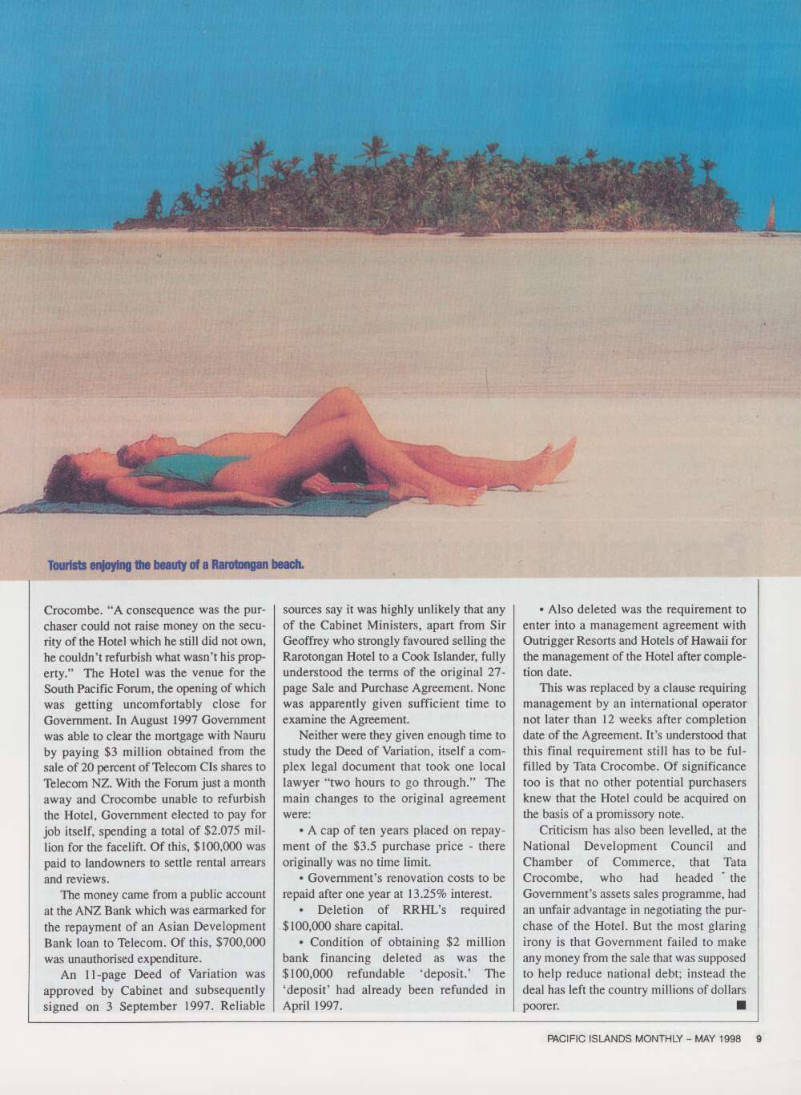
Tourists enjoying the beauty of a Rarotongan beach.