Slow-down hits Pacific economies
Economy
By Sophe Foster Hildebrand
The short-term growth prospects for the Pacific remained “generally
unpromising” according to
the Economic and Social Survey of Asia and the Pacific. However, the ESCAP report, released in mid-April, said that long-term improvements were possible because of structural reforms that many Pacific Island countries had committed themselves to. “Other than Samoa and Solomon Islands, which showed 7 and 4 per cent, these economies generally achieved less than 3 per cent growth in 1996. “Economic growth rates remained low in 1997 also, reflecting in part the softening of the prices of agricultural com modities and primary materials.”
The prospect for 1998, the report says, is that the negative impact of the financial crisis in Asia may affect some exports adversely. While Samoa and the Solomon Islands recorded relatively high growth
rates, their rates of inflation have also been high over a number of years. The report says the inflation rate of the Solomon Islands has been “traditionally high” rang ing from 9 to 15 per cent since 1991.
Samoa’s inflation rate has ranged from 1 to 18.4 per cent in the 1990 s because of its vulnerability to natural disasters and short age of staple crops.
Papua New Guinea recorded a double digit inflation rate in 1995-96 because of the devaluation of their dollar. Flotation of the local currency as a result of an eco nomic crisis in late 1994 also affected that country’s inflation rate. The report says that Pacific Other Pacific island countries have recorded inflation rates below 6 per cent since 1993. ■
The prospects tor 1998 Is that the negative Impact of the financial crisis in Asia may affect some exports adversely'
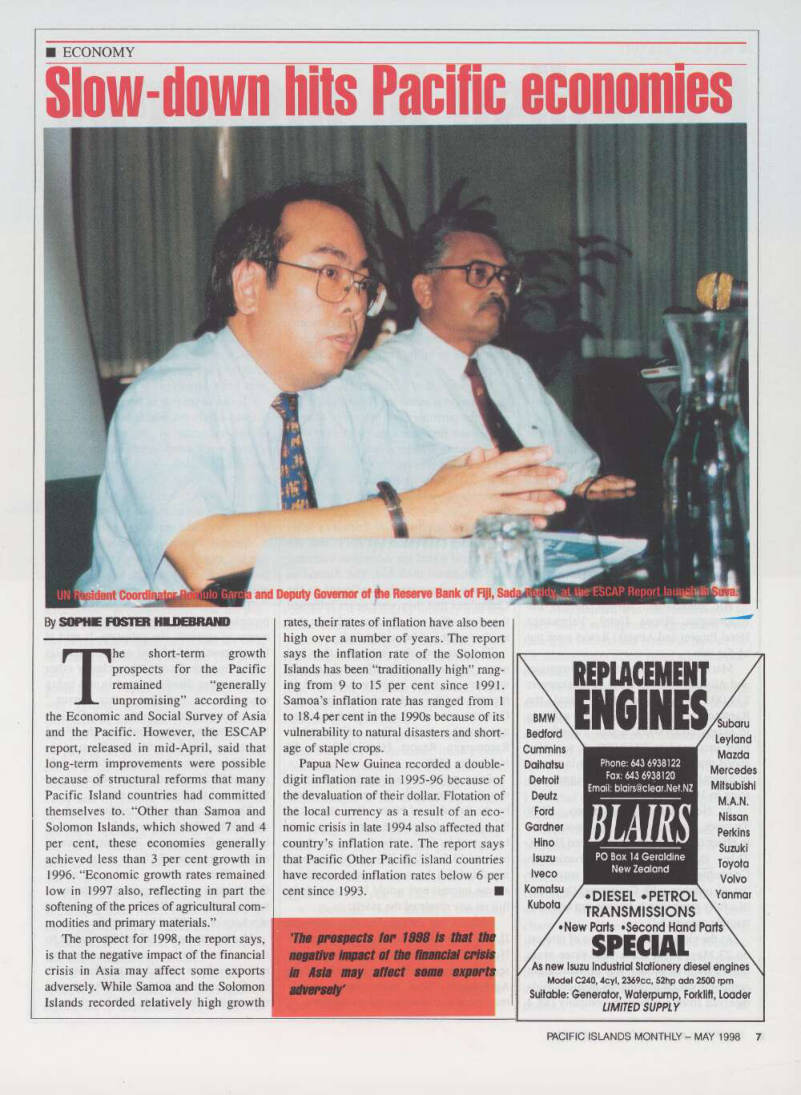
UN Residen Coordinator Romulo Garcia and Deputy Governor of the Reserve Bank of Fiji, Sade Reddy, at the ESCAP Report launch in Suva.