Die end for Vaega
pp. 48-49 · Read in the full issue
Sports
By Atama Raganivatu
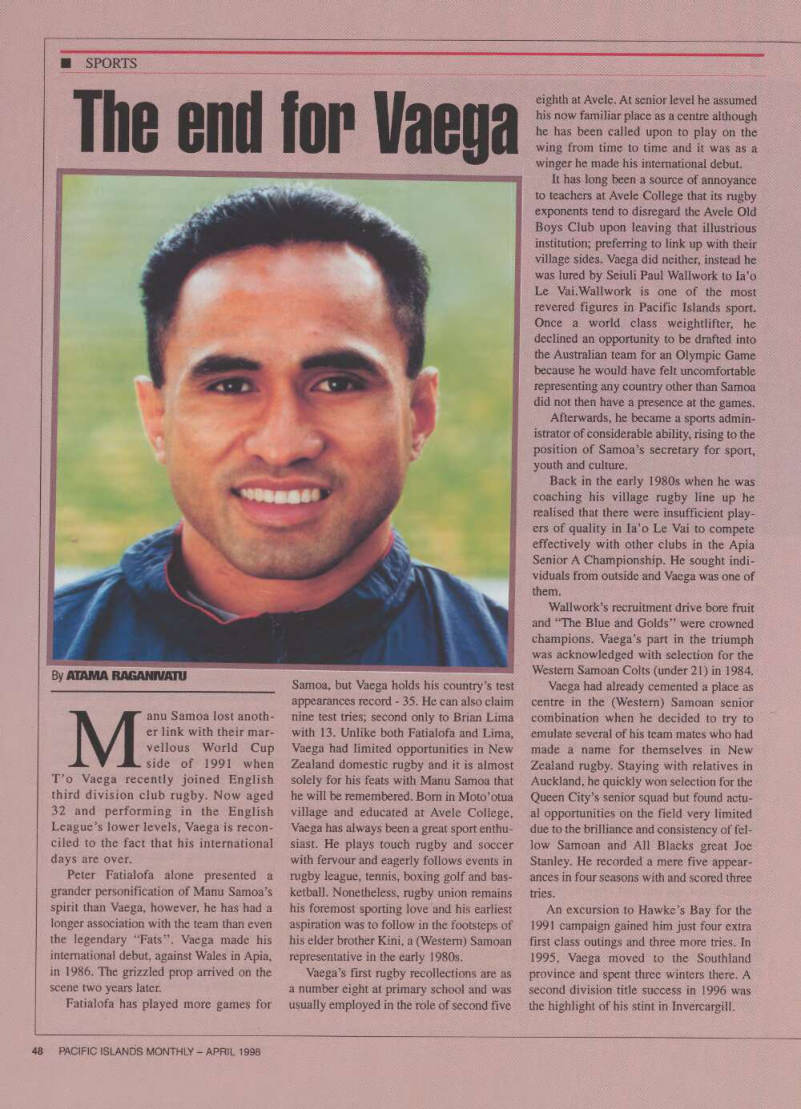
Manu Samoa lost anoth er link with their mar vellous World Cup side of 1991 when T’o Vaega recently joined English third division club rugby. Now aged 32 and performing in the English League’s lower levels, Vaega is recon ciled to the fact that his international days are over.
Peter Fatialofa alone presented a grander personification of Manu Samoa’s spirit than Vaega, however, he has had a longer association with the team than even the legendary “Fats”. Vaega made his international debut, against Wales in Apia, in 1986. The grizzled prop arrived on the scene two years later.
Fatialofa has played more games for
Samoa, but Vaega holds his country’s test appearances record - 35. He can also claim nine test tries; second only to Brian Lima with 13. Unlike both Fatialofa and Lima, Vaega had limited opportunities in New Zealand domestic rugby and it is almost solely for his feats with Manu Samoa that he will be remembered. Bom in Moto’otua village and educated at Avele College, Vaega has always been a great sport enthu siast. He plays touch rugby and soccer with fervour and eagerly follows events in rugby league, tennis, boxing golf and bas ketball. Nonetheless, rugby union remains his foremost sporting love and his earliest aspiration was to follow in the footsteps of his elder brother Kini, a (Western) Samoan representative in the early 1980 s.
Vaega’s first rugby recollections are as a number eight at primary school and was usually employed in the role of second five
eighth at Avele. At senior level he assumed his now familiar place as a centre although he has been called upon to play on the wing from time to time and it was as a winger he made his international debut.
It has long been a source of annoyance to teachers at Avele College that its rugby exponents tend to disregard the Avele Old Boys Club upon leaving that illustrious institution; preferring to link up with their village sides. Vaega did neither, instead he was lured by Seiuli Paul Wallwork to la’o Le Vai. Wall work is one of the most revered figures in Pacific Islands sport.
Once a world class weightlifter, he declined an opportunity to be drafted into the Australian team for an Olympic Game because he would have felt uncomfortable representing any country other than Samoa did not then have a presence at the games.
Afterwards, he became a sports admin istrator of considerable ability, rising to the position of Samoa’s secretary for sport, youth and culture.
Back in the early 1980 s when he was coaching his village rugby line up he realised that there were insufficient play ers of quality in la’o Le Vai to compete effectively with other clubs in the Apia Senior A Championship. He sought indi viduals from outside and Vaega was one of them.
Wallwork’s recruitment drive bore fruit and “The Blue and Golds” were crowned champions. Vaega’s part in the triumph was acknowledged with selection for the Western Samoan Colts (under 21) in 1984.
Vaega had already cemented a place as centre in the (Western) Samoan senior combination when he decided to try to emulate several of his team mates who had made a name for themselves in New Zealand rugby. Staying with relatives in Auckland, he quickly won selection for the Queen City’s senior squad but found actu al opportunities on the field very limited due to the brilliance and consistency of fel low Samoan and All Blacks great Joe Stanley. He recorded a mere five appear ances in four seasons with and scored three tries.
An excursion to Hawke’s Bay for the 1991 campaign gained him just four extra first class outings and three more tries. In 1995, Vaega moved to the Southland province and spent three winters there. A second division title success in 1996 was the highlight of his stint in Invercargill.
In addition, he experienced Super Twelve rugby with the Otago Highlanders in 1996 and 1997 but a spate of injuries restricted his effectiveness in that competi tion.
Vaega is one of the very few sportsmen whose influences in the test arena have given him his best rugby memories and the most cherished of them all came in 1991, when he scored the try which clinched the much celebrated defeat of Wales at Cardiff.
So thrilled was he by the events in the Welsh capital that he christened his new born boy Cardiff.
Vaega appeared in all the eight World Cup games Manu Samoa have graced to date. His incisive running has also been put to good effect in sevens rugby, most spec tacularly during Samoa’s Hong Kong vic tory of 1993.
The following year the powerhouse centre was offered a small fortune to sign for Australian rugby league outfit Cronulla Sutherland. After a great deal of consider ation, he turned them down and remained loyal to Manu Samoa. Only after an injury plagued in 1997, and realising Manu Samoa, with several promising young cen tres on call as well as the incomparable Va’aiga Tuigamala, would no longer require his services, did Vaega shift his focus away from the team that is so close to his heart.
Rugby, a club based in the English Midlands towns whose school gave the sport its name, offered Vaega an attractive financial package and he has chosen to wind his career down there.
But, there is a real chance he will not be lost to Samoan rugby for ever. Vaega has already indicated that he possess the cre dentials to be a top quality coach.
Despite his continuous reluctance to make himself available for their Old Boys’, Vaega was asked to prepare the Avele College XV that travelled to the 1992 World Schools Championship in New Zealand. They amazed everyone by finishing as runners up. His advice to the Avele boys was: “If you want to be a top sports person, you must keep fit, train hard and give all you’ve got in every game. Any match you play you must enjoy.”
Those words encapsulate the Samoan rugby philosophy. Sadly, at the current stage. Samoa has more star footballers than competent coaches.
Hopeful Vaega will be reducing the gap before too long. ■