returns home
pp. 49-51 · Read in the full issue
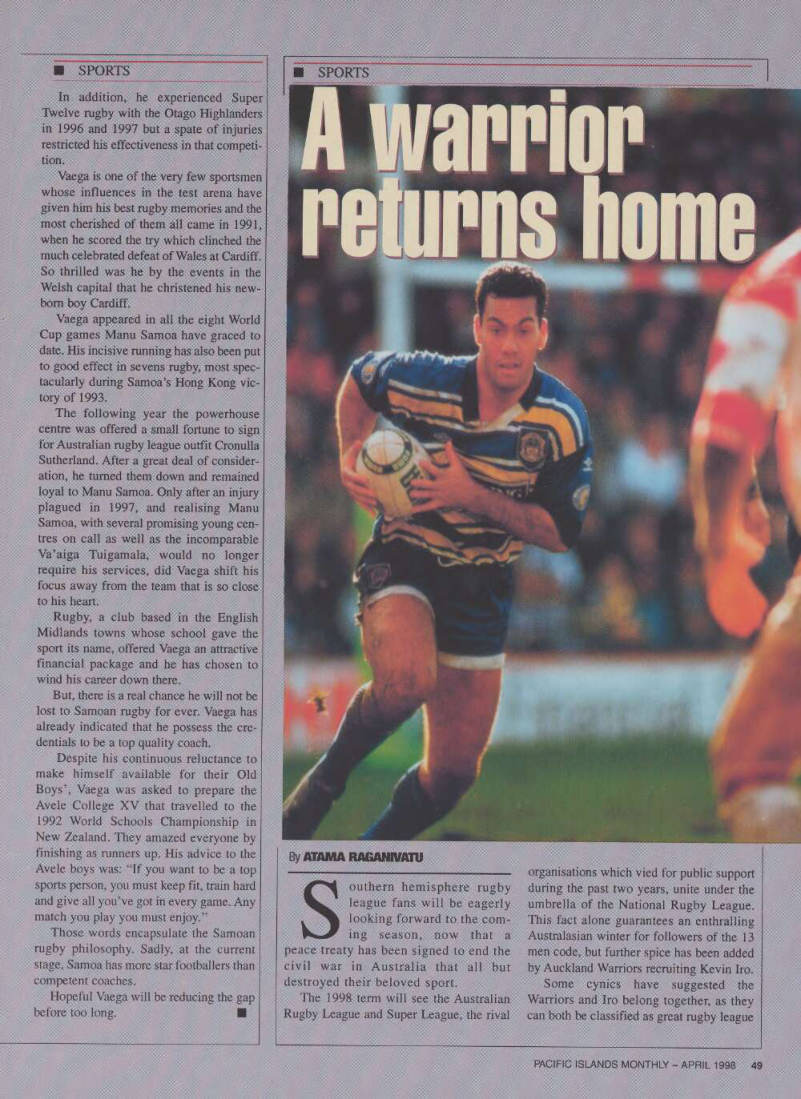
A warrior returns home
By Atama Raganivaiu
Southern hemisphere rugby
league fans will be eagerly looking forward to the coming season, now that a peace treaty has been signed to end the civil war in Australia that all but destroyed their beloved sport.
The 1998 term will see the Australian Rugby League and Super League, the rival
organisations which vied for public support during the past two years, unite under the umbrella of the National Rugby League.
This fact alone guarantees an enthralling Australasian winter for followers of the 13 men code, but further spice has been added by Auckland Warriors recruiting Kevin Iro.
Some cynics have suggested the Warriors and Iro belong together, as they can both be classified as great rugby league
underachievers. Such comments are cruel and unwarranted. Admittedly, the Warriors have not yet fulfilled their potential(in a mere three years of existence) and there are those who argue Iro has done less well than might normally be expected. Yet, an awful lot was expected of the Cook Islander following his dramatic introduc tion to the international scene 11 years ago.
Iro was a virtual unknown when pitched into the test arena in 1987.
Although he had represented New Zealand at schoolboys and junior international lev els, his senior experience was confined to just a handful of outings for the Mount Albert Club in the Auckland city champi onship when the Kiwi selectors sensation ally drafted him into their unit to meet Papua New Guinea at Port Moresby.
The 19 year old tore the hapless Kumuls apart! He scored three tries and four goals, to register 20 points. Never had
anybody accumulated so many on their international debut.
Nine days later, Iro confirmed the dis play against PNG to be no fluke by totally eclipsing his illustrious opposite number Gene Miles as New Zealand gained a rare 13-6 victory over world champions Australia in Brisbane.
Iro was suddenly a wanted man.
Leading clubs in Australia and Britain lined up to try and lure him away from Mount Albert and into the big time. The famous British outfit Wigan succeeded.
The big, powerful and pacy centre took British rugby league by storm while Wigan, under New Zealand coach Graham Lowe, maintained a long period of domes tic dominance. Nicknamed “The Beast” by local fans, Iro helped The Riversiders cap ture eight major trophies during his four seasons with them. Of his plentiful feats in the service of the Lancashire Club, the
most noteworthy was scoring a brace of tries in three successive Rugby League Challenge Cup finals at Wembley Stadium.
However, chauvinistic southern hemi sphere rugby league aficionados tend to dismiss British club fare as second rate and, when Iro followed his mentor Lowe to Manly in Sydney, they insisted that only in the Winfield Cup would he be able to prove his true worth.
Despite joining The Sea Eagles imme diately after undergoing a knee operation, he started his Australian career strongly.
Iro had been chosen to partner the great Mai Meninga in 1990 World XIII and a multitude of pundits then confidently pre dicted he would succeed Meninga as the game’s top centre. But Iro failed to grab Australian rugby league by the scruff of the neck and give it a good shake as he had with its British counterpart. Perhaps the
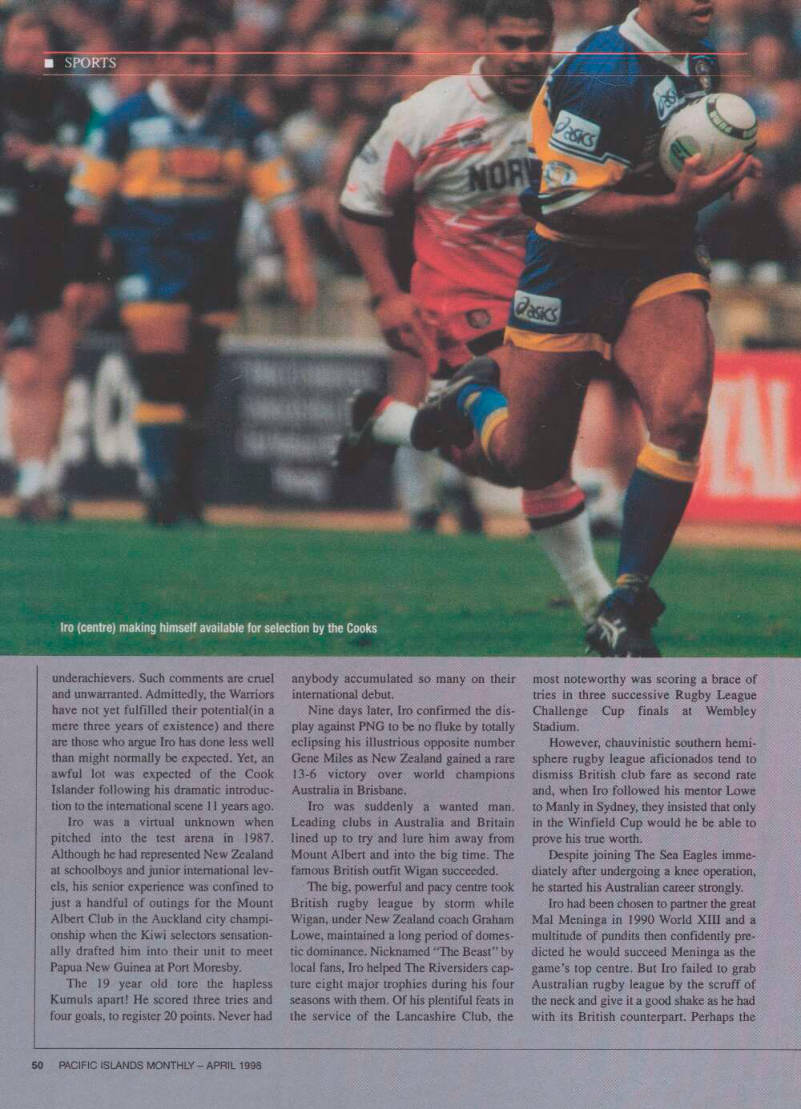
Iro (centre) making himself available for selection by the Cooks
grind of playing rugby league virtually without a break for four years from 1988 to 1991 was catching up with him, or a series of injuries or, more likely, the unfamiliar demands of a competition in which there were no easy canters (in stark contrast to his English experience). Whatever the rea son, Iro only occasionally sparkled. Even so, he was a valued member of the Manly side which reached the 1991 Winfield Cup semi finals. In 1992 Iro returned to Britain, upon being offered a lucrative contract by Leeds. “The Loiners”, as they are curious ly nicknamed, were then among England’s wealthiest clubs and boasted an impressive history. But, throughout Iro’s stint with them, they had to be content being one of the also rans following in Wigan’s wake.
Iro found himself relegated to the reserves when New Zealand began their 1995 World Cup campaign with mediocre performances against Tonga and PNG. He
was promoted to the starting line up for the semi final versus eventual trophy winner Australia and responded with an inspired display. But if it wasn’t for a late conver sion miss by the usually reliable Mathew Ridge, the unfancied Kiwis would have caused a huge upset. The rugby league world had been reminded that Iro remained a centre of exceptional class. Yet, before the acclaim could subsidise, he announced he would never again represent New Zealand. Iro has yet to say why though sev eral commentators speculated about a rift between him and Kiwi administrators. At the same point, he stated he was consider ing making himself available for selection by the Cook Islands in future.
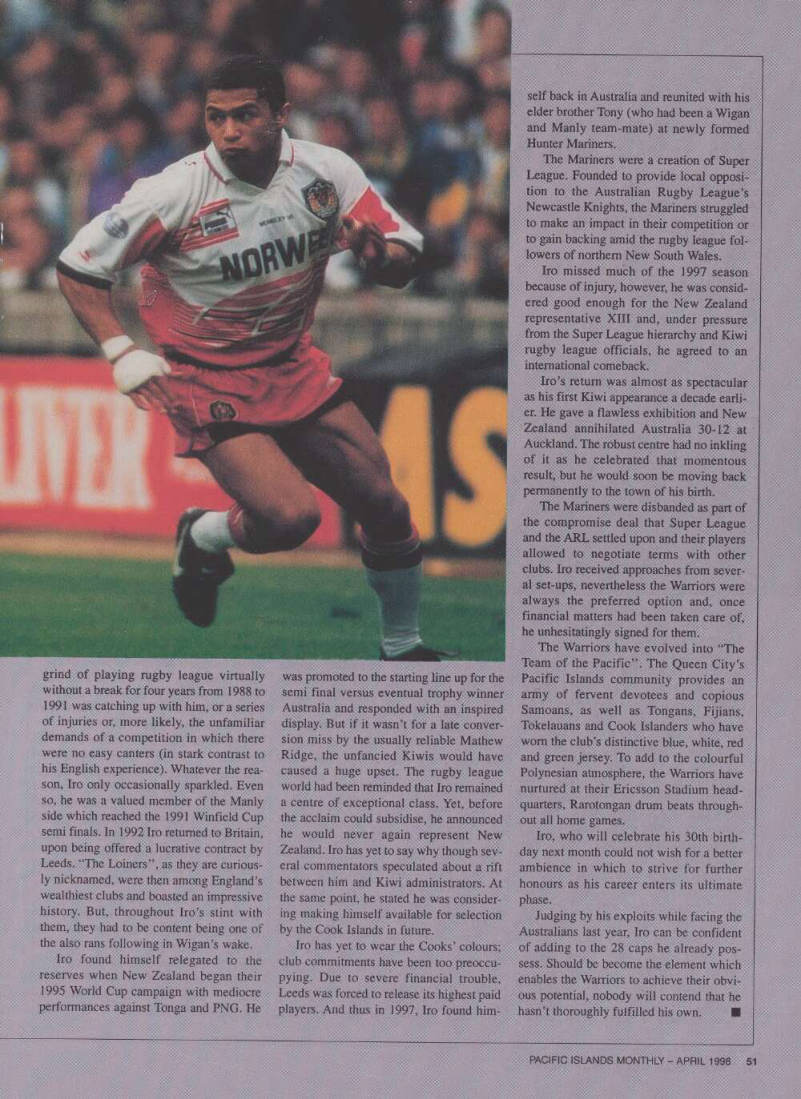
Iro has yet to wear the Cooks’ colours; club commitments have been too preoccu pying. Due to severe financial trouble, Leeds was forced to release its highest paid players. And thus in 1997, Iro found him-
The Mariners were a creation of Super lowers of northern New South Wales. ered good enough for the New Zealand representative XIII and, under pressure from the Super League hierarchy and Kiwi rugby league officials, he agreed to an international comeback.
Iro’s return was almost as spectacular as his first Kiwi appearance a decade earli er. He gave a flawless exhibition and New Zealand annihilated Australia 30-12 at Auckland. The robust centre had no inkling of it as he celebrated that momentous result, but he would soon be moving back permanently to the town of his birth.
The Mariners were disbanded as part of the compromise deal that Super League and the ARL settled upon and their players allowed to negotiate terms with other clubs. Iro received approaches from sever al set-ups, nevertheless the Warriors were always the preferred option and, once financial matters had been taken care of, he unhesitatingly signed for them.
The Warriors have evolved into “The Team of the Pacific”. The Queen City’s Pacific Islands community provides an army of fervent devotees and copious Samoans, as well as Tongans, Fijians, Tokelauans and Cook Islanders who have worn the club’s distinctive blue, white, red and green jersey. To add to the colourful Polynesian atmosphere, the Warriors have nurtured at their Ericsson Stadium head quarters, Rarotongan drum beats through out all home games.
Iro, who will celebrate his 30th birth day next month could not wish for a better ambience in which to strive for further honours as his career enters its ultimate phase.
Judging by his exploits while facing the Australians last year, Iro can be confident of adding to the 28 caps he already pos sess. Should be become the element which enables the Warriors to achieve their obvi ous potential, nobody will contend that he hasn’t thoroughly fulfilled his own. ■