Indigenous Australian music and dance
pp. 46-47 · Read in the full issue
Art
By Liz Thompson
Ngaramang Bayumi is a winding exhibition. Like wandering through the innards of a snake you wander through five different cham bers or pods, each one introducing you to a different aspect of indigenous Australian music and dance. For mil lennia, indigenous languages were spoken and sung. Storytelling, song and dance were ways in which knowl edge was passed from generation to
generation.
Indeed it is these art forms that have played a significant role in the rewriting of Australian history from an Aboriginal per spective. It is the arts which have given the loudest voice to protest.
Each of the five pods deal with individ ual themes - the second pod ngaramang (contemporary music) looks at the work of several contemporary musicians and the influences which they have drawn from English folk songs and Christian hymns to American country and western music and Jamaican reggae. The information provided explores not only the lives and careers but also the political and social issues such as
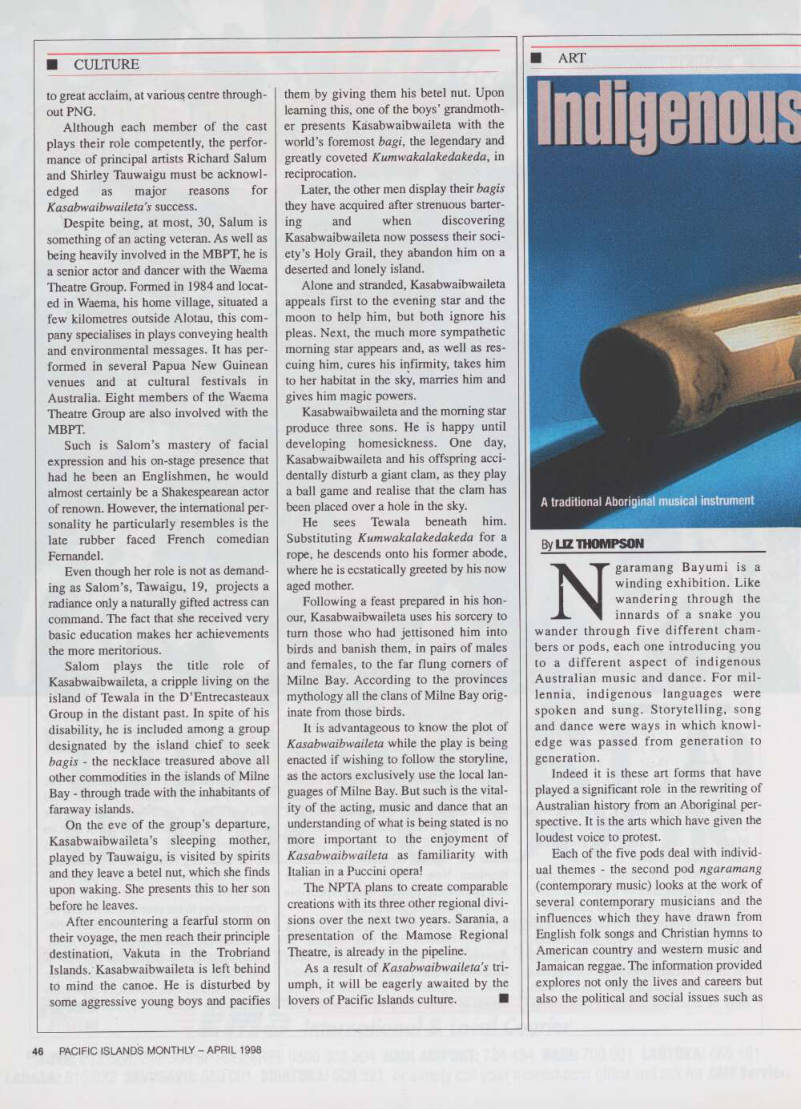
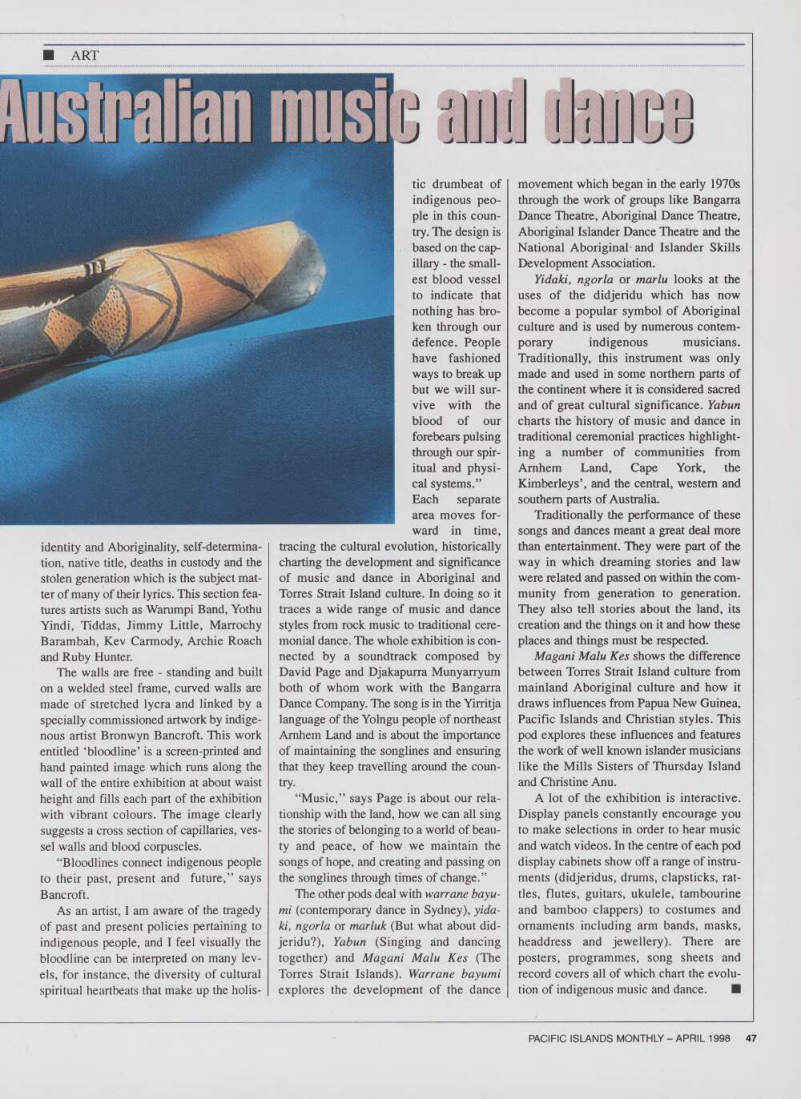
A traditional Aboriginal musical instrument
identity and Aboriginally, self-determina
tion, native title, deaths in custody and the stolen generation which is the subject mat ter of many of their lyrics. This section fea tures artists such as Warumpi Band, Yothu Yindi, Tiddas, Jimmy Little, Marrochy Barambah, Kev Carmody, Archie Roach and Ruby Hunter.
The walls are free - standing and built on a welded steel frame, curved walls are made of stretched lycra and linked by a specially commissioned artwork by indige nous artist Bronwyn Bancroft. This work entitled ‘bloodline’ is a screen-printed and hand painted image which runs along the wall of the entire exhibition at about waist height and fills each part of the exhibition with vibrant colours. The image clearly suggests a cross section of capillaries, ves sel walls and blood corpuscles.
“Bloodlines connect indigenous people to their past, present and future,” says Bancroft.
As an artist, I am aware of the tragedy of past and present policies pertaining to indigenous people, and I feel visually the bloodline can be interpreted on many lev els, for instance, the diversity of cultural spiritual heartbeats that make up the holis
tic drumbeat of indigenous peo ple in this coun try. The design is based on the cap illary - the small est blood vessel to indicate that nothing has bro ken through our defence. People have fashioned ways to break up but we will sur vive with the blood of our
forebears pulsing
through our spir itual and physi cal systems.”
Each separate area moves for ward in time,
tracing the cultural evolution, historically charting the development and significance of music and dance in Aboriginal and Torres Strait Island culture. In doing so it traces a wide range of music and dance styles from rock music to traditional cere monial dance. The whole exhibition is con nected by a soundtrack composed by David Page and Djakapurra Munyarryum both of whom work with the Bangarra Dance Company. The song is in the Yirritja language of the Yolngu people of northeast Amhem Land and is about the importance of maintaining the songlines and ensuring that they keep travelling around the coun try.
“Music,” says Page is about our rela tionship with the land, how we can all sing the stories of belonging to a world of beau ty and peace, of how we maintain the songs of hope, and creating and passing on
the songlines through times of change.”
The other pods deal with warrane bayu mi (contemporary dance in Sydney), yida ki, ngorla or marluk (But what about did
jeridu?), Yabun (Singing and dancing
together) and Magani Malu Kes (The Torres Strait Islands). Warrane bayumi explores the development of the dance
movement which began in the early 1970 s through the work of groups like Bangarra Dance Theatre, Aboriginal Dance Theatre, Aboriginal Islander Dance Theatre and the National Aboriginal- and Islander Skills
Development Association.
Yidaki, ngorla or marlu looks at the uses of the didjeridu which has now
become a popular symbol of Aboriginal
culture and is used by numerous contem porary indigenous musicians.
Traditionally, this instrument was only made and used in some northern parts of the continent where it is considered sacred and of great cultural significance. Yabun charts the history of music and dance in
traditional ceremonial practices highlight
ing a number of communities from Amhem Land, Cape York, the Kimberleys’, and the central, western and southern parts of Australia.
Traditionally the performance of these songs and dances meant a great deal more than entertainment. They were part of the way in which dreaming stories and law were related and passed on within the com
munity from generation to generation.
They also tell stories about the land, its creation and the things on it and how these places and things must be respected.
Magani Malu Kes shows the difference between Torres Strait Island culture from mainland Aboriginal culture and how it draws influences from Papua New Guinea, Pacific Islands and Christian styles. This pod explores these influences and features the work of well known islander musicians like the Mills Sisters of Thursday Island and Christine Anu.
A lot of the exhibition is interactive.
Display panels constantly encourage you to make selections in order to hear music and watch videos. In the centre of each pod display cabinets show off a range of instru ments (didjeridus, drums, clapsticks, rat tles, flutes, guitars, ukulele, tambourine and bamboo clappers) to costumes and ornaments including arm bands, masks, headdress and jewellery). There are posters, programmes, song sheets and record covers all of which chart the evolu tion of indigenous music and dance. ■