Keeping the culture alive
pp. 45-46 · Read in the full issue
Culture
By Atama Raganivatu
All peoples of the Pacific, are justifiably, proud of their own rich cultural inheritances.
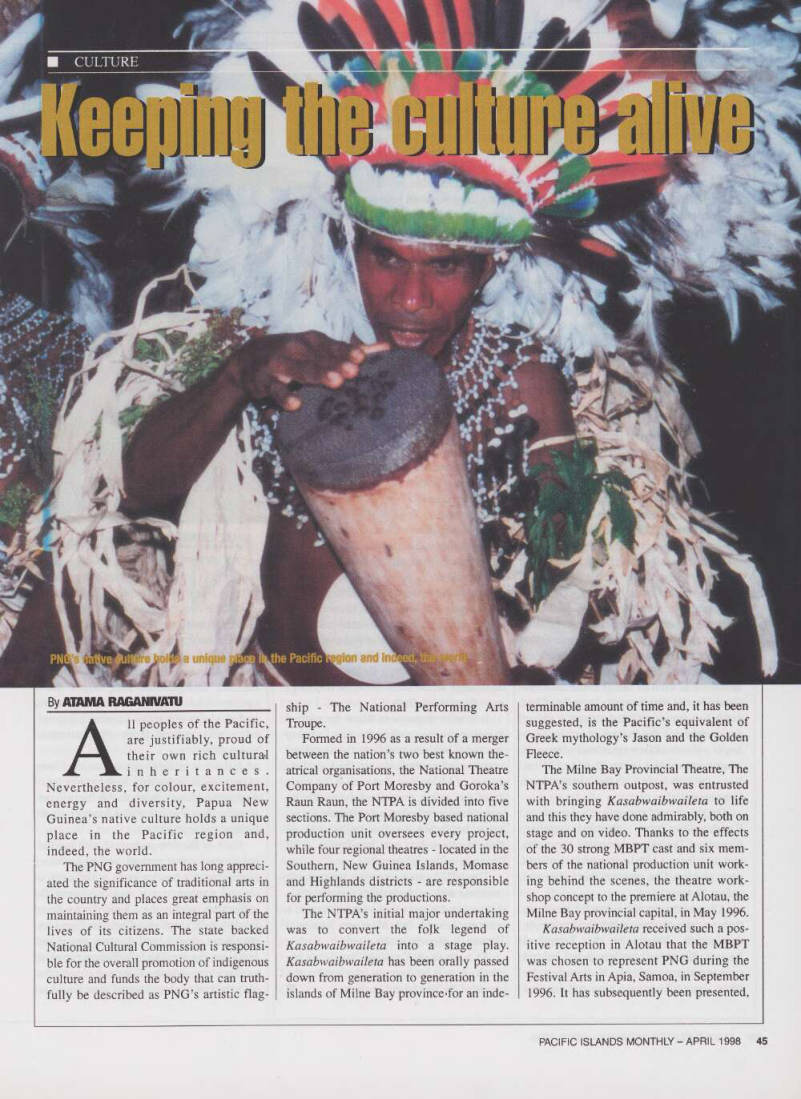
Nevertheless, for colour, excitement, energy and diversity, Papua New Guinea’s native culture holds a unique place in the Pacific region and, indeed, the world.
The PNG government has long appreci ated the significance of traditional arts in the country and places great emphasis on maintaining them as an integral part of the lives of its citizens. The state backed National Cultural Commission is responsi ble for the overall promotion of indigenous culture and funds the body that can truth fully be described as PNG’s artistic flag
ship - The National Performing Arts Troupe.
Formed in 1996 as a result of a merger between the nation’s two best known the atrical organisations, the National Theatre Company of Port Moresby and Goroka’s Raun Raun, the NTPA is divided into five sections. The Port Moresby based national production unit oversees every project, while four regional theatres - located in the Southern, New Guinea Islands, Momase and Highlands districts - are responsible for performing the productions.
The NTPA’s initial major undertaking was to convert the folk legend of Kasabwaibwaileta into a stage play.
Kasabwaibwaileta has been orally passed down from generation to generation in the islands of Milne Bay province-for an inde
terminable amount of time and, it has been suggested, is the Pacific’s equivalent of Greek mythology’s Jason and the Golden Fleece.
The Milne Bay Provincial Theatre, The NTPA’s southern outpost, was entrusted with bringing Kasabwaibwaileta to life and this they have done admirably, both on stage and on video. Thanks to the effects of the 30 strong MBPT cast and six mem bers of the national production unit work ing behind the scenes, the theatre work shop concept to the premiere at Alotau, the Milne Bay provincial capital, in May 1996.
Kasabwaibwaileta received such a pos itive reception in Alotau that the MBPT was chosen to represent PNG during the Festival Arts in Apia, Samoa, in September 1996. It has subsequently been presented.
PNG'S native culture holds a unique in the Pacific region and indeed, the world
to great acclaim, at various centre through out PNG.
Although each member of the cast plays their role competently, the perfor mance of principal artists Richard Salum and Shirley Tauwaigu must be acknowl edged as major reasons for Kasabwaibwaileta’s success.
Despite being, at most, 30, Salum is something of an acting veteran. As well as being heavily involved in the MBPT, he is a senior actor and dancer with the Waema Theatre Group. Formed in 1984 and locat ed in Waema, his home village, situated a few kilometres outside Alotau, this com
pany specialises in plays conveying health
and environmental messages. It has per formed in several Papua New Guinean venues and at cultural festivals in Australia. Eight members of the Waema Theatre Group are also involved with the
Mbpt.
Such is Salom’s mastery of facial expression and his on-stage presence that had he been an Englishmen, he would almost certainly be a Shakespearean actor of renown. However, the international per sonality he particularly resembles is the late rubber faced French comedian Femandel.
Even though her role is not as demand ing as Salom’s, Tawaigu, 19, projects a radiance only a naturally gifted actress can command. The fact that she received very basic education makes her achievements the more meritorious.
Salom plays the title role of Kasabwaibwaileta, a cripple living on the island of Tewala in the D’Entrecasteaux Group in the distant past. In spite of his disability, he is included among a group designated by the island chief to seek bagis - the necklace treasured above all other commodities in the islands of Milne Bay - through trade with the inhabitants of
faraway islands.
On the eve of the group’s departure, Kasabwaibwaileta’s sleeping mother, played by Tauwaigu, is visited by spirits and they leave a betel nut, which she finds upon waking. She presents this to her son before he leaves.
After encountering a fearful storm on their voyage, the men reach their principle destination, Vakuta in the Trobriand Islands. Kasabwaibwaileta is left behind to mind the canoe. He is disturbed by
some aggressive young boys and pacifies
them by giving them his betel nut. Upon learning this, one of the boys’ grandmoth er presents Kasabwaibwaileta with the world’s foremost bagi, the legendary and greatly coveted Kumwakalakedakeda, in reciprocation.
Later, the other men display their bagis they have acquired after strenuous barter ing and when discovering Kasabwaibwaileta now possess their soci ety’s Holy Grail, they abandon him on a deserted and lonely island.
Alone and stranded, Kasabwaibwaileta appeals first to the evening star and the moon to help him, but both ignore his pleas. Next, the much more sympathetic morning star appears and, as well as res cuing him, cures his infirmity, takes him to her habitat in the sky, marries him and gives him magic powers.
Kasabwaibwaileta and the morning star produce three sons. He is happy until developing homesickness. One day, Kasabwaibwaileta and his offspring acci dentally disturb a giant clam, as they play a ball game and realise that the clam has been placed over a hole in the sky.
He sees Tewala beneath him.
Substituting Kumwakalakedakeda for a rope, he descends onto his former abode, where he is ecstatically greeted by his now aged mother.
Following a feast prepared in his hon our, Kasabwaibwaileta uses his sorcery to turn those who had jettisoned him into birds and banish them, in pairs of males and females, to the far flung comers of Milne Bay. According to the provinces mythology all the clans of Milne Bay orig inate from those birds.
It is advantageous to know the plot of Kasabwaibwaileta while the play is being enacted if wishing to follow the storyline, as the actors exclusively use the local lan guages of Milne Bay. But such is the vital ity of the acting, music and dance that an understanding of what is being stated is no more important to the enjoyment of Kasabwaibwaileta as familiarity with Italian in a Puccini opera!
The NPTA plans to create comparable creations with its three other regional divi sions over the next two years. Sarania, a presentation of the Mamose Regional Theatre, is already in the pipeline.
As a result of Kasabwaibwaileta’s tri umph, it will be eagerly awaited by the lovers of Pacific Islands culture. ■