Samoa's tourism fture looks bleak
pp. 35-36 · Read in the full issue
By Chris Peteru
The ad in a weekend paper from the upmarket Samoan Village Resort says a lot about tourism in Samoa today. “Half price sale.
Because of the lack of Tourism - Business Stinks” it reads. Clearly, it is soul searching time for the Samoan tourist industry. While revenues have topped WSsloom (U 5540.48 mil lion) for the last two years easily outstripping agriculture as the economic mainstay. The actual numbers of those coming to sit beside the pool are down while expansive overheads continue to mount. With no indication of any upswing in the pipeline, the future looks like a tail spin for anxious investors.
Now several hotels are up for auction after finance houses called in their loans. Following a taro blight in 1994 that destroyed what was then the main export crop, the government began a campaign to promote tourism as the new growth industry.
Admist a climate of economic optimism several swank hotels opened on the two main islands. Helped financially by the visitors bureau, many coastal villages built simple island style thatched huts to be hired out anyone looking to enjoy the pristine beaches.
Indications now are that the party is over.
“So many of us committed ourselves, but there are not enough tourists upless there are big events like the Pacific Arts Festival. I think we are all facing the main problem. If occupancy improves there won’t be such a problem says one hotelier. But overseas wholesalers describe accommodation and goods here as over priced. A room at a three-star hotel runs is from SUSBO- SUSISO per night. Alcohol is SUS3.2O for a small Heineken beer and food - $U54.45 for a Big Mac and fries. Several places offer special rates for locals but only a trickle are taking up the offer.
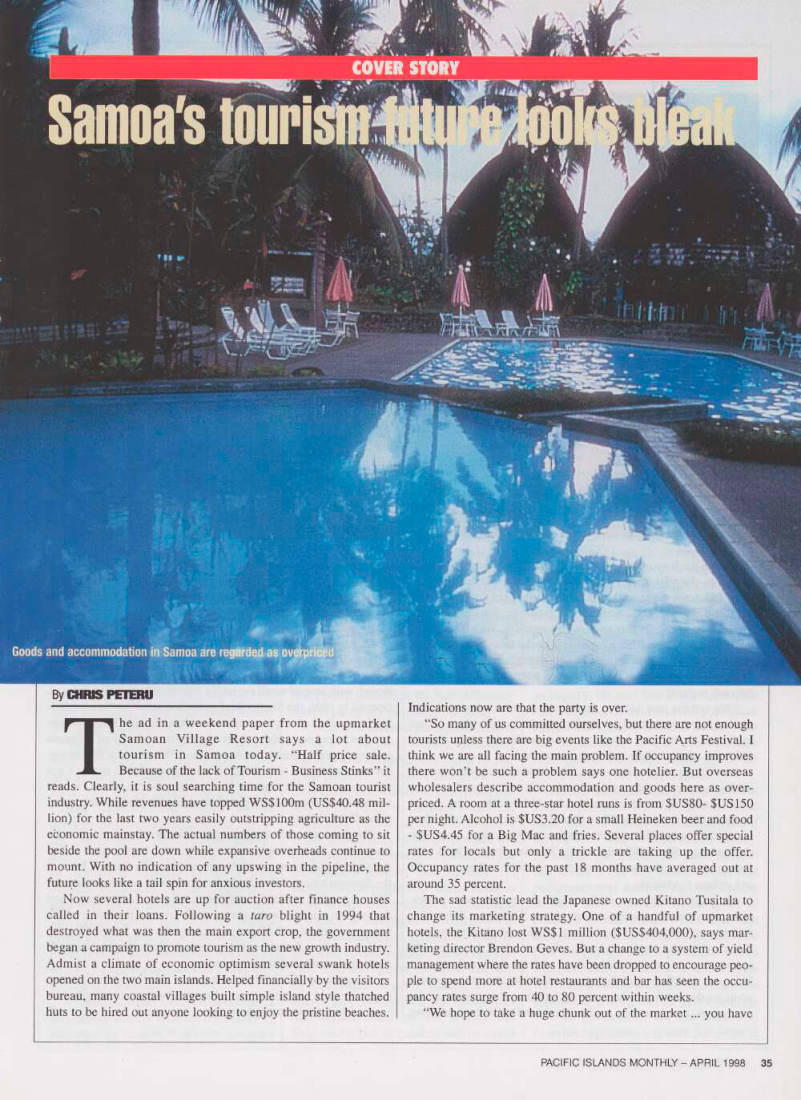
Occupancy rates for the past 18 months have averaged out at around 35 percent.
The sad statistic lead the Japanese owned Kitano Tusitala to change its marketing strategy. One of a handful of upmarket hotels, the Kitano lost WS$l million (SUSS4O4,OOO), says mar keting director Brendon Geves. But a change to a system of yield management where the rates have been dropped to encourage peo ple to spend more at hotel restaurants and bar has seen the occu pancy rates surge from 40 to 80 percent within weeks.
“We hope to take a huge chunk out of the market ... you have
Goods and accommodation in Samoa are regarded as overpriced
to go with the flow or you go down.” Those sentiments have been echoed by the government run visitors bureau, which has received some flak from the some in the industry who feel that the bureau has not done enough to bring in the business. Bureau manager Sonja Hunter believes they can only do so much. With a budget of just WS$2.5 million (US$l.2 million) for the financial year, com pared to Tahiti’s SUS 10 million budget and about SUS 7 million in Fiji, she says owners have to go out and hustle to get the result at the cash register.
“We are the new kids on the block, so the tourism industry must promote its individual products in the market place ... you can’t wait for the government or someone else, (you) do it your self,” she said in a Samoa Newsline interview.
Her comments are backed by Alise Stunnenberg, the bureau’s marketing manager who agrees that there is a shortage of tourists.
“But I firmly believe that hoteliers should be a little more proac tive in selling themselves. They should do their homework before taking the plunge.’’The government’s own promotions have been a mixed bag. Since 1994 the Teuila Tourism Festival held each September was intended to showcase the best in Samoan crafts and culture to visitors.
But the idea has never really caught on overseas with partici pating locals outnumbering tourists maybe 500 to one. Polynesian Airlines wants to extend its southern routes and plans to restart a Tahiti and Cook Islands service by mid-year which they hope will improve visitor numbers to the island with the right package deal.
This year the Ministry of Transport ordered all taxis to be painted white so that tourists, who make up less than five percent of the passengers, can spot them easily. The island’s 500 taxis all have
signs. What peeved the owners was that the money for the lousy idea had to come out of their own pockets. Attempts to bring in big hotel chains including Marriot and Sheraton flopped after reaching ground breaking stage, several times, when village land lords started haggling for more money.
As a result, the chance of any overseas interests ever building bit time here plummeted with Samoa’s reputation as a difficult place to do that kind of business. The news hasn’t been all bad though with several small exclusive resorts now showing the way.
Opened in 1996, the Sinalei Reef resort has just 20 rooms (includ ing four suites) giving it a capacity of less than 50. But occupan cy rates have been good and are already up on last year’s figures says manager Folasaitu Joe Annandale. “We cater for the upmar ket and one of the nice things about this market is that it’s not price sensitive.” He says the ideal market for the island “should be small, low volume high yield”. He added this helped take pres sure off the airlines.
“People don’t come here because of the beaches or the climate.
It’s because of our people and environment.” On the other end of the scale, backpackers are well catered for at the Seaside Inn and the Samoa Outrigger Hotel which report traffic as low but steady.
What is needed is more coordination between hotel owners and the tourism ministry and a proper blue print on the future of the industry thrashed out. Major promotions for the Year 2000 cele brations, where Samoa will be the last place on the planet to farewell the millennium are underway.
If organised efficiently to maximise the once in a life time event, it could also revive an industry growing increasingly ner vous over all those empty deck chairs. ■