Skate survives moves to dethrone him
pp. 37-38 · Read in the full issue
Politics
By Sam Vulum
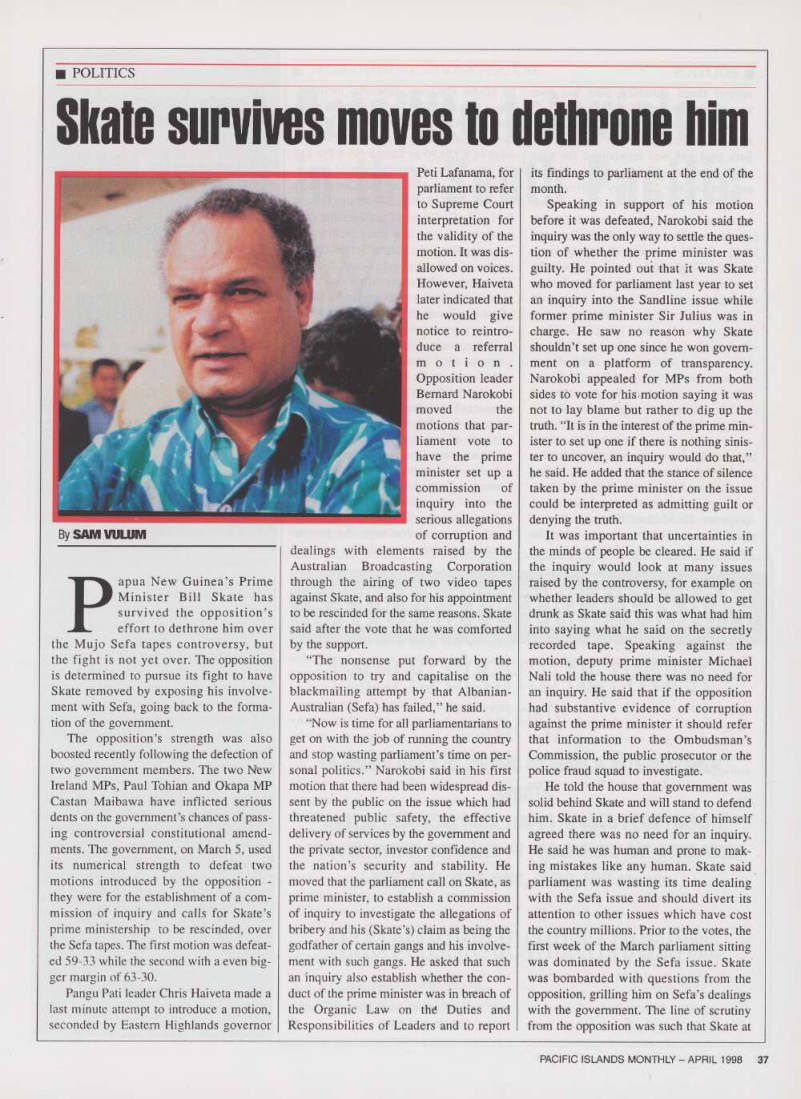
Papua New Guinea’s Prime Minister Bill Skate has survived the opposition’s effort to dethrone him over the Mujo Sefa tapes controversy, but the fight is not yet over. The opposition is determined to pursue its fight to have Skate removed by exposing his involve ment with Sefa, going back to the forma tion of the government.
The opposition’s strength was also boosted recently following the defection of two government members. The two New Ireland MPs, Paul Tohian and Okapa MP Castan Maibawa have inflicted serious dents on the government’s chances of pass ing controversial constitutional amend ments. The government, on March 5, used its numerical strength to defeat two motions introduced by the opposition they were for the establishment of a com mission of inquiry and calls for Skate’s prime ministership to be rescinded, over the Sefa tapes. The first motion was defeat ed 59-33 while the second with a even big ger margin of 63-30.
Pangu Pati leader Chris Haiveta made a last minute attempt to introduce a motion, seconded by Eastern Highlands governor
Peti Lafanama, for parliament to refer to Supreme Court
interpretation for
the validity of the motion. It was dis allowed on voices.
However, Haiveta later indicated that he would give notice to reintro duce a referral motion.
Opposition leader
Bernard Narokobi moved the motions that par liament vote to have the prime minister set up a commission of inquiry into the
serious allegations
of corruption and
dealings with elements raised by the
Australian Broadcasting Corporation
through the airing of two video tapes against Skate, and also for his appointment to be rescinded for the same reasons. Skate said after the vote that he was comforted by the support.
“The nonsense put forward by the opposition to try and capitalise on the blackmailing attempt by that Albanian- Australian (Sefa) has failed,” he said.
“Now is time for all parliamentarians to get on with the job of running the country and stop wasting parliament’s time on per sonal politics.” Narokobi said in his first motion that there had been widespread dis sent by the public on the issue which had threatened public safety, the effective delivery of services by the government and the private sector, investor confidence and the nation’s security and stability. He moved that the parliament call on Skate, as prime minister, to establish a commission of inquiry to investigate the allegations of bribery and his (Skate’s) claim as being the godfather of certain gangs and his involve ment with such gangs. He asked that such an inquiry also establish whether the con duct of the prime minister was in breach of the Organic Law on thd Duties and Responsibilities of Leaders and to report
its findings to parliament at the end of the month.
Speaking in support of his motion before it was defeated, Narokobi said the inquiry was the only way to settle the ques tion of whether the prime minister was guilty. He pointed out that it was Skate who moved for parliament last year to set an inquiry into the Sandline issue while former prime minister Sir Julius was in charge. He saw no reason why Skate shouldn’t set up one since he won govern ment on a platform of transparency.
Narokobi appealed for MPs from both sides to vote for his motion saying it was not to lay blame but rather to dig up the truth. “It is in the interest of the prime min ister to set up one if there is nothing sinis ter to uncover, an inquiry would do that,” he said. He added that the stance of silence taken by the prime minister on the issue could be interpreted as admitting guilt or denying the truth.
It was important that uncertainties in the minds of people be cleared. He said if the inquiry would look at many issues raised by the controversy, for example on whether leaders should be allowed to get drunk as Skate said this was what had him into saying what he said on the secretly recorded tape. Speaking against the motion, deputy prime minister Michael Nali told the house there was no need for an inquiry. He said that if the opposition had substantive evidence of corruption against the prime minister it should refer that information to the Ombudsman’s Commission, the public prosecutor or the police fraud squad to investigate.
He told the house that government was solid behind Skate and will stand to defend him. Skate in a brief defence of himself agreed there was no need for an inquiry.
He said he was human and prone to mak ing mistakes like any human. Skate said
parliament was wasting its time dealing
with the Sefa issue and should divert its attention to other issues which have cost the country millions. Prior to the votes, the first week of the March parliament sitting was dominated by the Sefa issue. Skate was bombarded with questions from the
opposition, grilling him on Seta’s dealings
with the government. The line of scrutiny from the opposition was such that Skate at
several times stumbled over his own answers and gave conflicting responses.
In the course of the question and answer session, parliament was told that Sefa paid and was reimbursed for trips
taken by prominent lawyer Peter Donigi
and former MP Sir Barry Holloway to study Hong Kong’s anti corruption laws; tried to entice Skate into corrupt deals with between K3O million (SUSI4m) and K4om (SUSI9m) invoiced the govern ment for K 100,000 for cost incurred in the lead-up to its formation including the tai loring of suits for MPs and had been paid half of this money and funds were still being raised to pay off the balance.
Parliament also heard a claim by Markham MP Andrew Baing that Ombudsman Commission lawyer Gred Toop had been offered the job of public prosecutor in return got “suppressing” 22 leadership charges against Skate. Skate admitted to some of the claims and denied others.
However, more questions had been fired at him which he refused to answer, adding that his lawyers were working on the case.
Former prime minister and East Sepik governor Sir Michael Somare tabled in parliament a PNG Post receipt which he said was evidence of K2000(5U5952) hav ing being paid to Forests Minister Dr Fabian Pok by Sefa. Dr Pok denied receiv ing any money, however, the opposition as of March 10 was expected to have tabled in parliament copies of receipts of various expenses allegedly met by Sefa for Skate’s Tufi Camp during the lead up to the for mation of the government.
It was at Tufi, in the northern province, where Skate consolidated his support.
Opposition sources said they had obtained from Sefa several receipts purposing to show payment of security, tailoring of suits, provision of medical services and purchase of beddings and food items for Skate’s team. These receipted costs, totalling about K 28,000 (SUSI3m) were met by Sefa through his ... making compa ny Globe PNG Pty Ltd. While Sefa claims he spent K 500,000 on Skate and the Tufi Camp during the elections, the prime min ister has admitted in parliament of the group receiving help totalling K 100,000 for which they repaid half the amount.
Receipts to be tabled show that a security firm The Corps (PNG) on May last year invoiced Skate for K 8343 for the provision of armed security. There is no evidence of this payment being made. Copies of cheques for several other payments made
by Globe PNG are, however, included.
These are of a K 2500 payment made to Dr Lam and Associates for the provision of medical consultancy and service; the pay ment of K 758.70 to Tamasi No 6 Pty Ltd for the supply of mattresses, bed sheets, pillows and towels to the Tufi Camp, and a payment of K 1518.60 to Marwin Motors for luncheon. Copies of invoices and cash payment receipts show that Lok Poy Wai Tailoring Pty Ltd charged Sefa K 10,435 for the sale of shoes and suits to 29 MPs.
The names of MPs who benefited, com plete with tailoring sizes are listed. Badili Meats also invoiced Sefa for K 2011.80 for the cash payment of a large supply of meat.
The opposition has also vowed not to support the government’s proposed amendments to the Constitution aimed at creating stability in the office of the prime minister. The amendments will make it tougher for the opposition to move motions of no confidence against the prime minister. The changes would also see the abolishment of the National Executive Council and vest the executive powers of government placed in six-man “government caucus committee.” A suc cessful motion to discharge the govern ment caucus committee will face a general election.
Skate who was accused of trying to pro tect his tenure in office by introducing the changes, said he was putting his job on the line in order to achieve greater political stability and instil more investor confi dence. The opposition said it will also oppose the government’s other important bill which is for the establishment of an anti-corruption commission. The commis sion argued, among other things, why should there be another special commis sion when the existing organisations like the public prosecutor and the public solic itor offices, the police force, the army, the national and supreme courts lack manpow er and funding? Narokobi also asked: “What guarantee is there that a new com mission will not generate into a malfunc tioning institution, open to exploitation and manipulation by evil-minded heads of government through appointments to achieve political ends?” In a state of the nation address broadcasted by EMTV on March 2, Skate said that corruption was rife in the country and this was the best means to stamp it out.
“There are several alleged corrupt deals that have robbed our nation of public money.” Skate said. ■