restopo its parauise image
p. 33 · Read in the full issue
Van uatu struggling to restopo its parauise image
Bv Patrick Decloitre
After the January 12 riot and a four-week state of emergency that entailed, Vanuatu’s tourism industry is struggling to get back on its feet ... and seems to be managing quite well. Vanuatu Hotel and Resort Association president Adrian Gray said the riots in the capital, although only two days, have had severe effects on tourist arrivals.
“It’s not only the riots, it’s mainly the state of emergency that followed for four weeks”, he said. On January 12, a riot broke out in front of Vanuatu’s National Provident Fund (VNPF), where angry contributors to the compulsory retirement scheme were demanding full refund. The next day, a state of emergency was declared for two weeks, and later extended to another fortnight. It ended on February 10. “This stopped people from actually book ing because they couldn’t get travel insurance in a country under state of emergency”.
He said bookings in the short term were down by 50 percent for February and first half of March. But business was expected to pick up later. Tourism-related companies, including hotels and local tour operators, certainly felt the sting and some of them have started laying off workers. Tour Vanuatu, the government’s tour operator, said last February it was asking its staff to work only half-days until things got better.
The tourism industry is Vanuatu’s largest private employer and provides about half of Vanuatu’s total foreign exchange earnings in the services branch, official statistics say here. Ironically, two days before the riots, Vanuatu hotels and international- flag carrier
Air Vanuatu had launched a joint television and newspaper cam paign in Australia, which provides over half of Vanuatu’s some 49,000 annual tourist numbers.
“(The riots) pretty much wiped out a lot of the value which was desperately needed”. To top it all, Vanuatu’s events came at a time when nearly all South Pacific destinations were struggling to face the impact of the Asian meltdown.
“We can’t afford to get in the big fight that’s going on with our competitor destinations, like Fiji and Bali, where everything is cut. We’re too small a player to play that game”. “What we need to do is emphasise Vanuatu’s specificity, its proximity to Australia, its natural and cultural diversity and activities close to resorts and hotels,” Gray said. “Tourists come here because they don’t want to be part of a crowd. They want to go diving, fishing, kayaking and enjoy a helicopter picnic”.
Some tourists were, however, not deterred. Last February, Australia’s deputy Prime Minister Tim Fischer spent three days in the capital on a private visit. Fischer’s choice was more than wel come, Gray said. “It’s great that he chose to come here away from it all. It’s very safe, contrary to any past television report. “The riots were purely for two days.
It’s finished and Vanuatu’s back to normal. To have (Fischer) stay with us was certainly a very big coup on our part”. To top it all, in early March, both Le Meridien Hotel, casino and resort and Vanuatu’s flag carrier Air Vanuatu received awards by the Pacific Islands Travel Company, one of the biggest wholesalers on the Australian market for their role in developing tourism. Le Meridien was awarded for outstanding performance while Air Vanuatu, for best airline. ■
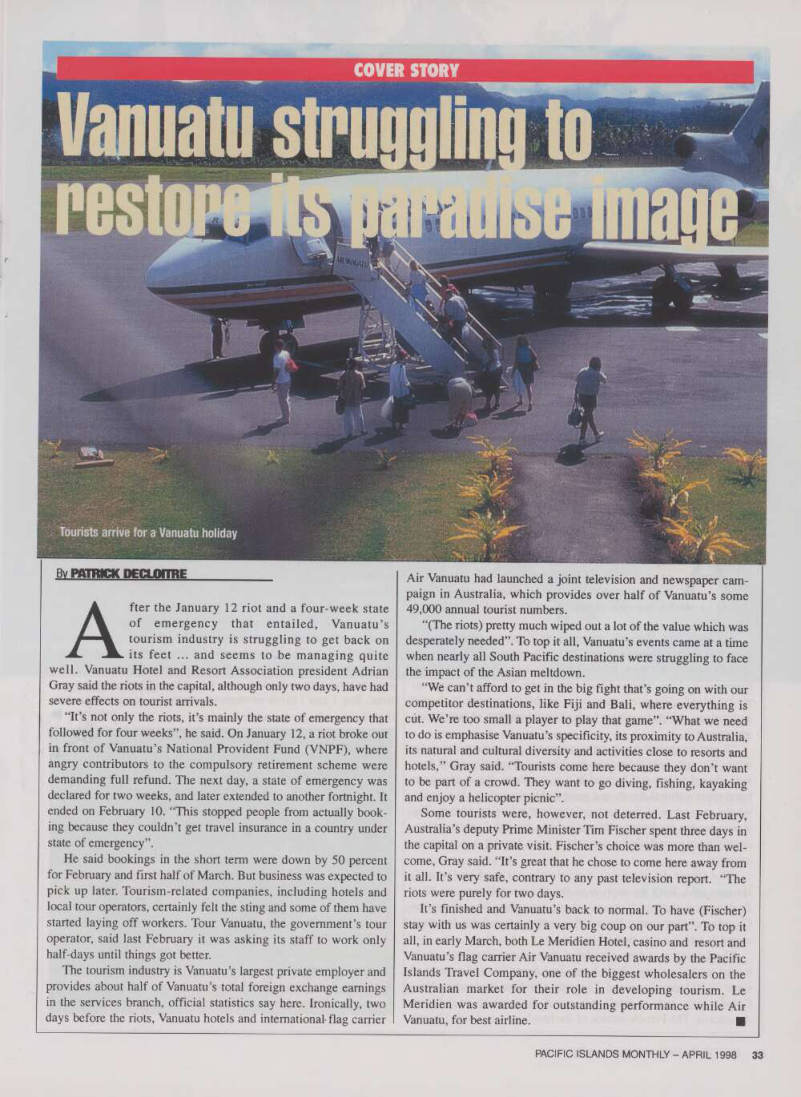
Tourists arrive for a Vanuatu holiday