Fiji loote towards other
pp. 30-32 · Read in the full issue
Cover Story
Fiji loote towards other marketer Asian crisis FVB focuses its energy on “productive markets”
By Bernadette Hussein
The Asian economy crisis late last year has put many countries in Asia in a very fragile situa tion. And this has filtered down to other coun tries which in some way or another benefited from these strong economies - especially in the area of tourism. Fiji is one of those countries which had a large number of visitors coming in from Japan but this number has dropped drastically. Last year the total number of visitors from Japan was 44,500 and the target for this year is 49,500 but the Fiji Visitors Bureau is sure that this will not be reached.
In a realistic approach the FVB is instead directing its efforts, energy and money towards productive markets which are the United States, United Kingdom and Continental Europe. In a press conference to outline the bureau’s tourism targets and goals for this year, FVB chief executive Steve Yaqona said they still expected to exceed the record number of tourists in 1997 despite the crisis. “In 1997 the number of tourists to Fiji was 359,441.
This year we are forecasting a total of 377,000 visitors. With the Asian crisis it is now estimated that the figure will be a little lower but still exceeding 1997 figure,” Yaqona said.
“We are very concerned at how the Asian financial crisis will affect tourism especially in the longer term. The longer term effects on our country and how it could influence the arrival from
key markets of Australia and New Zealand. “In the short term we are confident that we will more than compensate for the loss expected out of the Japan and Korean market with growth out of Canada, US and New Zealand.” To boost their work around the world, the FVB received an increase in their budget allocation for 1998 without which Yaqona feels that the bureau would have been in “dire straits right now”. “This has allowed us to mount the biggest promotional campaign ever in our key markets of New Zealand, Australia, US and Europe. We believe these campaigns will effectively counter the damages done by the Asian crisis allowing Fiji to maintain its record numbers although with less expected growth than earlier forcasted.” Last year 40 percent of the visitors to Fiji were from Australia and New Zealand, fol lowed by good support from other markets like USA. The Europe and UK combined made 19 percent of the arrivals while Korea only three percent . Looking at the first two months in the first quarter for 1998, Yaqona said it was important know that January was the off-season period. He said around the middle of January, every hotellier in the country starts complaining about bookings.
“This happens every year - even February. If you see the bookings since 1961 - that’s over a 30 year period - February has always been our lowest month. That is the reality of the market.”
As for the Asian currency crisis “ which has gone worse since we prepared our marketing plan” FVB is most concerned about
its impact on the markets outside which is Australia, New Zealand and possible others. “But right now bookings out of Australia, New Zealand and US are on par with that from last year. We are seeing very intense competition coming in. We are also seeing sit
uations where airlines are can celling many of their services and one is Korean Airlines which from March 29 can celled all its flights into Fiji.”
He added that with all that was happening with the Asian economy it was important to point out that the Fiji tourism sector was not having a crisis but had a greater challenge ahead.
“It is not disastrous, maybe a little softer than last year,”
Yaqona said. He added that airlines such as Air New Zealand and Fiji’s national air line, Air Pacific had a vital role to play in offsetting the loss in the Asian markets. “The court
hearing particularly co-sharing agreement between New Zealand and United Airlines will clearly push ahead our case in the US as well as beyond those shores. “United Airlines is selling Fiji as a
destination through its 35,000 travel agencies in the US as well as in Canada and Europe. It has put Fiji in its computer system as a United destination. “This will see passengers booked to come to Fiji through Air New Zealand’s flight out of Los Angeles from all
over the US, Canada and Europe. “Similarly, with the court hearing between Air Pacific and American Airlines, we will again increase the saleability of Fiji by this system in the US as well as Europe.
“We believe that this will assist a great deal in our efforts to try and continue the growth of arrivals into Fiji in the year 1998.” FVB marketing manag er Bill Whiting outlined the marketing strategy for this year.
He said that it was important to target strongly and maximise visitor arrivals while they could.
“We are facing competition with cheap Asian packages such Asian holidays where top class
hotel in various parts of Asia are offering very cheap rates up to $l2 per night in a four star hotel or a five star hotel in Kuala Lumpur, Malaysia, for $39 as a stopover with Malaysian Airlines.
“At the Sheraton in Bangkok, twin river views was $4OO a night but is now $lO3 a night with a 24 hour butler, limousine from the airport, free cocktails, free breakfast, all your local phonecalls, laundry and a boat ride.” Looking towards the US market he said the economy there was strong and the bureau need ed to capitalise strongly on market opportunities. “We believe that air capacity schedules can be improved and we are optimistic that it will happen in the near future.” As for Canada, he said while it had additional air capacity it was not performing upto expecta tions but had great opportunities for growth. This is another which the bureau feels it should market strongly. “As for the UK and European markets, the Asian crisis has had little impact on the their economies. Competition for cheap Asian passengers is there but it’s not severe as what we face in Australia and New Zealand,”
Whiting said. “As for air capacity, at the moment it is very diffi cult to get a seat between Fiji and Europe. This is another country where there is a good opportunity for growth and one area we are
planning to strongly market.”
With these markets to build up on, the bureau has launched vigorous market ing campaigns in these countries which they believe will great benefit and help reach the tourism numbers markets for this year. Whiting said FVB has targeted 83,300 arrivals this year from Australia and is confident of achieving this.
FVB is also doing a lot of campaigns in Australia right now. One of the cam paigns was with Air Pacific which offered $599 travel between February 2 and April 3. This was followed up with Air Pacific’s initia- J live of kids flying free between the April to June
period. FVB also has aggressive television, radio and print cam paigns to promote this deals. Apart frorh this, FVB is also taking part in various travel shows and is also bringing travel agents into the country to show what Fiji has to offer. The FVB target for the New Zealand market is 70,000, up from the 68,116 from last year.
Here as well, FVB is carrying out aggressive advertising cam paign through the media. “One of the offers which we have is again with Air Pacific which is offering $549 return from March till the end of June,” Whiting said. “Another good thing out of that was shortly after this offer was announced by Air Pacific, Air New Zealand matched this and so we are planning of some sort of advertising with them.” The US is another market which FVB is strongly marketing. Its target for 1998 is 47,000, 3000 up from last year and once again is confident of achieving this target. “At the moment we are running an advertising campaign on cable televi sion which is costing us about $U5230,000. This is a very expan sive campaign but we believe its getting the results and Air Pacific is telling us that their bookings are well ahead of last year,”
Whiting said. “We are also running a honeymoon advertising cam paign where newlyweds can come to Fiji. It started in February and will run throughout the year. There are advertisements on tele vision and print media. We are promoting the Fiji experience.
“For UK and Continental Europe, our target is actually lower than what we achieved in 1997. The reason for that is that we set the targets before we got our results for 1997. UK was our best performing market last year. “We are very confident that this is in fact understating what we will achieve out of UK this year. As for Continental Europe - we are participating in a number of cam paigns. The biggest one is with the New Zealand Tourist Board and what is called a recovery campaign to rebuild its business in Germany which took a dive after the nuclear testings and didn’t really come back too quickly. “We also have a number of promo tions with Air New Zealand in Eastern Europe.” As for the Japanese market, he agrees with Yaqona that the target of 49,500 will not be achieved. “Japanese arrivals we do believe will be down this year but we are more than sure that this will be made up
by the arrival from other mar kets.” As for its marketing strategy in Japan, Whiting said they had revised their
marketing tactics.
“We have 100 Japanese travel agents arriving here on April 1. This group is coming with Air New Zealand and we are
currently discussing a similar
size group with Air Pacific.
“In June this year we are hav ing the Fiji Marathon where we expect about 200 Japanese runners to participate. To mark this event we are pro
ducing posters designed for
the Japanese market. “We are also interested in developing new events and we have con cepts of developing spe cialised golf tournaments with
Japanese markets, masters events which is something being dis cussed at the moment. “We also recognise that there is more research needed in understanding profiles of the various Japanese market segments. In addition to that, in the January to March peri od we had a number of promotions happening.”
As for the other Asian market. South Korea, Whiting said again the target for the number of tourists was set before the crisis so once again they were not confident of meeting it. “Koreans made up three percent of our arrivals and about one to one and half per cent of tourism receipts. They only stayed an average of two nights three days so while it is not good to lose business, we don’t see it as being a crisis situation. “We have slashed our budget for Korea and are spending it in more productive markets.” With all these marketing strategies and campaigns what remains to be seen is how successful they will prove to be.
One hopes that the results are upto expectations FVB but if it does 1 not happen, what will it mean for the tourism industry in Fiji.
That remains to be seen. ■
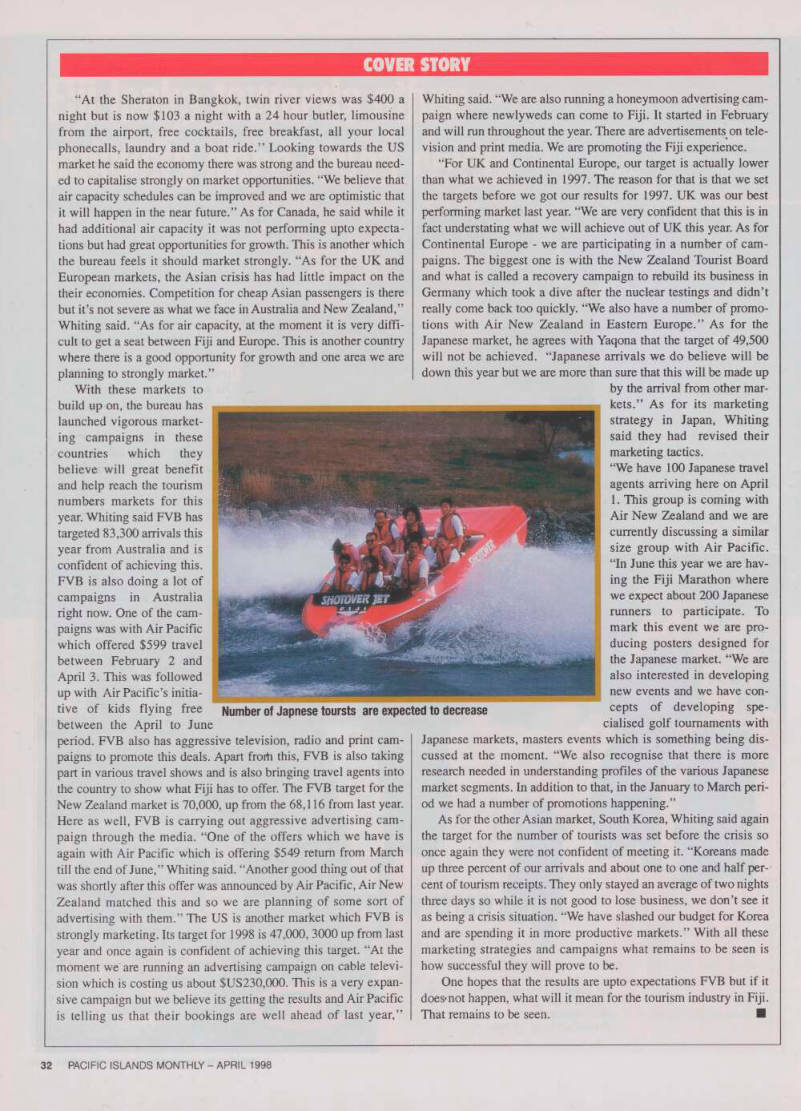
Number of Japnese toursts are expected to decrease