Battle among the royals
p. 22 · Read in the full issue
Business
By Michael Feld
Sibling rivalry has broken
out in Tonga’s royal family with brother and sister struggling for control of the kingdom’s lucrative but secretive satellite operations. And it comes at a time when a Supreme Court judge labelled King Taufa’ahau Tupou IV “an authoritar ian ruler” who ignores
requests to account for his actions.
Both the claim and the fight revolve, in part, around Tongasat, which has the exclusive right to lease out Tonga’s equatorial satellite slots. Although the whole scheme was the idea of a grieving American, Tongasat is now 60 percent owned by the king’s only daughter.
Princess Pilolevu Tuita, who according to Forbes, the US business magazine, has made a personal US$25 million.
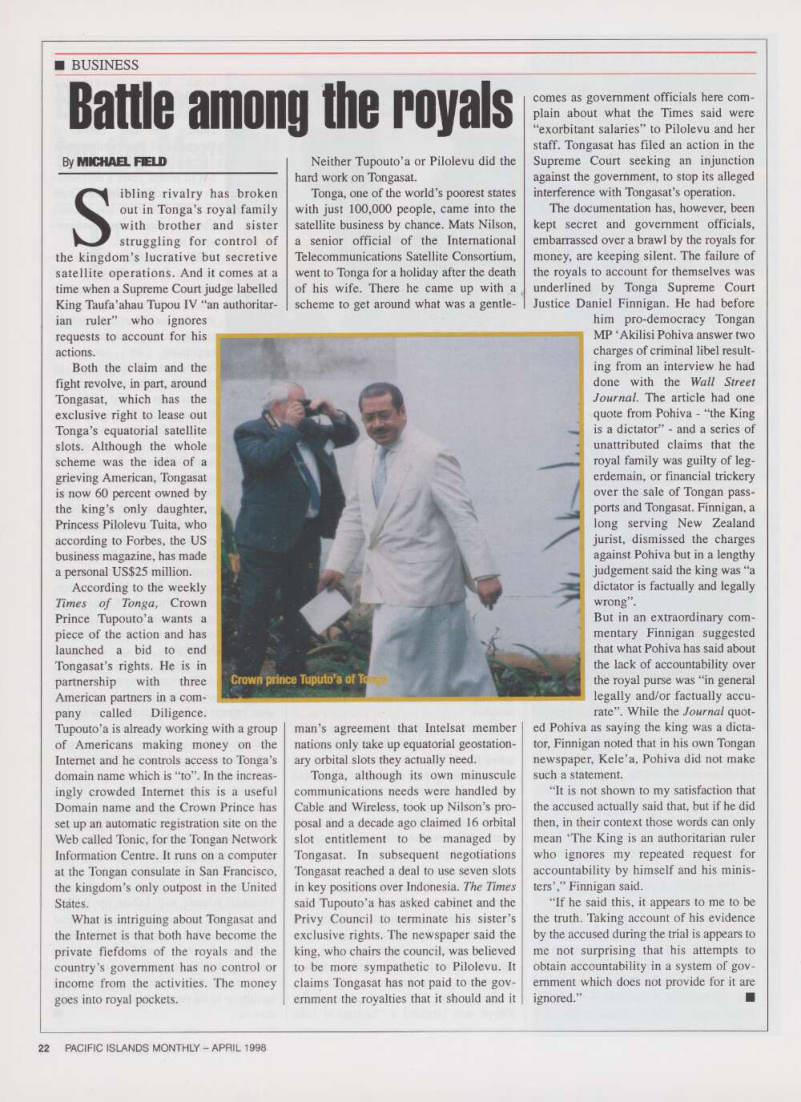
According to the weekly Times of Tonga, Crown Prince Tupouto’a wants a piece of the action and has launched a bid to end Tongasat’s rights. He is in partnership with three American partners in a com pany called Diligence.
Tupouto’a is already working with a group of Americans making money on the Internet and he controls access to Tonga’s domain name which is “to”. In the increas ingly crowded Internet this is a useful Domain name and the Crown Prince has set up an automatic registration site on the Web called Tonic, for the Tongan Network Information Centre. It runs on a computer at the Tongan consulate in San Francisco, the kingdom’s only outpost in the United States.
What is intriguing about Tongasat and the Internet is that both have become the private fiefdoms of the royals and the country’s government has no control or income from the activities. The money
goes into royal pockets.
Neither Tupouto’a or Pilolevu did the hard work on Tongasat.
Tonga, one of the world’s poorest states with just 100,000 people, came into the satellite business by chance. Mats Nilson, a senior official of the International Telecommunications Satellite Consortium, went to Tonga for a holiday after the death of his wife. There he came up with a scheme to get around what was a gentle-
man’s agreement that Intelsat member nations only take up equatorial geostation ary orbital slots they actually need.
Tonga, although its own minuscule communications needs were handled by Cable and Wireless, took up Nilson’s pro posal and a decade ago claimed 16 orbital slot entitlement to be managed by
Tongasat. In subsequent negotiations
Tongasat reached a deal to use seven slots in key positions over Indonesia. The Times said Tupouto’a has asked cabinet and the Privy Council to terminate his sister’s exclusive rights. The newspaper said the king, who chairs the council, was believed to be more sympathetic to Pilolevu. It claims Tongasat has not paid to the gov ernment the royalties that it should and it
comes as government officials here com plain about what the Times said were “exorbitant salaries” to Pilolevu and her staff. Tongasat has filed an action in the Supreme Court seeking an injunction against the government, to stop its alleged interference with Tongasat’s operation.
The documentation has, however, been kept secret and government officials, embarrassed over a brawl by the royals for money, are keeping silent. The failure of the royals to account for themselves was underlined by Tonga Supreme Court Justice Daniel Finnigan. He had before
him pro-democracy Tongan MP ‘Akilisi Pohiva answer two charges of criminal libel result ing from an interview he had done with the Wall Street Journal. The article had one quote from Pohiva - “the King is a dictator” - and a series of unattributed claims that the
royal family was guilty of leg
erdemain, or financial trickery over the sale of Tongan pass ports and Tongasat. Finnigan, a
long serving New Zealand
jurist, dismissed the charges
against Pohiva but in a lengthy judgement said the king was “a dictator is factually and legally wrong”.
But in an extraordinary com mentary Finnigan suggested that what Pohiva has said about the lack of accountability over the royal purse was “in general legally and/or factually accu rate”. While the Journal quot
ed Pohiva as saying the king was a dicta tor, Finnigan noted that in his own Tongan newspaper, Kele’a, Pohiva did not make such a statement.
“It is not shown to my satisfaction that the accused actually said that, but if he did then, in their context those words can only mean ‘The King is an authoritarian ruler who ignores my repeated request for accountability by himself and his minis ters’,” Finnigan said.
“If he said this, it appears to me to be the truth. Taking account of his evidence by the accused during the trial is appears to me not surprising that his attempts to obtain accountability in a system of gov ernment which does not provide for it are ignored.” ■
Crown prince Tupulo’a of Tonga