Bleak economic outlook continues
pp. 20-21 · Read in the full issue
lor the Marshall Islands
By Off Johnson
The promise of a nearly SUS 7 million Asian Development Bank loan to shore up failing health, sanitation, water and power operations on Ebeye Island is welcome news for the beleaguered Marshall Islands. But
Ebeye’s desperate situation - ongoing
for the past two years - has become increasingly synonymous with the state of this north Pacific nation’s eco nomic situation. The real question is what will pull the Marshalls out of its current economic malaise that has forced the government to layoff close to 25 percent of its work force, and the private sector into similar contrac tions.
Long dependent on now-diminishing American aid, the Marshall Islands has lit tle in the way of a productive economy.
While the ADB has become a major player in the islands during the past five years, there is scant optimism that an economic recovery is on the horizon. Moreover, rela tions between the Marshalls and the ADB have been rocky since late 1997 when dis putes over loan conditions began surfacing with increasing vehemence.
While the Marshalls will received more than SUSI billion from the US during the life of the Compact of Free Association that ends in 2001, the country has been unable to stimulate a productive economy with those resources. During the first 10 years of the Compact with America, the Marshalls engineered a series of multi-mil lion dollar loans using the guarantee of 15 years of US payments as collateral. Those funds were used up heavily on infrastruc ture and failed government-sponsored business ventures. Now, the government is obligated to pay upwards of SUS2O million annually to the banks that lent the money - 25 percent of its national budget - at a time when Compact funding from the US is declining.
When the ADB came on the scene in the early 19905, they were given the red carpet treatment. By the mid-19905, loans to
revamp public elementary education, to implement primary health care programs and to start a locally-based long line fish ing industry were in progress, followed shortly by a loan to improve fresh water and sewer services on Majuro. Meanwhile, Technical Assistance (TA) was providing training, funding and personnel to develop programs and strategies in a variety of gov ernment agencies. In the mid-19905, one ADB official called the Marshalls one of the fastest moving countries for imple menting loans and TAs.
The government’s increasingly poor economic outlook led the ADB and the government to agree to a major govern ment reform programme beginning in 1995. The aim was to cutback the govern ment work force, end subsidies to govern ment agencies, improve business opera tions of utilities, bolster the private sector, and democratise the Marshalls government system in ADB jargon, increase the “trans parency” in government operations and emphasise “good governance”.
While the Marshalls has marched ahead with the reduction in force and slashed subsidies to most government agencies, the good governance objective remains elu sive. Loans in education, health and water continue to move forward, but for six months the ADB has held up the second draw down of the loan for the govern ment’s reform program because the gov ernment has not met conditions of the loan.
Although this hasn’t stopped some of the reform objectives from continuing to be carried out, it is becoming increasingly problematic for Air Marshall Islands, which was to be the recipient of SUS 2 mil lion of the SUS3.S million second phase loan payment.
Two key conditions that the ADB has set are the hiring of a qualified general manager to run the airline free of govern ment interference and public release of a controversial commission of inquiry report into financial abuses at the Marshall Islands Social Security Administration.
President Imata Kabua fired AMl’s last expatriate manager in August after just eight months on the job, and it has taken
AMI until March to appoint a new manag er. Release of the report on the investiga tion into Social Security has been promised since last year by the president, but earlier this year he reopened the probe. The initial report commissioned by the late President Amata Kabua, which has never been offi cially released, implicated one of the cur rent president’s key cabinet ministers (along with program administrators) in the misuse of hundreds of thousands of dollars of Social Security retirement funds.
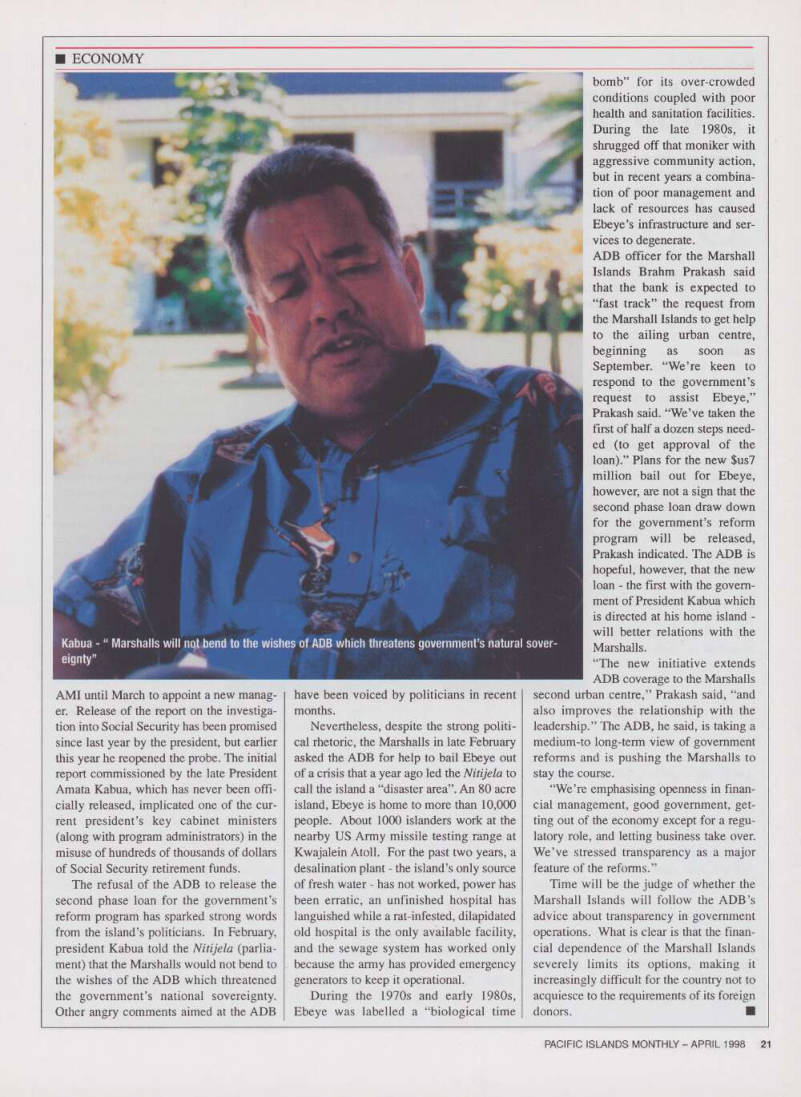
The refusal of the ADB to release the second phase loan for the government’s reform program has sparked strong words from the island’s politicians. In February, president Kabua told the Nitijela (parlia ment) that the Marshalls would not bend to the wishes of the ADB which threatened the government’s national sovereignty.
Other angry comments aimed at the ADB
have been voiced by politicians in recent months.
Nevertheless, despite the strong politi cal rhetoric, the Marshalls in late February asked the ADB for help to bail Ebeye out of a crisis that a year ago led the Nitijela to call the island a “disaster area”. An 80 acre island, Ebeye is home to more than 10,000 people. About 1000 islanders work at the nearby US Army missile testing range at Kwajalein Atoll. For the past two years, a desalination plant - the island’s only source of fresh water - has not worked, power has been erratic, an unfinished hospital has languished while a rat-infested, dilapidated old hospital is the only available facility, and the sewage system has worked only because the army has provided emergency generators to keep it operational.
During the 1970 s and early 1980 s, Ebeye was labelled a “biological time
bomb” for its over-crowded conditions coupled with poor health and sanitation facilities.
During the late 1980 s, it shrugged off that moniker with
aggressive community action,
but in recent years a combina tion of poor management and lack of resources has caused Ebeye’s infrastructure and ser vices to degenerate.
ADB officer for the Marshall Islands Brahm Prakash said that the bank is expected to “fast track” the request from the Marshall Islands to get help to the ailing urban centre, beginning as soon as September. “We’re keen to respond to the government’s request to assist Ebeye,”
Prakash said. “We’ve taken the first of half a dozen steps need ed (to get approval of the loan).” Plans for the new sus7 million bail out for Ebeye, however, are not a sign that the second phase loan draw down for the government’s reform program will be released, Prakash indicated. The ADB is hopeful, however, that the new loan - the first with the govern ment of President Kabua which is directed at his home island will better relations with the Marshalls.
“The new initiative extends ADB coverage to the Marshalls
second urban centre,” Prakash said, “and also improves the relationship with the leadership.” The ADB, he said, is taking a medium-to long-term view of government reforms and is pushing the Marshalls to stay the course.
“We’re emphasising openness in finan cial management, good government, get ting out of the economy except for a regu latory role, and letting business take over.
We’ve stressed transparency as a major feature of the reforms.”
Time will be the judge of whether the Marshall Islands will follow the ADB’s advice about transparency in government operations. What is clear is that the finan cial dependence of the Marshall Islands severely limits its options, making it increasingly difficult for the country not to acquiesce to the requirements of its foreign donors. ■
Kabua - “ Marshalls will not bend to the wishes of ADB which threatens government’s natural sover eignty”