looming as
pp. 18-19 · Read in the full issue
Pacific resource battle looming as gold found
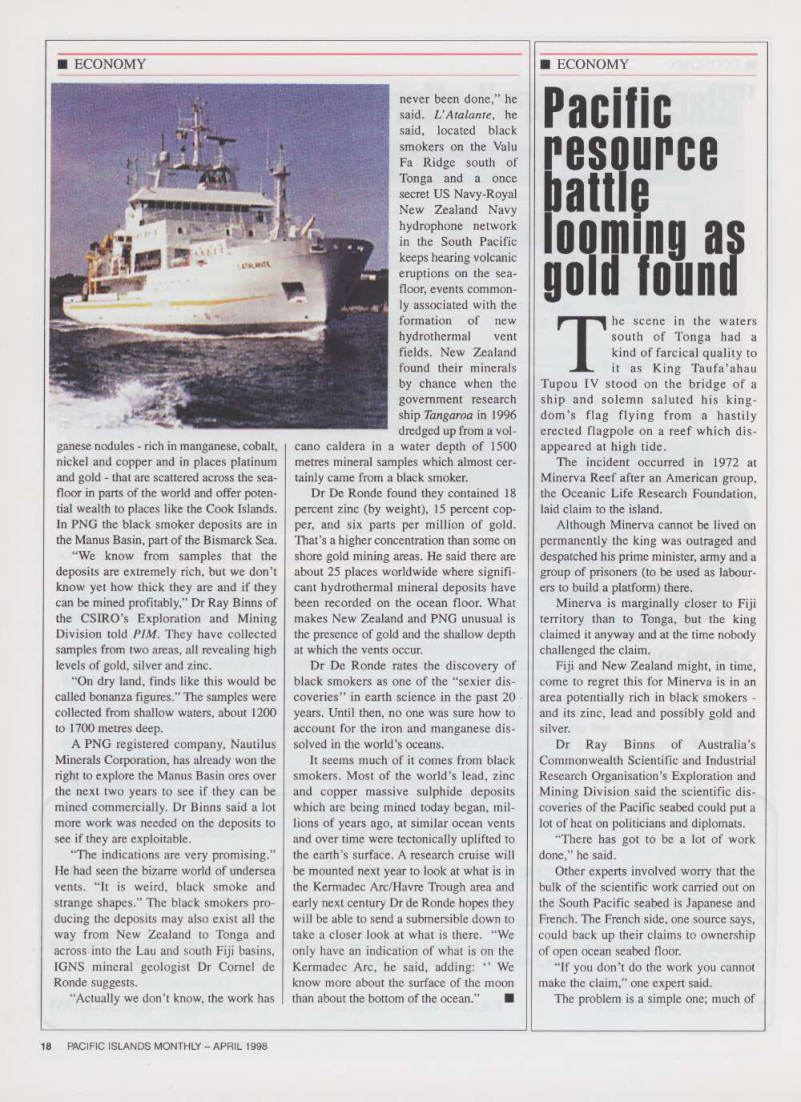
The scene in the waters south of Tonga had a kind of farcical quality to it as King Taufa’ahau Tupou IV stood on the bridge of a ship and solemn saluted his king
dom’s flag flying from a hastily
erected flagpole on a reef which dis appeared at high tide.
The incident occurred in 1972 at Minerva Reef after an American group, the Oceanic Life Research Foundation, laid claim to the island.
Although Minerva cannot be lived on
permanently the king was outraged and
despatched his prime minister, army and a group of prisoners (to be used as labour ers to build a platform) there.
Minerva is marginally closer to Fiji territory than to Tonga, but the king claimed it anyway and at the time nobody challenged the claim.
Fiji and New Zealand might, in time, come to regret this for Minerva is in an area potentially rich in black smokers and its zinc, lead and possibly gold and silver.
Dr Ray Binns of Australia’s Commonwealth Scientific and Industrial Research Organisation’s Exploration and Mining Division said the scientific dis coveries of the Pacific seabed could put a lot of heat on politicians and diplomats.
“There has got to be a lot of work done,” he said.
Other experts involved worry that the bulk of the scientific work carried out on the South Pacific seabed is Japanese and French. The French side, one source says, could back up their claims to ownership of open ocean seabed floor.
“If you don’t do the work you cannot make the claim,” one expert said.
The problem is a simple one; much of
the wealth lies outside the 360 kilometre exclusive economic zones (EEZ). Under the United Nation’s Law of the Sea the next boundary a state can claim is the limit of the continental shelf can extend beyond
the EEZ.
Finding and “de-limiting” (as the UN puts it) the conti nental shelf is legalistically
immensely complex and has
the potential to bring states into diplomatic dispute. One such place is between Australia’s Norfolk Island and New Zealand’s Cape
Reinga. Three Kings Ridge
which runs between the two is part of New Zealand’s continental shelf. Black smokers or at least their remnants are suspected to exist on the ridge.
New Zealand has until 2006 to lodge its continental shelf claims with the UN.
Tonga and Fiji have over lapping EEZs and will.
when they deal with the continental shelf issue, find more potential for dispute.
France and Vanuatu are already in dispute.
Between New Zealand, Tonga and Fiji is a vast area of international waters, part
of what the UN gracelessly calls “The Area”. The Law of the Sea terms this the “common heritage of mankind” and says “No State shall claim or exercise sovereignty or sovereign rights over any part of the Area...”
Controlling “The Area” is the Jamaica based International Seabed Authority (ISA) which has registered “pioneer investors” who can explore the areas.
Among them are the Institut Francais de Recherche pour TExploitation de la Mer (French Institute of Research and Exploitation of the Sea) whose ship L’Atalante who has already explored the South Pacific and found black smokers between Tonga and Fiji. Fiji has an intellec tual advantage over most states when it comes to asserting its claims. The found ing secretary-general of the ISA is Indo- Fijian lawyer Satya N Nandan who more than any other individual has defined the issues at stake.
Possession is nine-tenths of the law and Tonga must now be quietly satisfied that they did something right and got their flag over Minerva first. ■
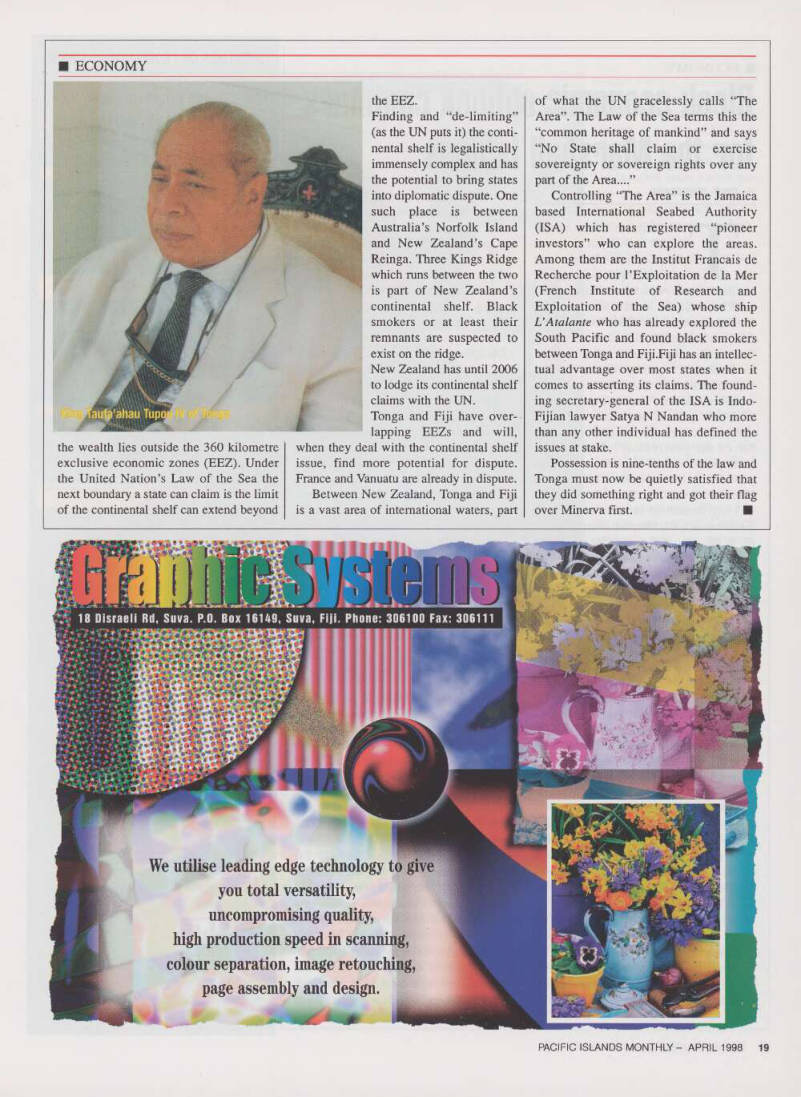
King Taufa'shau Tupou IV of Tongs