"Black smokers" offer Pacific new riches
pp. 17-18 · Read in the full issue
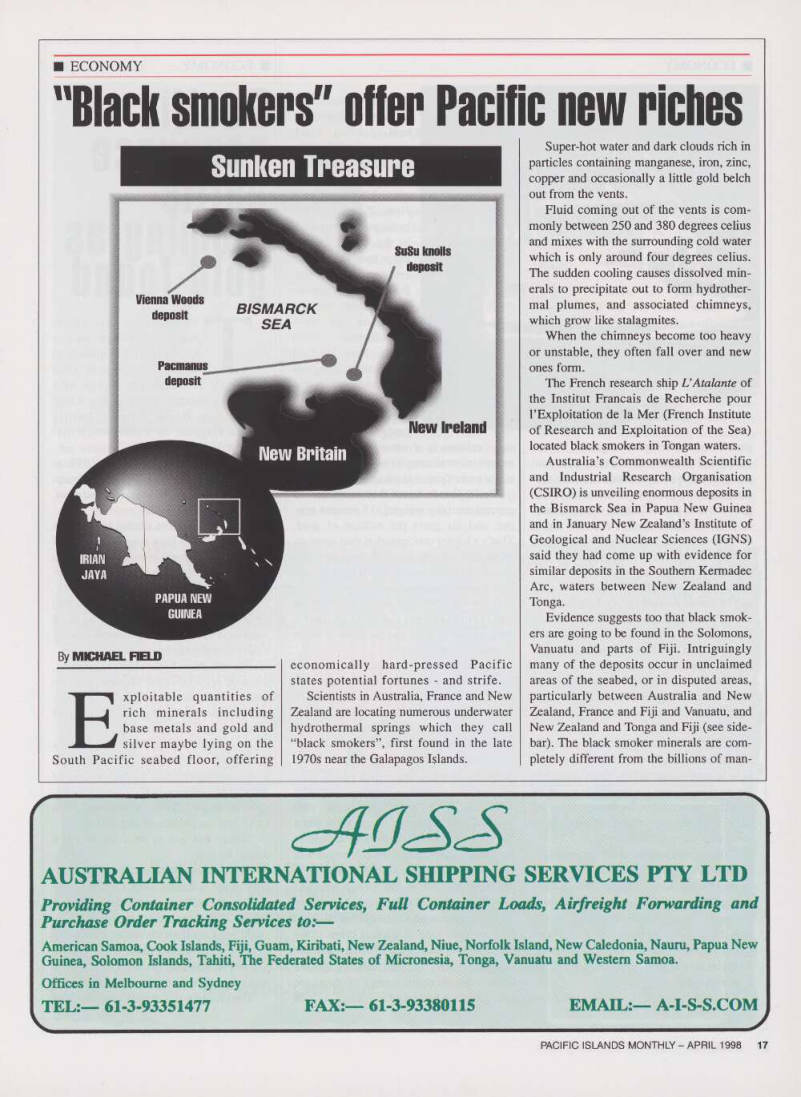
Sunken Treasure
By Michael Held
Exploitable quantities of
rich minerals including base metals and gold and silver maybe lying on the South Pacific seabed floor, offering
economically hard-pressed Pacific states potential fortunes - and strife.
Scientists in Australia, France and New Zealand are locating numerous underwater hydrothermal springs which they call “black smokers”, first found in the late 1970 s near the Galapagos Islands.
Super-hot water and dark clouds rich in particles containing manganese, iron, zinc, copper and occasionally a little gold belch out from the vents.
Fluid coming out of the vents is com monly between 250 and 380 degrees celius and mixes with the surrounding cold water which is only around four degrees celius.
The sudden cooling causes dissolved min erals to precipitate out to form hydrother mal plumes, and associated chimneys, which grow like stalagmites.
When the chimneys become too heavy or unstable, they often fall over and new ones form.
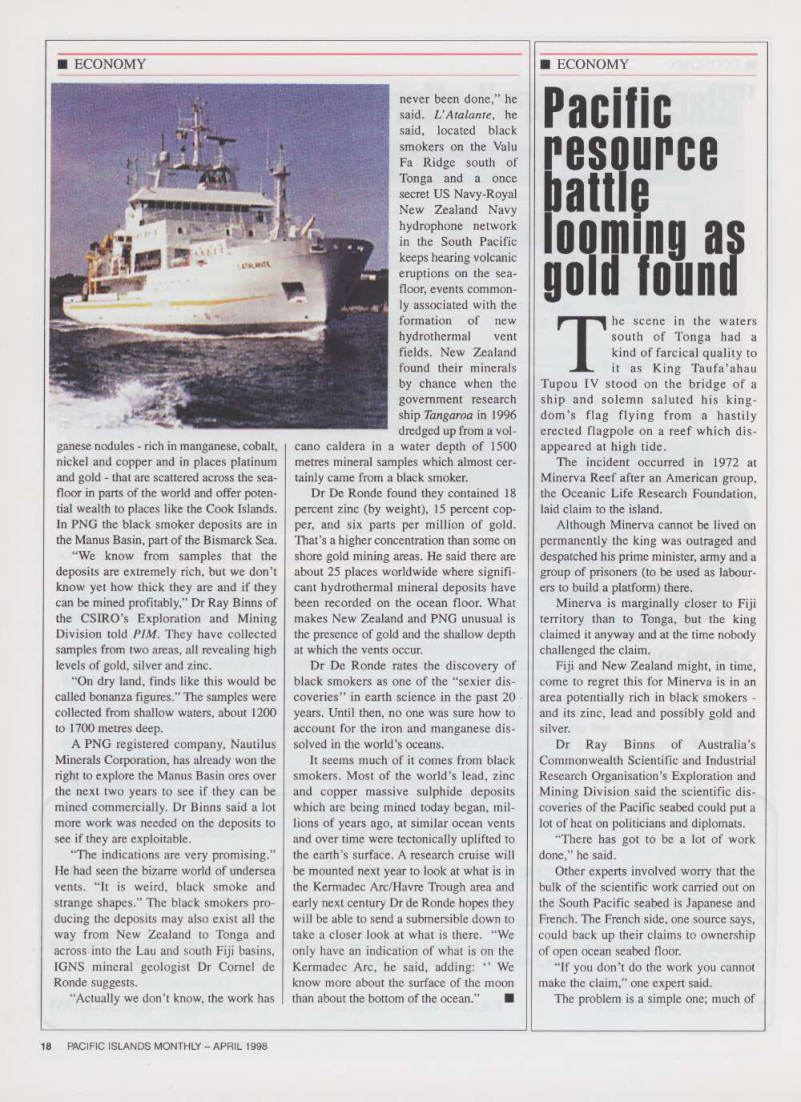
The French research ship L’Atalante of the Institut Francais de Recherche pour I’Exploitation de la Mer (French Institute of Research and Exploitation of the Sea) located black smokers in Tongan waters.
Australia’s Commonwealth Scientific and Industrial Research Organisation (CSIRO) is unveiling enormous deposits in the Bismarck Sea in Papua New Guinea and in January New Zealand’s Institute of Geological and Nuclear Sciences (IGNS) said they had come up with evidence for similar deposits in the Southern Kermadec Arc, waters between New Zealand and Tonga.
Evidence suggests too that black smok ers are going to be found in the Solomons, Vanuatu and parts of Fiji. Intriguingly many of the deposits occur in unclaimed areas of the seabed, or in disputed areas, particularly between Australia and New Zealand, France and Fiji and Vanuatu, and New Zealand and Tonga and Fiji (see side bar). The black smoker minerals are com pletely different from the billions of man-
ganese nodules - rich in manganese, cobalt, nickel and copper and in places platinum and gold - that are scattered across the sea floor in parts of the world and offer poten tial wealth to places like the Cook Islands.
In PNG the black smoker deposits are in the Manus Basin, part of the Bismarck Sea.
“We know from samples that the deposits are extremely rich, but we don’t know yet how thick they are and if they can be mined profitably,” Dr Ray Binns of the CSIRO’s Exploration and Mining Division told PIM. They have collected samples from two areas, all revealing high levels of gold, silver and zinc.
“On dry land, finds like this would be called bonanza figures.” The samples were collected from shallow waters, about 1200 to 1700 metres deep.
A PNG registered company, Nautilus Minerals Corporation, has already won the right to explore the Manus Basin ores over the next two years to see if they can be mined commercially. Dr Binns said a lot more work was needed on the deposits to see if they are exploitable.
“The indications are very promising.”
He had seen the bizarre world of undersea vents. “It is weird, black smoke and strange shapes.” The black smokers pro ducing the deposits may also exist all the way from New Zealand to Tonga and across into the Lau and south Fiji basins, IGNS mineral geologist Dr Cornel de Ronde suggests.
“Actually we don’t know, the work has
never been done,” he said. L’Atalante, he said, located black smokers on the Valu Fa Ridge south of Tonga and a once secret US Navy-Royal New Zealand Navy
hydrophone network
in the South Pacific keeps hearing volcanic eruptions on the sea floor, events common ly associated with the formation of new
hydrothermal vent
fields. New Zealand found their minerals by chance when the government research ship Tangaroa in 1996 dredged up from a vol
cano caldera in a water depth of 1500 metres mineral samples which almost cer tainly came from a black smoker.
Dr De Ronde found they contained 18 percent zinc (by weight), 15 percent cop per, and six parts per million of gold.
That’s a higher concentration than some on shore gold mining areas. He said there are about 25 places worldwide where signifi cant hydrothermal mineral deposits have been recorded on the ocean floor. What makes New Zealand and PNG unusual is the presence of gold and the shallow depth at which the vents occur.
Dr De Ronde rates the discovery of black smokers as one of the “sexier dis coveries” in earth science in the past 20 years. Until then, no one was sure how to account for the iron and manganese dis solved in the world’s oceans.
It seems much of it comes from black smokers. Most of the world’s lead, zinc and copper massive sulphide deposits which are being mined today began, mil lions of years ago, at similar ocean vents and over time were tectonically uplifted to the earth’s surface. A research cruise will be mounted next year to look at what is in the Kermadec Arc/Havre Trough area and early next century Dr de Ronde hopes they will be able to send a submersible down to take a closer look at what is there. “We only have an indication of what is on the Kermadec Arc, he said, adding; *’ We know more about the surface of the moon than about the bottom of the ocean.” ■