Samoa’s changing finances
pp. 14-16 · Read in the full issue

Economy
By Sophie Foster Hildebrand
To help create greater flex ibility in the Samoan mar ketplace, on January 12 this year, the Central Bank deregulated the financial system in Samoa, relinquishing control of interest rates and credit ceilings in commercial banks.
The immediate result was an increase in both the lending and deposit rates given by the banks. However Central Bank Governor Papali’i Tommy Scanlan says that was to be expected since the pre- January 12 rates had been in control since 1992.
“We expected that interest rates would move up but there will come a time when the demand and supply of funds will reach a level that will be in line with the demands in the financial system in which case I think we will should see the interest rates coming down,” he said.
In an interview with PIM, Scanlan said the move was a “big step” for the country but he was hopeful that it would make the financial climate more attractive.
Currently there are three commercial
banks in Samoa - ANZ Samoa (100 per cent owned by ANZ), Pacific Commercial Bank (45 percent Bank of Hawaii, 45 per cent Westpac, 10 percent local sharehold ers), and the National Bank of Samoa (wholly private owned by various local shareholders).
“There is competition between the three banks which is healthy for the economy and that is one of the reasons why we decided to move away from direct controls in the financial system to indirect con trols,” Scanlan. It is still too early to tell what sort of success the deregulation has had, but Scanlan warned that “the success of this major change depends on commer cial banks”.
“I would be very unhappy if it was to come to a situation where the commercial banks lending rates are fairly high and their deposit rates are fairly low such that the spread between deposit and lending rates is high,” he said. The tide of change in the financial system has affected not only the commercial banks. The Central Bank has had to adopt a wait-and-see approach in terms of attracting deposits from the bank ing system. At present even the National Provident Fund in Samoa does not buy into
Central Bank securities because the inter est rates are not as attractive as commercial banks. However, Scanlan is hopeful that this will change soon.
“The commercial banks, where there is a lot of deposits in the system, are bound to see interest rates come down, in which case it will make it unattractive for the National Provident Fund to put funds there so there fore they will bid more competitively for funds with us,” he said.
The CBS is now starting to change its tactics in order to compete in Samoa.
Recently the Asian Development Bank approved a programme loan for $0.5 mil lion to help the Central Bank with the issue of CBS securities.
“Once the Central Bank participates in the market actively, there will be a big cost to the Central Bank. For instance we’re paying at the moment 3.5 percent to com mercial banks for their funds with us, but with the issue of Central Bank securities, to which the commercial banks are eligible to tender, they’re getting about 5.5 to 6 per cent. These are only on 91 day bills.
“If we go on to much longer securities, then we’ll end up paying more to attract deposits from the banking system,” he
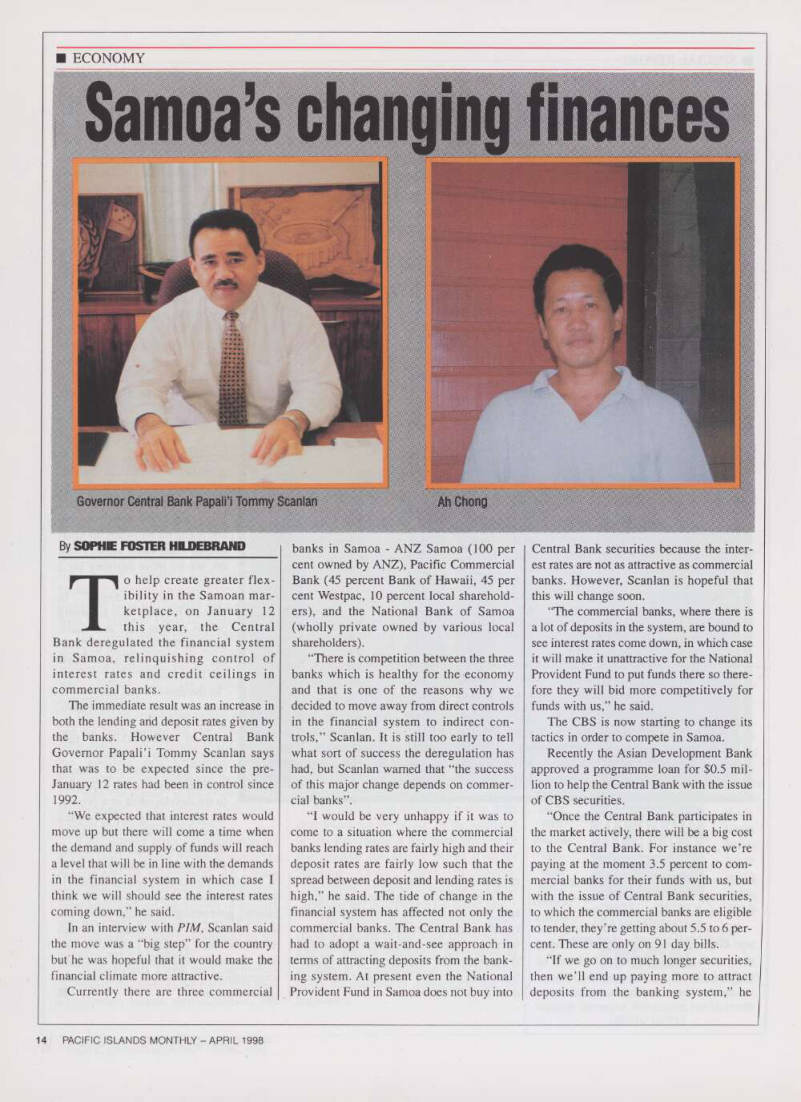
Governor Central Bank Papali’i Tommy Scanlan
Ah Chong
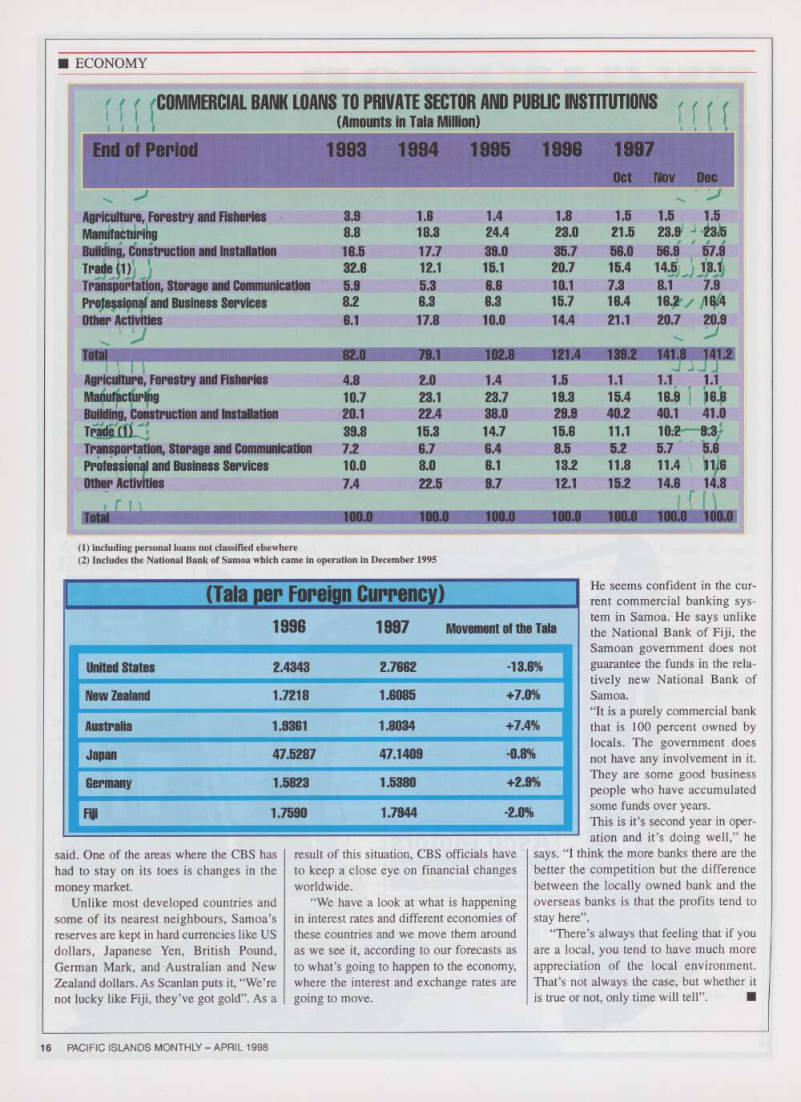
COMMERCIAL BANK LOANS TO PRIVATE SECTOR AND PUBLIC INSTITUTIONS (Amounts in Tala Million)
(1) including personal loans not classified elsewhere (2) Includes the National Bank of Samoa which came in operation in December 1995
said. One of the areas where the CBS has had to stay on its toes is changes in the money market.
Unlike most developed countries and some of its nearest neighbours, Samoa’s reserves are kept in hard currencies like US dollars, Japanese Yen, British Pound, German Mark, and Australian and New Zealand dollars. As Scanlan puts it, “We’re not lucky like Fiji, they’ve got gold”. As a
result of this situation, CBS officials have to keep a close eye on financial changes worldwide.
“We have a look at what is happening in interest rates and different economies of these countries and we move them around as we see it, according to our forecasts as to what’s going to happen to the economy, where the interest and exchange rates are going to move.
He seems confident in the cur rent commercial banking sys tem in Samoa. He says unlike the National Bank of Fiji, the Samoan government does not guarantee the funds in the rela tively new National Bank of Samoa.
“It is a purely commercial bank that is 100 percent owned by locals. The government does not have any involvement in it.
They are some good business people who have accumulated some funds over years.
This is it’s second year in oper ation and it’s doing well,” he
says. “I think the more banks there are the better the competition but the difference between the locally owned bank and the overseas banks is that the profits tend to stay here”.
“There’s always that feeling that if you are a local, you tend to have much more appreciation of the local environment.
That’s not always the case, but whether it is true or not, only time will tell”. ■
End of Period
1993 1994 1995 1996 1997 Oct Nov Dec Agriculture, Forestry and Fisheries 3.9 1.6 1.4 1.8 1.5 1.5 1.5 Manufacturing 8.8 18.3 24.4 23.0 21.5 23.9 J 23.5 Building, Construction and Installation 16.5 17.7 39.0 35.7 56.0 56.9 57.9 Trade fl)) j 32.6 12.1 15.1 20.7 15.4 Transportation, Storage and Communication 5.9 5.3 6.6 10.1 7.3 8.1 7.9 Professional and Business Services 8.2 6.3 6.3 15.7 16.4 16.£v /16/4 Other Activities 6.1 17.8 10.0 14.4 21.1 20.7 20.9 J Total 82.0 79.1 102.8 121.4 139.2 141.8 141.2 Agriculture, Forestry and Fisheries 4.8 2.0 1.4 1.5 1.1 1.1 1.1 Manufacturing 10.7 23.1 23.7 19.3 15.4 16.9 16.6 Building, Construction and Installation 20.1 22.4 38.0 29.9 40.2 40.1 41.0
Tpaj^SU.
39.8 15.3 14.7 15.6 11.1 10:2—9:3/ Transportation, Storage and Communication 7.2 6.7 6.4 8.5 5.2 5.7 5.6 Professional and Business Services 10.0 8.0 6.1 13.2 11.8 11.4 \ 11/6 Other Activities 7.4 22.5 9.7 12.1 15.2 14.6 14.8 ' r , . f ( ( \ r / I \ 1 \ I 1 Total 100.0 100.0 100.0 100.0 1 100.0 100.0 100.0
(Tala per Foreign Currency)
1996 1997 Movement of the Tala United States 2.4343 2.7662 -13.6% New Zealand 1.7218 1.6085 +7.0% Australia 1.9361 1.8034 +7.4% Japan 47.5287 47.1409 -0.8% Germany 1.5823 1.5380 +2.9% Fiji 1.7590 1.7944 -2.0%