The hand that nocks the cradle
pp. 10-13 · Read in the full issue
Special Report
By Sophie Foster Hilderrand
A favourite feminist say ing is ‘the hand that rocks the cradle rules the world’, but in Samoa, known as the Cradle of Polynesia, the hands that rule the country are rocking their world.
Rife with allegations and counter-alle gations of corruption, political bribery, abuse of power, and vast unaccountability, Samoa is at a critical point in its develop mental history. 1998 will make it the eighth year running since the Samoan gov ernment last audited their accounts.
During that time, the trade deficit gap has continued to widen and the spill-over into the lives of the average Samoan is
increasing.
According to the Central Bank of Samoa (CBS) economic indicators, the overall trade deficit for the 12 months to December 1997 stood at 218.79 million tala (SUS7O m). But the biggest problem facing Samoans, is the soaring inflation rate which is currently double the govern ment’s target.
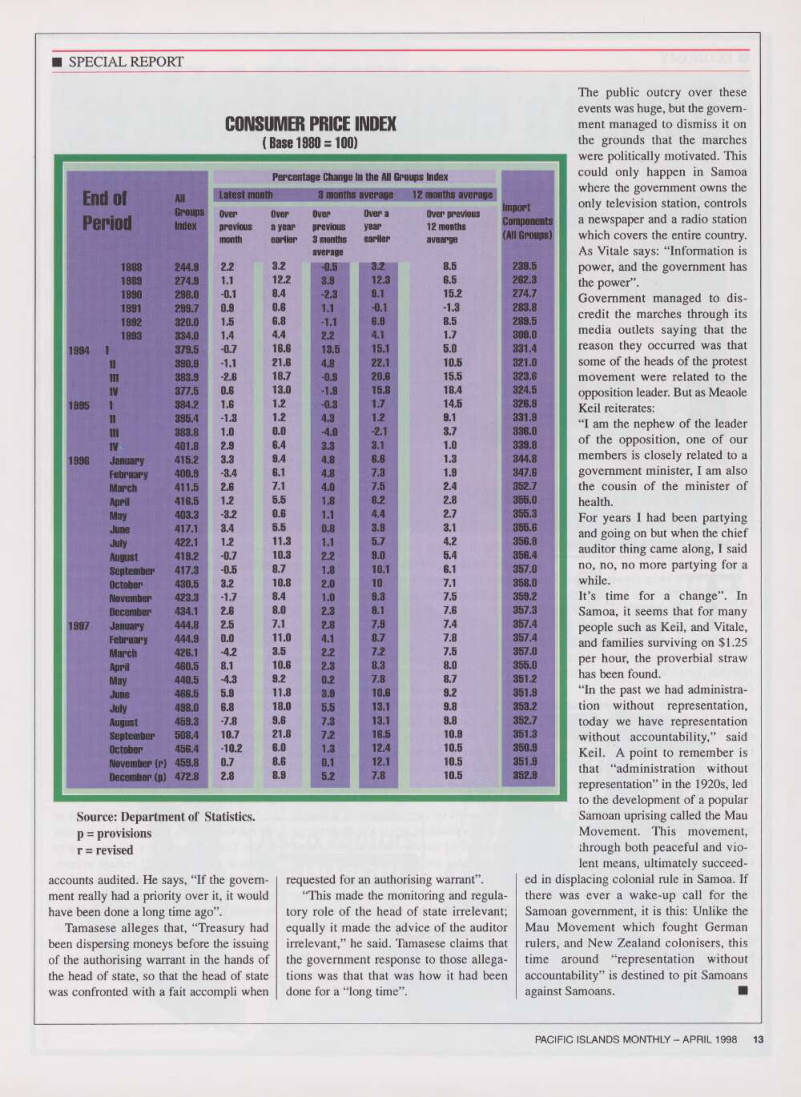
The average inflation rate for 1997 was 10.5 percent, a figure which most govern ment officials agree is high.
“The only worrying factor for us is our inflation rate. Our inflation rate at the end of last year was very high compared to our trading partners, to Fiji for instance,” CBS governor Papali’i Tommy Scanlan told
Pim.
“But there is a problem with the index that we are using. It’s got a very high weighting of the taro , and the taro as you know has been very badly affected by this blight that we had since 1992. So our department of statistics is revising our index now.
“We have an underlying index which calculated by us and the treasury and we are looking'at about six or seven and a half percent inflation. Our target rate is about four to five percent so that’s the main wor rying factor at the moment,” Scanlan said.
In December the Consumer Price Index (CPI) rose 2.8 percent, a figure which was nine percent higher than the same month in 1996. According to CBS, that particular month’s rise in the CPI was “caused main
ly by a 4.9 percent increase in the “Food” group sub-index which recorded higher prices for taro and fresh fish”. Despite this, Samoan finance minister and deputy prime minister Tuilaepa Sailele Malielegaoi says the country is “on course”.
“We are on course in the sense that we have put in place policies. “If we keep adopting these policies then we are on a proper economic target,” he says.
For all intents and purposes, the gov ernment seems to have lost touch with the reality of living in modem-day Samoa.
As local businessman, Corey Keil, pro prietor of Magic FM9B, put it: “It looks good on the surface, but scratch below and people are hurting”.
The cost of delivering an essential ser vice such as electricity to the consumer is astoundingly high, standing at about 100 tala (SUS3I) per month, at the very least says one family, for most households.
High rates of duty placed on imports, regardless of the fact that there are no local substitutes for most goods, make it very difficult to sustain increases in the standard of living. For what are considered luxury
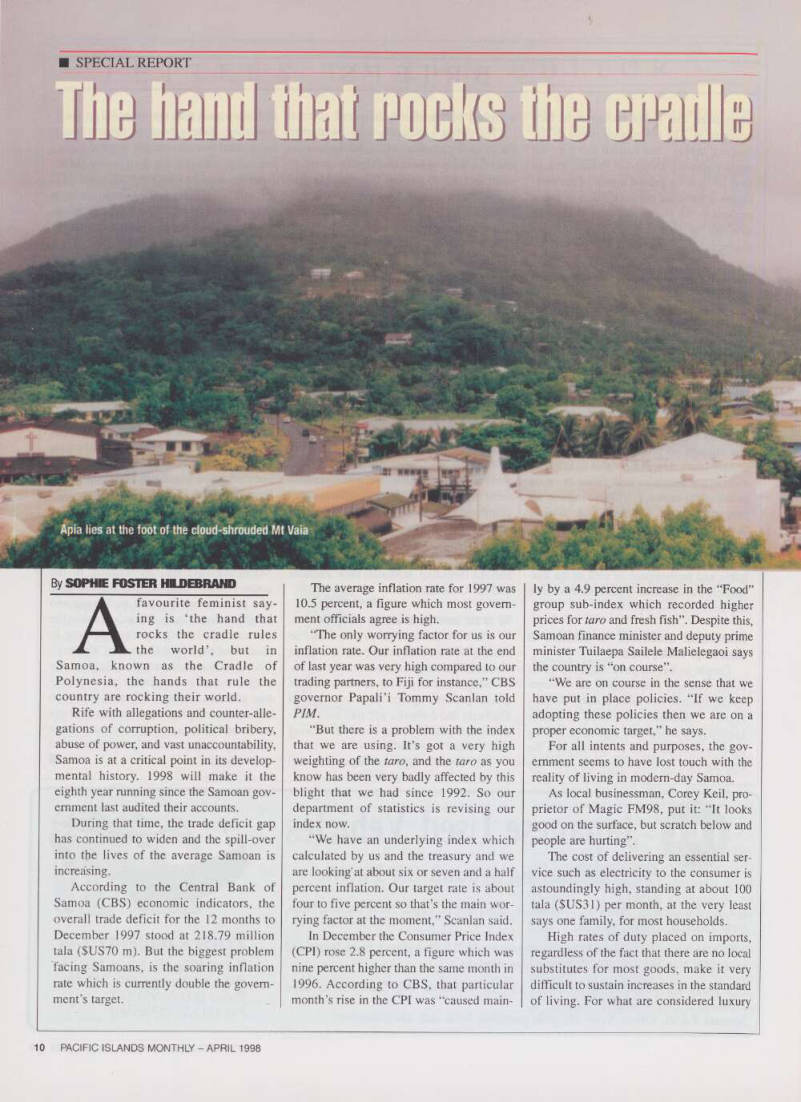
Apia ties at the foot of the cloud-shrouded Mt Vaia
items such as stereo systems, the import duty is 110 percent, for televisions the rate is 20 percent.
What happens is that it works out cheaper for people to buy white-goods and other appliances while returning from overseas trips, and it is not uncommon for some families on the higher income brack et to fly to Fiji to buy such goods.
“Samoa is nice but the currency rate makes it extra hard. Like when you trans fer money across to Fiji to buy a television or something it actually drains a lot more money out of the country where as if they brought in stuff duty-free or low duty like they do in Suva, a lot of people would buy locally rather than fly over to Fiji to get it.
All my stuff is from Fiji, my stereo, my
television, my video...” says Keil. Even the cost of imported food products has gone out of control. About 130tala (SUS4I) will usually buy enough import ed food products to last for two days for the average Samoan family. Is it any won der that a lot of people have turned to cheap imports of fatty meats and other products.
The cost of buying local goods at the Fugalei Market is steadily getting more expansive. In fact, over 1997 the Price Index at the market almost doubled (48 percent) over the 1996 figure.
As a result of a poor manufacturing base locally, the overall Samoan economy is heavily reliant on overseas help to keep afloat. The main sources of foreign
exchange in Samoa are tourism, remit tances from Samoans living overseas, overseas loans, and foreign aid.
Scanlan says “While exports continue to go up, our tourism receipts have contin ued to go up as well, reserves are continu ing to grow, and we’re keeping a close eye on exchange rates developments”.
One area where Samoa’s future is close ly tied to that of certain overseas countries is the effect of the Asian currency crisis.
But Scanlan says “We’re not overly con cerned that the Asian currency crisis will affect us.
Not yet anyway. If it does affect Australia and New Zealand much more adversely than it has now then we’ll look at what the repercussions are on the econo
my but we’ve been fortunate that it has not filtered through yet”.
However, because of the heavy reliance on overseas assistance, the Central Bank has warned government to get out of the current situation. According to a Central Bank memorandum to the minister of finance in January this year, “to be inde pendent, we must reduce our reliance on remittances, overseas borrowing and for
eign aid”.
The memorandum continues “therefore we must promote tourism and encourage exports by providing the appropriate finan cial, political and social environment”. For many people who are beginning to awaken from their slumber in the cradle of Polynesia, the government is failing on all
accounts.
Popular movements against the govern ment are growing in number, and many Samoans who have lived overseas or who are fairly well educated are beginning to wake up to the modern-day realities.
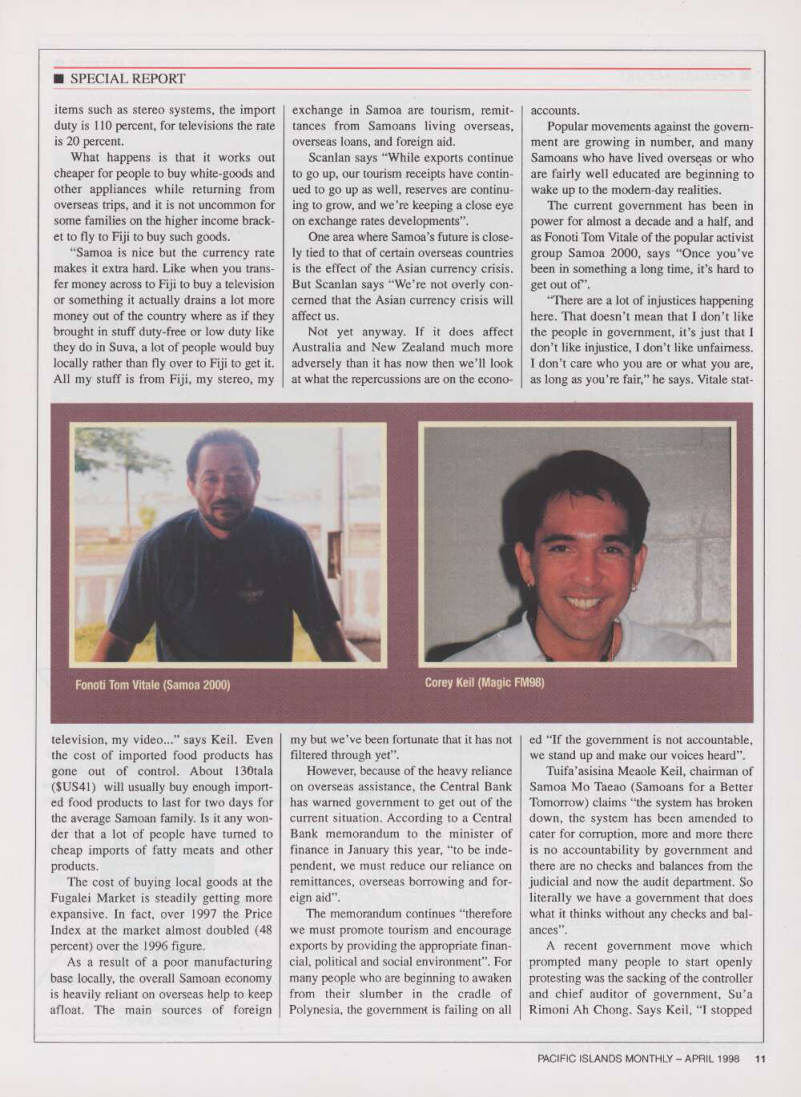
The current government has been in power for almost a decade and a half, and as Fonoti Tom Vitale of the popular activist group Samoa 2000, says “Once you’ve been in something a long time, it’s hard to get out of’.
“There are a lot of injustices happening here. That doesn’t mean that I don’t like the people in government, it’s just that I don’t like injustice, I don’t like unfairness.
I don’t care who you are or what you are, as long as you’re fair,” he says. Vitale stat-
ed “If the government is not accountable, we stand up and make our voices heard”.
Tuifa’asisina Meaole Keil, chairman of Samoa Mo Taeao (Samoans for a Better Tomorrow) claims “the system has broken down, the system has been amended to cater for corruption, more and more there is no accountability by government and there are no checks and balances from the judicial and now the audit department. So literally we have a government that does what it thinks without any checks and bal ances”.
A recent government move which
prompted many people to start openly
protesting was the sacking of the controller and chief auditor of government, Su’a Rimoni Ah Chong. Says Keil, “I stopped
Fonoti Tom Vitale (Samoa 2000)
Corey Keil (Magic FM98)
being a bystander when that happened”.
In August last year the chief auditor was dismissed from his position after he filed a case against a Commission of Inquiry appointed by government. Since that time, he is still waiting for a decision from the Supreme Court in Samoa.
The events which preceded that move shocked many people. In the June 1994 session of parliament, the Auditor’s Report was tabled in the House of
Representatives.
The report stated that public accounts had not been audited for five years at the time. Among other things it alleged that the minister and chairman of the Polynesian Airlines Board and its directors had been “negligent” in their “dealings in the company’s affairs and gave rise to sig nificant and unrepayable debts”.
It also alleged serious corruption in the Public Works, Inland Revenue and other departments of government, Ah Chong says after that report was tabled, govern ment appointed a Commission of Inquiry into the report which cleared senior public officials and ministers mentioned in the report of any wrongdoing.
“Subsequently I took the Commission of Inquiry to court on the basis that their examination lacked natural justice, and
also government for setting up such a Commission, and also certain things that government did in relation to the position of chief auditor,” he says.
This matter is still to be decided in court. However, Ah Chong says “’’When I took the matter to the court because it was a constitutional issue to be dealt with by the court, they suspended me”.
“They issued another suspension to me when the first one expired and then later on, because they still couldn’t dismiss me, they amended the Constitution, and after that I was dismissed,” Ah Chong explains.
In April 1997, using its majority in par liament, the Samoan government amended the country’s Constitution to allow for the dismissal of the chief auditor.
The amendment allowed for only three year terms for the person in the auditor’s office. Previously it had been until he or she reached the age of 60 as it is for Supreme Court judges in Samoa.
Opposition Leader Tuiatua Tupua Tamasese Efi in opposing the move said “The framers of the constitution under stood the perils of the audit office. If the auditor was to discharge his duties as intended in the Constitution, he was bound to tax the patience of government and the
legislators.
Our forebears wanted to make very sure that the grounds for dismissal were misbe haviour or of infirmity or body or mind and not resistance to legitimate audit reporting”.
According to Ah Chong, up to the time that he was dismissed from the position, he Was still given no cooperation to get those
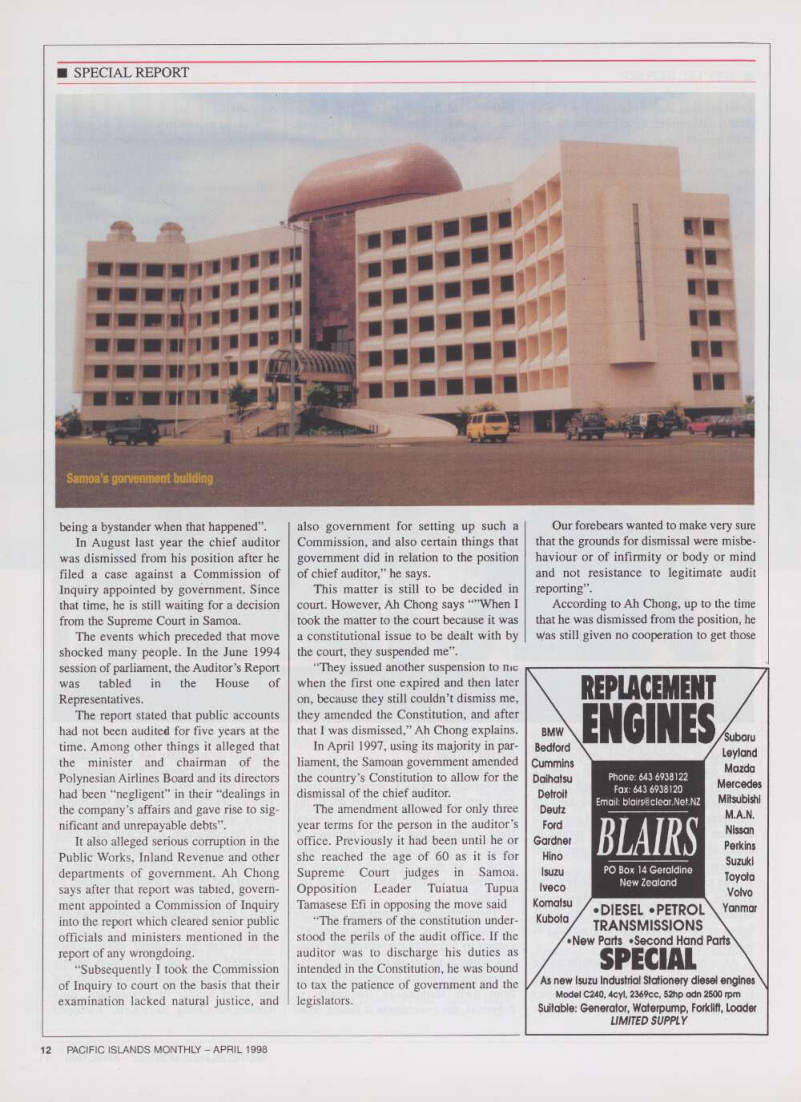
Samoa’s gorvenment building
Consumer Price Index
(Base 1980 = 100)
Source: Department of Statistics, p = provisions r = revised
accounts audited. He says, “If the govern ment really had a priority over it, it would have been done a long time ago”.
Tamasese alleges that, “Treasury had been dispersing moneys before the issuing of the authorising warrant in the hands of the head of state, so that the head of state was confronted with a fait accompli when
requested for an authorising warrant”.
“This made the monitoring and regula tory role of the head of state irrelevant; equally it made the advice of the auditor irrelevant,” he said. Tamasese claims that the government response to those allega tions was that that was how it had been done for a “long time”.
The public outcry over these events was huge, but the govern ment managed to dismiss it on the grounds that the marches were politically motivated. This could only happen in Samoa where the government owns the only television station, controls a newspaper and a radio station which covers the entire country.
As Vitale says: “Information is power, and the government has
the power”.
Government managed to dis credit the marches through its media outlets saying that the reason they occurred was that some of the heads of the protest movement were related to the opposition leader. But as Meaole Keil reiterates: “I am the nephew of the leader of the opposition, one of our members is closely related to a government minister, I am also the cousin of the minister of health.
For years I had been partying and going on but when the chief auditor thing came along, I said no, no, no more partying for a while.
It’s time for a change”. In Samoa, it seems that for many people such as Keil, and Vitale, and families surviving on $1.25 per hour, the proverbial straw has been found.
“In the past we had administra tion without representation, today we have representation without accountability,” said Keil. A point to remember is that “administration without representation” in the 19205, led to the development of a popular Samoan uprising called the Mau Movement. This movement, through both peaceful and vio lent means, ultimately succeed
ed in displacing colonial rule in Samoa. If there was ever a wake-up call for the Samoan government, it is this: Unlike the Mau Movement which fought German rulers, and New Zealand colonisers, this time around “representation without accountability” is destined to pit Samoans against Samoans. ■
Percentage Change In the All Groups index
End of
All Latest month 3 months average 12 months average Groups Over Over Over Over a Over previous Import
Period
Index previous a year previous year 12 months Components month earlier 3 months earlier avearge (All Groups) 2.2 3.2 average 3.2 8.5 239.5 1988 244.9 -0.5 1989 274.9 1.1 12.2 3.9 12.3 6.5 262.3 1990 298.0 -0.1 8.4 -2.3 9.1 15.2 274.7 1991 299.7 0.9 0.6 1.1 -0.1 -1.3 283.8 1992 320.0 1.5 6.8 -1.1 6.9 8.5 289.5 1993 334.0 1.4 4.4 2.2 4.1 1.7 309.0 1994 1 379.5 -0.7 16.6 13.5 15.1 5.0 331.4 II 390.9 -1.1 21.6 4.8 22.1 10.5 321.0 in 383.9 -2.6 18.7 -0.9 20.6 15.5 323.6 IV 377.5 0.6 13.0 -1.9 15.8 18.4 324.5 1995 1 384.2 1.6 1.2 -0.3 1.7 14.5 328.9 II 395.4 -1.3 1.2 4.3 1.2 9.1 331.9 m 383.8 1.0 0.0 -4.0 -2.1 3.7 336.0 IV 401.8 2.9 6.4 3.3 3.1 1.0 339.8 1996 January 415.2 3.3 9.4 4.8 6.6 1.3 344.8 February 400.9 -3.4 6.1 4.8 7.3 1.9 347.6 March 411.5 2.6 7.1 4.0 7.5 2.4 352.7 April 416.5 1.2 5.5 1.8 6.2 2.8 355.0 May 403.3 -3.2 0.6 1.1 4*4 2.7 355.3 June 417.1 3.4 5.5 0.8 3.9 3.1 355.6 July 422.1 1.2 11.3 1.1 5.7 4.2 356.9 August 419.2 -0.7 10.3 2.2 9.0 5.4 356.4 September 417.3 -0.5 8.7 1.8 10.1 6.1 357.0 October 430.5 3.2 10.8 2.0 10 7.1 358.0 November 423.3 -1.7 8.4 1.0 9.3 7.5 359.2 December 434.1 2.6 8.0 2.3 9.1 7.6 357.3 1997 January 444.8 2.5 7.1 2.8 7.9 7.4 357.4 February 444.9 0.0 11.0 4.1 8.7 7.8 357.4 March 426.1 -4.2 3.5 2.2 7.2 7.5 357.0 April 460.5 8.1 10.6 2.3 8.3 8.0 355.0 May 440.5 -4.3 9.2 0.2 7.8 8.7 351.2 June 466.5 5.9 11.8 3.9 10.6 9.2 351.9 July 498.0 6.8 18.0 5.5 13.1 9.8 353.2 August 459.3 -7.8 9.6 7.3 13.1 9.8 352.7 September 508.4 10.7 21.8 7.2 16.5 10.9 351.3 October 456.4 -10.2 6.0 1.3 12.4 10.5 350.9 November (r) 459.8 0.7 8.6 0.1 12.1 10.5 351.9 December (p) 472.8 2.8 8.9 5.2 7.8 10.5 352.9