The Hawaiian
pp. 50-51 · Read in the full issue
Literature
A classic in the truest sense
By Nicolas
Rothwell
The Hawaiian
Archipelago,’ by Isabella Bird, publ by Picador, London. UK pounds 13.00 Review by Nicolas Rothwell.
ON THE 26th of January 1871, at 6.30 in the morning, Isabella Bird, a lady trav eller aged 40, ensconced in her cabin aboard the distinctly ramshackle steamer “Nevada”, was aroused from her sleep.
“The Islands” were in sight the Hawaiian Archipelago, announced by the grand promontory of Diamond Head.
So began a stay of half a year, which Isabella Bird punctuated with a remarkable series of letters to her sister: letters descrip tive and speculative, anthropological, geo
logical and political; letters brimming with
Hawaiian life in all its frantic colour.
So sharp were the writer’s powers, so keen her eye and lush the prose that dripped from her pen, that it was decided her accounts should be published. The result: “The Hawaiian Archipelago”, lavishly sub titled “Six Months Among the Palm Groves, Coral Reefs and Volcanoes of the Sandwich Islands”, was the first example of that now-familiar popular genre, the nar rative of western travel in the Pacific.
Long unavailable, it has just been reprinted in the attractive series of “travel classics” published by Picador. For once, the term is fully justified. Isabella Bird, one of the great characters of Victorian literary life, a superbly fearless enquirer and a
sunny-spirited, open-minded bluestocking,
found, in “The Islands”, her calling.
Hawaii, at the time of her arrival, was an independent kingdom enjoying the eager attention of missionaries. Since Captain Cook’s arrival in 1778, the popula tion had dropped precipitately from 400,000 to 49,000. The cultural flux and fusion under way was palpable. Old tradi tions remained potent: European dreams of the Pacific idyll were still alive. Early in
her story, indeed before beginning her acute researches into Hawaiian beliefs and customs, Isabella Bird could write fulsome ly that “a sea of delicious blue shimmers beneath the.sun, so soft, so blue, so.dream like, an ocean worthy of its name, the enchanted region of perpetual calm, and an endless summer.”
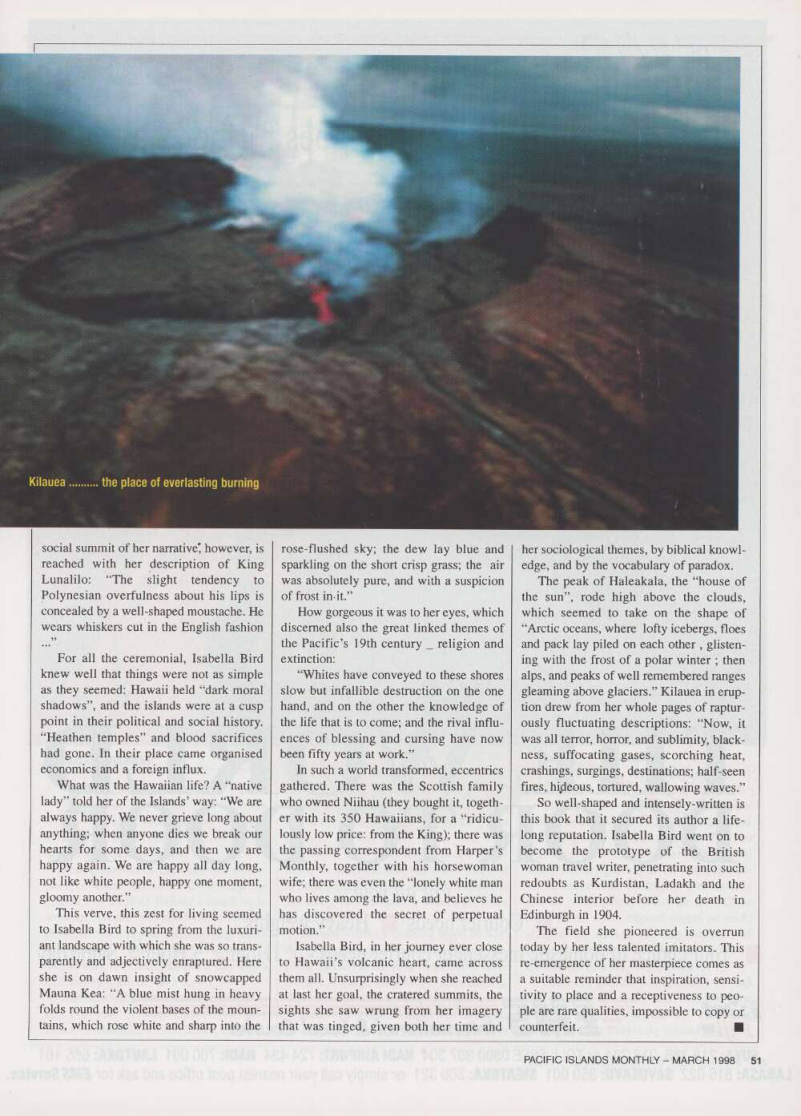
The land, though, was a different mat ter. Isabella Bird travelled relentlessly on mule-back across the Islands, discovering and listing the forms of vegetation, anatomising the landscape, coaxing details from the men and women living in it, build ing up a picture at once informative and evocative. Inexorably, she found herself drawn to the volcanoes. She began a study of them, an intellectual and emotional jour ney to the heart of the fiery mountains, beginning with nothing less than the largest active volcano in the world, Kilauea, the “place of everlasting burnings”.
In parallel with this quest was her voy age to Hawaii’s human heart. She met Chinese plantation workers and indigenous families; she went wide-eyed through sugai processing plants; she encountered the most renowned of all the missionaries, the Reverend Titus Coan (helpfully, he was also a distinguished vulcanologist). The
social summit of her narrative' however, is reached with her description of King Lunalilo: “The slight tendency to Polynesian overfulness about his lips is concealed by a well-shaped moustache. He wears whiskers cut in the English fashion For all the ceremonial, Isabella Bird knew well that things were not as simple as they seemed: Hawaii held “dark moral shadows”, and the islands were at a cusp point in their political and social history.
“Heathen temples” and blood sacrifices had gone. In their place came organised economics and a foreign influx.
What was the Hawaiian life? A “native lady” told her of the Islands’ way: “We are always happy. We never grieve long about anything; when anyone dies we break our hearts for some days, and then we are happy again. We are happy all day long, not like white people, happy one moment, gloomy another.”
This verve, this zest for living seemed to Isabella Bird to spring from the luxuri ant landscape with which she was so trans parently and adjectively enraptured. Here she is on dawn insight of snowcapped Mauna Kea: “A blue mist hung in heavy folds round the violent bases of the moun tains, which rose white and sharp into the
rose-flushed sky; the dew lay blue and sparkling on the short crisp grass; the air was absolutely pure, and with a suspicion of frost in-it.”
How gorgeous it was to her eyes, which discerned also the great linked themes of the Pacific’s 19th century religion and extinction: “Whites have conveyed to these shores slow but infallible destruction on the one hand, and on the other the knowledge of the life that is to come; and the rival influ ences of blessing and cursing have now been fifty years at work.”
In such a world transformed, eccentrics gathered. There was the Scottish family who owned Niihau (they bought it, togeth er with its 350 Hawaiians, for a “ridicu lously low price: from the King); there was the passing correspondent from Harper’s Monthly, together with his horsewoman wife; there was even the “lonely white man who lives among the lava, and believes he has discovered the secret of perpetual motion.”
Isabella Bird, in her journey ever close to Hawaii’s volcanic heart, came across them all. Unsurprisingly when she reached at last her goal, the cratered summits, the sights she saw wrung from her imagery that was tinged, given both her time and
her sociological themes, by biblical knowl edge, and by the vocabulary of paradox.
The peak of Haleakala, the “house of the sun”, rode high above the clouds, which seemed to take on the shape of “Arctic oceans, where lofty icebergs, floes and pack lay piled on each other , glisten ing with the frost of a polar winter ; then alps, and peaks of well remembered ranges gleaming above glaciers.” Kilauea in erup tion drew from her whole pages of raptur ously fluctuating descriptions: “Now, it was all terror, horror, and sublimity, black ness, suffocating gases, scorching heat,
crashings, surgings, destinations; half-seen
fires, hideous, tortured, wallowing waves.”
So well-shaped and intensely-written is this book that it secured its author a life long reputation. Isabella Bird went on to become the prototype of the British woman travel writer, penetrating into such redoubts as Kurdistan, Ladakh and the Chinese interior before her death in Edinburgh in 1904.
The field she pioneered is overrun today by her less talented imitators. This re-emergence of her masterpiece comes as a suitable reminder that inspiration, sensi tivity to place and a receptiveness to peo ple are rare qualities, impossible to copy or counterfeit. ■
Kilauea... the place of everlasting burning