greatest rugby
pp. 48-50 · Read in the full issue
Sports
Michael Jones the world's greatest rugby player
By Atama Raganivatu
A Worldwide Poll
recently named Pele as the greatest soccer play er of all time.
Should a similar ballot be held to deter mine who is regarded as the best to have graced a rugby union ground in that game’s history, Michael Jones would prob ably head it.
Amongst those who, without any prompting, declare their belief Jones is the nearest thing they have seen to the perfect rugby player are Clem Thomas, John Reason and Keith Quinn; the doyens of rugby journalism in Wales, England and New Zealand respectively.
In addition, John Hart, the current New Zealand national team coach, was moved two years ago to state “Michael Jones is the finest footballer I have seen.”
It is his all round strengths which mark Jones as a unique talent. His mobility, tack ling ability, reflexes, explosiveness, courage, determination, strength, pace, ball skills, vision, flair and intelligence are equally exceptional. He has no weakness es.
As with Pele, an off-field modesty has added further lustre to Jones’ image. The two also share similarly humble back grounds.
Bom and raised in the west Auckland suburb of Henderson, Jones lost his father, Derek, through a heart attack, when he was four. As a consequence of that tragedy, Samoan influences have been predominant
. in his life ever since.
His mother, Maina Apa, a native of Moata’a in Upolu, took immense pride in her Asi Falanaipupu title and was fully aware of the responsibilities which tradi tionally go with it right up to her tragic death in a car accident late in 1997.
Both Christianity and rugby feature prominently in Samoan culture and Jones has embraced the two with carefully allo cated devotion.
Jones was seven when he joined the Waitemata Rugby Club. Even at the early age, he harboured ambitions of becoming a member of New Zealand’s revered national side, the All Blacks, and emulat ing his childhood hero Bryan Williams, the fellow Samoan-New Zealander who presently coaches Manu Samo... 1985 saw Jones make his debut for the Auckland province’s senior selection and announce his arrival on the first class scene by scoring three tries versus South Canterbury. No other forward has scored a hat trick in his initial match for The Auks.
Jones’ earliest taste of international fare followed less than a year later.
He wore Western Samoa’s jersey against Wales at Apia. However, that tran spired to be his single outing for the nation he regards as his second home because it became apparent soon afterwards that the realisation of Jones’ boyhood dream of All Black selection was a mere formality.
His introduction to All Black ranks could hardly have been more dramatic.
Enlisted for the opening fixture of the
inaugural World Cup, he scored that now illustrious tournament’s first ever try and notched another in the final when New Zealand defeated France 22-9.
By 1989, Jones had already established himself as one of the most naturally gifted individuals to have laced up a pair of rugby boots. It seemed that everything he touched turned to gold until, one dark afternoon, his world threatened to crum ble.
Midway through a routine test victory
against Argentina, Jones fell awkwardly over a tackled opponent and ruptured knee ligaments. He required a complete recon struction of the joint and, for several
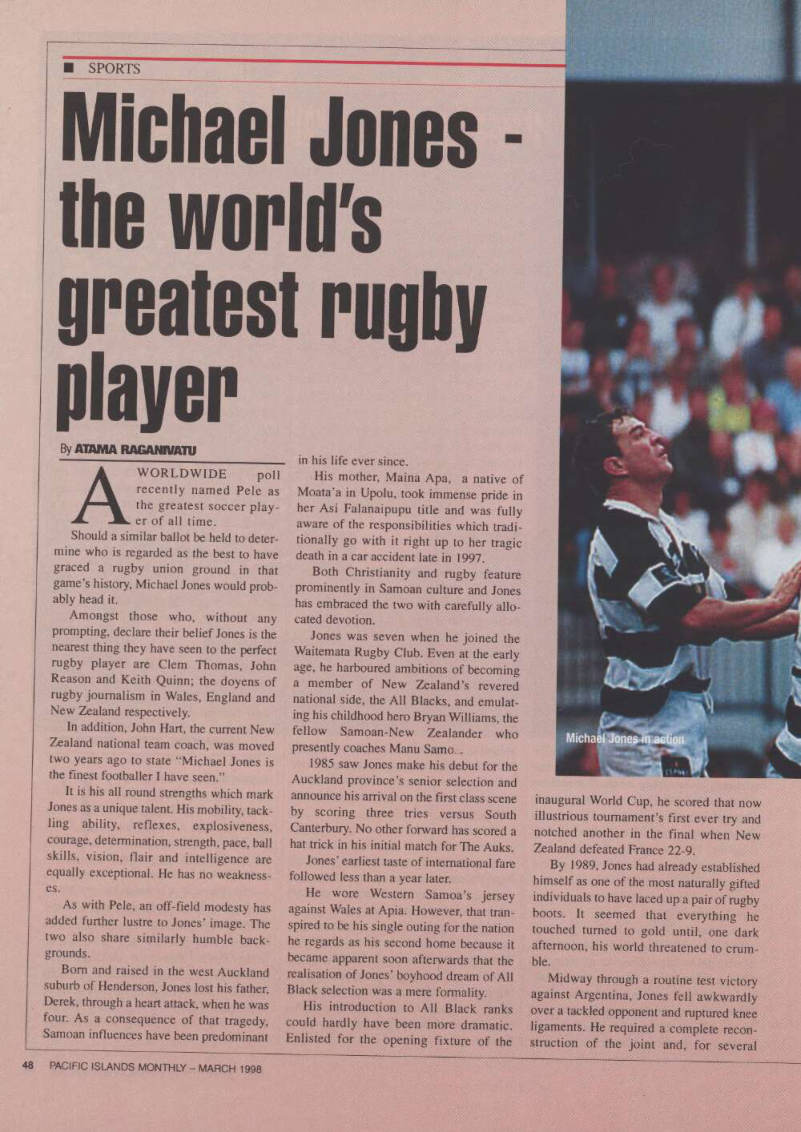
Michael Jones in action
months, it appeared likely he would never step on to a rugby pitch again. In actuality, Jones was sidelined for a whole season.
Looking with handsight today, Jones considers the setback as something of a blessing. He says: “I realised Td been endowed with a great deal of natural talent and really didn’t have to work too hard to achieve a lot prior to 1989.
Then, 1 found I had to work exceeding ly hard to re-attain fitness harder than at any time in my life. That requires self-dis cipline.
“I had to be far more dedicated than in the past and much more honest with
myself. To recapture my All Black jersey was a great personal achievement and I have treasured every appearance since; to a greater extent than those which had come before.
“Every subsequent game has been a bonus. Reviewing all those months I was striving to recover, I these days regard the injury as one of the foremost things that has happened to me.
I believe such trials and tribulations build your character and the whole experi ence built and strengthened my spiritual attributes.” The injury robbed Jones of a little speed around the field, however, but
when 1991 and the second World Cup came round he was once more rated as the world’s outstanding loose forward. Again he scored the competition’s opening try, but those who believed this to be an omen pointing to the Kiwis retaining their crown were to be disappointed.
In a dramatic semi final, Australia elim inated their transTasman rivals 16-6. Jones did not appear in that match because it was staged on a Sunday and the devout Christian steadfastly refuses to play on the Sabbath. ‘I made the decision in my teenage years,” he explains. "When I thought of
playing on Sundays, I had no peace with that. I knew, in my simple faith, that if I didn’t honour the Lord’s Day and set it aside for spending time with my family and going to Church I would be dishonouring God. I gained my gifts from God and I felt that to play on Sunday would be turning my back on Him.”
Jones’ stance cost him his place in the New Zealand squad which travelled to South Africa for the 1995 World Cup. With the quarter-final as well as the semi final falling on a Sunday, Jones, the Kiwi selec tors reasoned, was a luxury that could not be justified.
Although New Zealand failed to regain the world championship, Josh Kronfeld was a revelation in Jones’ position of open side flanker and many observers reluctant ly concurred the veteran had had his day.
He quickly made them reconsider.
Switching across the scrum to the role of blindside flanker, where the speed and anticipation blunted by age are nowhere near as valuable assets as the strength and shrewdness he has gained through experi ence, Jones excelled to the extent that he became acknowledged as the leading num ber six in the game!
Nobody played a greater part than Jones as New Zealand captured the newly insti tuted Tri Nations Series with a 100 per cent record in 1996 and then won at test series on the soil of world champions South Africa for the first time.
The All Blacks continued their tri umphant ways during 1997 but, alas, Jones played barely a minor part in them. In the commencing fixture of the test programme, facing Fiji, he again suffered serious knee
damage.
New Zealand’s most venerated rugby figure is due to make his comeback in the forthcoming Super Twelve Series, for Auckland Blues. Naturally, his progress in that will be followed with immense inter est. 33 on Bth April, Jones acquired the nickname “Iceman” due to the number of times he has been seen applying ice to cuts, bruises and strains.
In spite of his age and the toll inevitably taken by his numerous injuries, Jones may again defy the odds and return to the top.
After the resolve he displayed when overcoming his earlier knee problem, only a fool would discount this. A star of Michael Jones’ unique status deserves a fit
ting finale.
The 1999 World Gup would fit the bill superbly. ■